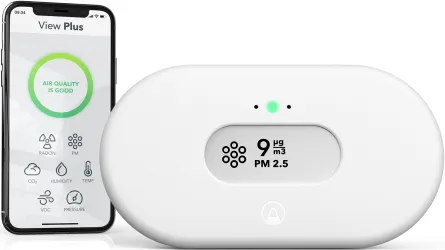
After reading one too many articles about indoor air quality and its effects on health and cognitive function, I decided I wanted serious monitoring -- not just a temperature and humidity gauge, but something that could track the invisible threats like radon, particulate matter, and CO2 buildup. The Airthings View Plus is the most comprehensive consumer air quality monitor available, packing seven sensors into a battery-powered device with an always-on display. After six months of continuous monitoring, it's fundamentally changed how I think about the air in my apartment.
The question isn't whether the Airthings View Plus is good -- it is, unambiguously, the best device in its category. The question is whether you need this much data, because the $300 price tag puts it firmly in the "enthusiast" category. Most people would be well served by a $50 temperature and humidity sensor and occasionally opening a window. But if you have specific concerns about radon exposure, air quality in a home office, or respiratory health conditions that benefit from environmental monitoring, the View Plus provides genuinely actionable data that cheaper alternatives can't match.
Design & Build
The View Plus is a white rectangular device about the size of a small paperback book -- roughly 8 by 5 by 1.5 inches. It's not trying to be a design statement; it's a functional instrument that sits on a shelf or mounts to a wall. The clean, Scandinavian-influenced aesthetic is pleasant enough, and the white plastic blends into most room decors without drawing attention. It's not ugly, but it won't win any industrial design awards either.
The standout design feature is the E-ink display, similar to a Kindle screen. It's always on, consumes almost no power, and is easily readable in any lighting condition including direct sunlight. The display cycles through your monitored parameters with color-coded indicators: green for good, yellow for moderate, and red for concerning levels. You can wave your hand in front of the sensor to manually cycle through readings without reaching for your phone -- a small but surprisingly useful feature when I glance at it while walking through the room.
Build quality is solid plastic construction that feels durable without feeling premium. The battery compartment holds six AA batteries (included) that Airthings rates for approximately two years of life, or you can connect a USB-C cable for continuous power. I've been running mine on batteries for six months with no noticeable depletion according to the app's battery indicator. The ventilation slots along the sides allow air to flow through the sensor chambers, which means placement matters -- don't shove it in a tight bookshelf corner where air circulation is restricted.
Wall mounting is supported via included hardware, but the device is designed to sit on a flat surface. The rear has a slight angle that tilts the display toward the viewer when shelf-mounted, a thoughtful detail that makes readings more legible from across the room.
Features
The sensor suite is the View Plus's reason for existing, and it's genuinely comprehensive. Seven sensors cover: radon (unique at this price point), PM2.5 particulate matter, CO2, temperature, humidity, VOCs (volatile organic compounds), and atmospheric pressure. No other consumer device I'm aware of packs all seven into a single unit, and several of these -- particularly radon and PM2.5 -- are typically found only in dedicated single-purpose monitors costing $150+ each.
Radon monitoring is the headline sensor and the primary differentiator. Radon is a radioactive gas that seeps from soil into buildings and is the second leading cause of lung cancer after smoking. Most people never test for it because traditional testing involves buying a charcoal canister, mailing it to a lab, and waiting weeks for results. The View Plus provides continuous radon readings that update hourly, building a long-term average that becomes more accurate over time. After 48 hours you get a preliminary reading; after 30 days, the data is reliable enough to inform remediation decisions. My apartment measured 1.2 pCi/L -- well below the EPA's 4.0 pCi/L action level -- which was genuinely reassuring information I wouldn't have obtained otherwise.
The PM2.5 sensor has proven surprisingly actionable. It correctly identifies cooking smoke within minutes (my readings spike to 50+ ug/m3 when searing meat on the stove), flags periods when outdoor air quality degrades (wildfire smoke season showed clearly in the data), and confirmed that my HEPA air purifier actually works (PM2.5 drops from 25 to under 5 within 30 minutes of turning it on). CO2 monitoring has changed my ventilation habits -- I discovered that my home office with the door closed reaches 1200+ ppm CO2 by mid-afternoon, well above the 1000 ppm threshold associated with cognitive impairment. Opening a window for 15 minutes brings it back to 600 ppm.
WiFi connectivity feeds data to the Airthings app and cloud dashboard, where historical graphs show trends over days, weeks, and months. The app integrates with Amazon Alexa, Google Home, and IFTTT for automation triggers. A public API enables Home Assistant integration through a community add-on, though it's cloud-dependent rather than local -- a frustrating limitation for privacy-conscious users who want to keep their environmental data on their own network.
Performance
Sensor accuracy is the critical question for a monitoring device, and the View Plus performs well against the reference points I could verify. Temperature readings consistently match my ecobee thermostat within 1 degree Fahrenheit. Humidity tracks within 2-3% of a calibrated hygrometer. CO2 readings align with my expectations based on room occupancy and ventilation state -- empty room with window open reads 400-450 ppm (ambient outdoor levels), occupied closed room climbs predictably to 800-1200 ppm over a few hours.
PM2.5 detection is responsive and has matched qualitative observations consistently over six months. Cooking smoke, vacuuming, burning candles, and outdoor pollution events all register with appropriate magnitude and timing. The sensor correctly shows PM2.5 returning to baseline after running my air purifier, which gives me confidence in its relative accuracy even if I can't verify absolute calibration against a professional-grade monitor.
Radon readings take patience. The initial 48-hour reading is a rough estimate with wide confidence intervals. After a week, the data is directionally useful. After 30 days, Airthings considers the long-term average reliable for decision-making. My reading stabilized at 1.2 pCi/L with seasonal variation between 0.8 and 1.8 -- the expected pattern for ground-floor apartments. Users with elevated readings (above 4.0 pCi/L) should still get a professional radon test to confirm before investing in mitigation systems, but the View Plus provides excellent ongoing screening.
Battery life has been exceptional. After six months on the original set of AA batteries, the app still shows a healthy battery level. Airthings' two-year claim seems realistic at this rate. The E-ink display's minimal power draw is clearly paying dividends here. WiFi connectivity has been stable with data syncing reliably to the cloud, though there's a noticeable 5-10 minute delay between real-world conditions changing and the app reflecting updated readings -- the sensors sample at intervals, not continuously, which is a reasonable trade-off for battery life.
Ease of Use
Initial setup is straightforward: download the Airthings app, create an account, insert the batteries (or connect USB-C power), and follow the app's Bluetooth pairing process to connect the device to your WiFi network. The entire process took about eight minutes, and the device began displaying readings almost immediately for temperature, humidity, and VOCs. PM2.5 and CO2 readings populated within an hour. Radon, as mentioned, takes 48 hours for a preliminary reading.
The app is well-designed with clear data visualization. The dashboard shows all seven parameters at a glance with color-coded status indicators matching the E-ink display. Tapping any parameter reveals historical graphs that you can view at hourly, daily, weekly, or monthly resolution. Trend lines help you identify patterns -- I discovered that my apartment's humidity spikes overnight and my CO2 levels peak every weekday at 3 PM when my office door has been closed all day. These insights led to concrete behavior changes (cracking the office door at lunch, running a dehumidifier overnight).
The wave-to-wake feature on the E-ink display is genuinely convenient for quick checks. Walking past the device, a wave of the hand cycles the display through each parameter with its current reading and status color. No need to pull out your phone for a quick air quality check. For household members who don't use the app, this physical interaction makes the data accessible without any technical knowledge.
The only setup friction is placement optimization. Airthings recommends positioning the device in the breathing zone (table or shelf height) away from windows, doors, and direct airflow from HVAC vents. The radon sensor specifically needs stable air to provide accurate readings, so a busy hallway with constant door openings isn't ideal. I tested two locations before settling on a bookshelf in my living room that represents the main living space without being subject to drafts or direct sunlight.
Value
The Airthings View Plus retails for approximately $299. That's a significant investment for an air quality monitor, and whether it's justified depends entirely on what you need to monitor and why. Let me break down the value proposition honestly for different use cases.
If you need radon monitoring, the View Plus is actually reasonable. Standalone continuous radon monitors (like the Airthings Wave or Ecosense RadonEye) cost $150-200 and only measure radon. The View Plus adds six more sensors for an additional $100, which makes the incremental cost of comprehensive monitoring quite attractive. A professional radon test costs $150-200 per test and gives you a single snapshot in time -- the View Plus gives you continuous monitoring indefinitely for a one-time purchase.
If you don't need radon monitoring, the value equation changes significantly. A basic temperature and humidity sensor costs $15-30. A CO2 monitor alone costs $80-150. A PM2.5 monitor costs $80-200. You could cobble together individual sensors for similar total cost, but you'd have three separate devices, three separate apps, and no unified dashboard. The View Plus's value here is consolidation and convenience more than raw cost savings.
For general curiosity about air quality without specific health concerns, the View Plus is likely overkill. An Amazon Smart Air Quality Monitor at $70 covers temperature, humidity, PM2.5, VOCs, and CO -- enough for most people to make informed ventilation decisions. You lose radon and CO2 monitoring, but for casual awareness, it provides 80% of the actionable value at a quarter of the price.
There are no subscription fees, which is important for a monitoring device. All historical data, trend analysis, and smart home integrations work without ongoing costs. The cloud storage of your data is included indefinitely. Given that the device runs on AA batteries lasting two years, the ongoing cost of ownership is effectively zero after the initial purchase.
Pros
- Most comprehensive sensor suite available
- Radon monitoring (unique feature)
- Always-on E-ink display
- Long battery life
- Good data visualization
- API for Home Assistant
Cons
- Very expensive
- Requires cloud account
- Most people don't need this much data
- Radon readings take time to stabilize
- No local API option
Final Grade
The Airthings View Plus is the most comprehensive consumer air quality monitor available, and it executes its mission well. The seven-sensor suite provides genuinely actionable data -- my radon screening, cooking ventilation habits, and home office air quality management have all been directly informed by this device over six months of use. The E-ink display makes readings accessible without an app, battery life is excellent, and the build quality is solid.
The $300 price tag limits the audience to people with specific monitoring needs rather than casual curiosity. If you need continuous radon screening, have respiratory health concerns that benefit from PM2.5 and VOC tracking, or work from home and want to optimize your office air quality for cognitive performance, the View Plus provides real value that cheaper alternatives can't match. For everyone else, a basic temperature/humidity sensor and an occasional window opening will serve you just as well at a fraction of the cost. Know your use case before buying -- this is a specialist tool, not a mainstream smart home gadget.