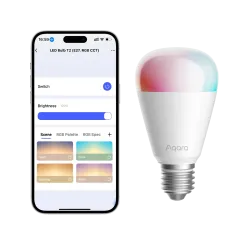
I've had about a dozen Aqara T2 bulbs scattered throughout my apartment for the past six months -- office, living room, bedroom, even the back porch. After living with both the tunable white and RGB versions, I can say these have become my go-to recommendation for anyone building a Thread-based smart home. They're not the cheapest or flashiest, but they do something surprisingly rare: they just work, day after day, without drama.
If you've ever been jolted awake at 3am by a bulb that turned itself on after a firmware update, or spent an hour re-pairing a bulb that spontaneously forgot your network, you'll understand why "boring reliability" is the highest compliment I can give a smart lighting product.
Design & Build
The Aqara T2 looks like a normal light bulb, and I mean that as a compliment. Standard E26 base, familiar A19 shape, fits in virtually any fixture without looking like a science experiment. Some smart bulbs have oversized heat sinks or odd proportions that look conspicuous in open fixtures. The T2 avoids this entirely. The frosted diffuser hides the LED array well, producing even, uniform light without visible hot spots.
Build quality is solid. The bulbs are slightly heavier than standard dumb LEDs -- probably the radio hardware -- but not enough to cause issues in lightweight fixtures. I've got a couple in ceiling fans with noticeable vibration, and after six months there's been zero flickering or looseness.
My one gripe is the lack of any visual indicator showing which protocol mode the bulb is running in. During initial setup, it would help to know at a glance whether a bulb paired in Thread or Zigbee mode. Once configured, it doesn't matter. But when you're pairing a dozen bulbs in one session, a simple LED blink pattern difference would save some app-checking.
Features
The headline feature is dual-protocol support: every T2 bulb contains both Thread and Zigbee radios. I run mine in Thread mode through Home Assistant, taking advantage of Thread's mesh networking and Matter compatibility. But knowing I could switch to Zigbee if needed -- say, for adaptive lighting features through an Aqara hub -- provides genuine flexibility. You're not locked into a protocol decision at purchase time.
The tunable white version covers 2700K to 6500K, spanning warm candlelight to energizing daylight. The RGB model extends to 2000K-9000K plus full color. Color accuracy is excellent with CRI above 90, so skin tones and artwork look natural -- details that matter when you're living with these bulbs daily.
Brightness hits 1100 lumens, a true 75W equivalent. My office has two overhead and it's more than enough for focused work. Dimming is equally impressive -- smooth all the way down to very low levels without stepping, flicker, or buzzing.
Home Assistant integration via Matter/Thread has been seamless. Every bulb paired on the first attempt, all twelve. Commands execute with roughly 100-200ms latency, essentially imperceptible. I've seen scattered reports of pairing difficulties online, but having multiple Thread border routers (an Apple TV 4K and HomePod Mini) may be helping my mesh stability.
Performance
Six months, twelve bulbs, zero reliability issues. No disconnects, no unresponsive bulbs, no mysterious state changes. This is where Thread's mesh architecture shines -- each bulb acts as a router node, so adding more bulbs strengthens the network rather than congesting it. With a dozen spread across my apartment plus other Thread devices, I've built a robust, self-healing mesh.
I should be transparent that my experience seems better than some online accounts. There are forum posts from people with pairing issues or intermittent connectivity. My setup: Home Assistant on a Home Assistant Green, with an Apple TV 4K and HomePod Mini as Thread border routers. Whether multiple border routers help or I got a good batch, I can't say. But for me, rock solid.
Dimming deserves special mention. These bulbs dim continuously with no visible stepping, no flicker at any brightness level. My wife uses the bedroom ones as a wake-up light via Home Assistant automation -- a 30-minute fade from warm to cool. The transition is perfectly smooth. She says it's "actually useful," which from someone who tolerates rather than shares my smart home hobby, is high praise.
Power outage recovery is a thoughtful touch. After brief power interruptions, the bulbs return to their previous state. No blinding full-brightness surprise at 3am.
Ease of Use
Pairing was among the easiest setup experiences in my year of building home automation. Screw in the bulb, five quick on/off cycles for pairing mode, Home Assistant discovers it immediately. Repeated twelve times, worked twelve times. No retries, no factory resets, no forum deep-dives.
Switching between Thread and Zigbee modes is a toggle in the Aqara app. Once you've chosen a protocol, there's little reason to switch. Thread mode gives you the essentials: on/off, brightness, color temperature. For advanced features like adaptive lighting or custom dimming curves, you need an Aqara hub and Zigbee mode. For most people, Thread basics are enough.
The real ease-of-use test is my wife. Zero interest in the technical side, zero tolerance for misbehaving devices. In six months, not a single complaint. Lights turn on when automations say they should, respond to voice commands through the HomePod Mini, and never behave unexpectedly. She particularly likes the sunset routine where bulbs warm from 5000K to 2700K and dim as evening approaches.
One note for people coming from Philips Hue: the Aqara/Thread setup requires a Thread border router and compatible hub platform. It's not complicated, but it's more involved than "plug in bridge, screw in bulb." The tradeoff is more flexibility and significantly lower per-bulb cost.
Value
At roughly $20 per bulb, the T2 isn't the cheapest smart bulb available. Basic WiFi bulbs go for $8-12, and decent Zigbee bulbs from Sengled run $12-15. But for Thread/Matter bulbs specifically -- where the industry is clearly heading -- the T2's pricing is competitive. Nanoleaf Essentials Thread bulbs cost about the same and don't offer Zigbee fallback.
My calculation: $240 for a dozen bulbs. Flawless for six months, zero maintenance, perfect Home Assistant integration. No hub purchase required (I already had border routers), no subscription fees, no cloud dependency. Compare that to a Philips Hue Bridge ($60) plus a dozen Hue White Ambiance bulbs ($300+), and the Aqara route saves real money with equal or better reliability.
There's also the long-term Thread/Matter bet. WiFi bulbs clog your network. Zigbee requires a dedicated hub. Thread is the clear protocol winner going forward -- it's the connectivity layer for Matter, supported by Apple, Google, Amazon, and Samsung. Investing in Thread bulbs now future-proofs your setup.
If you're serious about building a reliable, local-first smart home, the T2 is one of the best values in smart lighting. You're paying a modest premium for dual-protocol flexibility and the kind of reliability that lets you stop thinking about your light bulbs entirely.
Pros
- Excellent Thread reliability – paired first try every time
- Dual Thread/Zigbee protocol for flexibility
- Bright 1100 lumens with smooth dimming
- Rock solid six-month track record, no disconnects
- Power outage memory – bulbs restore previous state
Cons
- Some users report pairing issues (not my experience)
- Thread mode lacks advanced features like adaptive lighting
- Premium pricing compared to basic smart bulbs
- No visual indicator for protocol mode
Final Grade
The Aqara LED Bulb T2 has become the foundation of my apartment's lighting. After six months with a dozen of them, Thread pairing was consistently painless, Home Assistant integration is solid, and dual Thread/Zigbee support provides flexibility no other bulb at this price offers. Reliability has been perfect -- zero disconnects, zero surprises.
They cost more than budget WiFi bulbs, and some people online haven't had as smooth an experience. But for anyone building a Thread-based smart home -- particularly on Home Assistant -- the T2 is the bulb I recommend without hesitation. It provides beautiful, controllable light, then gets out of the way so you can forget it's even smart.