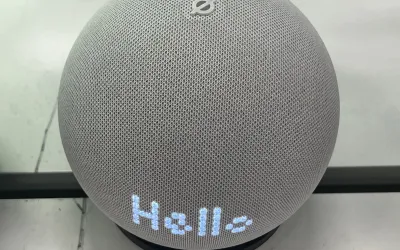
The Echo Dot has become the gateway drug of smart homes -- Amazon practically gives them away during Prime Day, and before you know it, there's one in every room. I've been using the 5th generation Echo Dot with Clock in my bedroom for five months now, and it handles the basics competently. The improved speaker is a genuine step up, the clock display is handy, and the $50 price tag (frequently slashed to $25) makes it the easiest smart speaker recommendation on paper. But living with it daily has also meant living with Alexa's increasingly aggressive subscription pitches, creeping ad integrations, and a voice assistant that feels like it's gotten worse at its core job over the past year. The Echo Dot is capable and cheap, but the trade-offs are worth understanding before you scatter them around your home.
Design & Build
Amazon moved from the hockey-puck shape to a sphere design with the 4th generation, and the 5th Gen refines that look. It's a pleasant, fabric-wrapped orb that sits unobtrusively on a nightstand. The mesh fabric comes in charcoal, glacier white, and deep sea blue -- all inoffensive choices that blend into most decor. The LED light ring moved from the top to the bottom with the sphere redesign, which is a genuine improvement. Instead of a glaring ring shining up at you from the nightstand at 2 AM, the light casts a subtle glow onto the surface beneath it. Much less disruptive for bedroom use.
The Clock variant adds a segmented LED display on the front that shows time, outdoor temperature, timer countdowns, and alarm times. It auto-adjusts brightness based on ambient light, and in practice it serves as a perfectly adequate bedside clock. The display isn't high-resolution -- you can see the individual segments -- but it's legible and the auto-dimming means it doesn't light up the room at night. Physical buttons on top handle volume, microphone mute, and action/invoke. I appreciate that the mute button has a clear red indicator showing when the microphone is disabled -- a small but important trust signal for a device that's always listening. Build quality is plastic but appropriate for the price point. Nothing about it feels fragile or cheap.
Features
Alexa handles the fundamentals: setting timers, playing music, reporting weather, controlling smart home devices, and answering basic questions. For these everyday tasks, the Echo Dot remains competent. I use mine primarily as a bedroom alarm clock with voice-controlled smart home commands -- turning off living room lights from bed, checking whether I locked the front door, setting morning alarms. For this narrowly defined role, it works well.
The built-in temperature sensor is a genuinely useful addition. I have a routine that turns on our bedroom fan when the room exceeds 74 degrees Fahrenheit, and it triggers reliably. The Eero WiFi mesh extension capability is a nice bonus if you already run Eero networking gear, though it's irrelevant for everyone else. Bluetooth streaming works for playing audio from your phone, and the tap-to-transfer feature with compatible Echo devices is convenient when you want to move music between rooms.
Now for the uncomfortable part. Amazon's direction with Alexa has become increasingly user-hostile. The free tier is shrinking while Alexa Plus subscription pushes grow louder. I've noticed Alexa inserting product suggestions into responses, offering to "help" me buy things I didn't ask about, and occasionally playing brief audio ads before fulfilling music requests on ad-supported tiers. The Alexa app itself has devolved into a shopping interface with smart home controls buried beneath deal promotions and Amazon service pitches. The underlying voice AI also seems to have regressed -- I get more "I don't know how to help with that" responses to straightforward questions than I did a year ago, and routines occasionally fail to trigger without explanation. It feels like the platform is being optimized for Amazon's revenue rather than user experience.
Performance
Sound quality is the most tangible improvement in the 5th Gen. The 1.73-inch front-firing speaker delivers noticeably fuller audio than the 4th Gen, with actual bass presence that was previously absent. It won't replace a dedicated speaker for serious music listening -- the low end is present but not deep, and the mids can sound a bit compressed at higher volumes -- but for podcasts, audiobooks, ambient music, and spoken content, it's perfectly adequate. I listen to podcasts every night before sleep and the audio is clear and pleasant at low volumes. For a bedroom or kitchen speaker, it punches well above its $50 price class.
Voice recognition is reliable. The Echo Dot picks up my commands from across the bedroom even with a fan running, and the far-field microphones do a decent job of isolating my voice from background noise. Wake word detection is good -- false activations happen maybe once or twice a week in my experience, usually triggered by something on TV that sounds vaguely like "Alexa." Response latency is acceptable -- there's a brief pause between command and action, but it's not long enough to feel frustrating. Smart home commands execute within one to two seconds for most devices.
Where performance disappoints is in Alexa's intelligence, or lack thereof. Complex questions often get deflected or answered with a web search summary that misses the point. Multi-step routines sometimes partially fail with no clear error reporting. And the inconsistency is maddening -- the same command might work perfectly five times and then fail on the sixth. Compared to Google's assistant for general knowledge queries, or Siri for HomeKit device control, Alexa feels like it's treading water rather than improving. The HomePod Mini costs more but offers notably better audio quality and more reliable Siri integration for Apple households.
Ease of Use
Initial setup is dead simple. Plug in the Echo Dot, download the Alexa app, sign into your Amazon account, connect to WiFi, and you're done in under five minutes. Amazon has streamlined this process over many generations and it shows. If you already have other Echo devices, the new Dot appears in your app automatically and you can assign it to a room group immediately. For non-technical users, this is about as painless as smart home setup gets.
The day-to-day experience is intuitive for basic interactions. My wife uses it exclusively by voice -- timers while cooking, alarms for morning, quick weather checks -- and has never needed to open the app for any of that. The Clock display means she can check the time and temperature by glancing at the nightstand. That's the ideal Echo Dot experience: simple voice interactions that just work.
The Alexa app, however, has become a frustration. What should be a straightforward smart home controller has been stuffed with Amazon shopping integrations, Alexa skill recommendations, promotional banners, and upsell prompts for Alexa Plus. Finding device settings requires navigating through multiple menu layers. Routine creation is powerful but the interface for building complex automations is clunky compared to Apple's Home app or Home Assistant. Amazon seems to have decided the Alexa app is primarily a shopping portal that also controls your smart home, rather than the other way around.
Value
At its regular price of around $50, the Echo Dot with Clock is a fair deal. At the $25-30 sale price that Amazon offers during Prime Day, Black Friday, and seemingly random promotional events throughout the year, it's practically an impulse purchase. For the hardware you're getting -- decent speaker, LED clock, temperature sensor, far-field microphones -- the price is genuinely hard to beat. No competitor offers this feature set at this price point.
But the low hardware cost comes with strings attached, and it's important to be honest about the trade-off. Amazon subsidizes Echo hardware because each device is a data collection endpoint and a gateway to Amazon's shopping ecosystem. Alexa voice recordings are stored and used for improving Amazon's services. Human reviewers have access to recordings (you can opt out, but the setting is buried in privacy menus). Your usage patterns inform Amazon's advertising targeting. The device is a conduit for promotional content that's becoming more aggressive with each software update.
If you're comfortable with that exchange -- affordable hardware in return for data and attention -- the Echo Dot is excellent value. If privacy is a priority, the Apple HomePod Mini at $99 offers a privacy-first approach with better audio quality, though at double the regular price and four times the sale price. For the truly privacy-conscious, local voice assistants running on Home Assistant exist but require significant technical investment. The Echo Dot is cheap for a reason, and understanding that reason matters.
Pros
- Affordable (especially on sale)
- Improved sound quality over previous Dots
- Built-in temperature sensor
- Broad smart home compatibility
- Easy setup
Cons
- Amazon's increasing push for subscriptions
- Privacy concerns with always-listening device
- Alexa app cluttered with shopping/ads
- Voice assistant quality declining over time
- Locked into Amazon ecosystem
Final Grade
The Echo Dot 5th Gen with Clock is a competent budget smart speaker that handles everyday tasks well. The improved speaker sounds notably better than previous generations, the clock display is genuinely useful as a bedside alarm, and the built-in temperature sensor adds practical smart home automation options. At sale prices especially, the hardware value is outstanding. But five months of daily use has made me increasingly uncomfortable with Amazon's direction. Alexa is getting worse at being helpful while getting better at selling things. The app is a shopping portal first and a smart home controller second. The free tier is shrinking. If you want a cheap, capable smart speaker and don't mind being the product, the Echo Dot delivers. If Amazon's trajectory concerns you, spending more on a HomePod Mini or investing in local alternatives may be money better spent in the long run. Know what you're buying into -- not just the speaker, but the ecosystem.