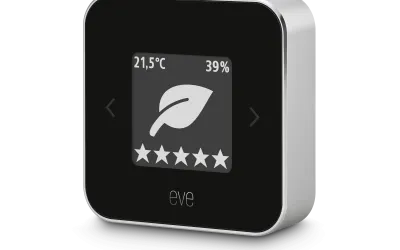
The Eve Room caught my eye as one of the few HomeKit-native air quality sensors that doesn't look like a piece of lab equipment. After living with it on my desk for over four months, I've developed a genuine appreciation for what it does well and a clear understanding of who it's actually for. The E-ink display, Thread connectivity, and elegant design make it a pleasure to use daily. But at roughly $100 for an environmental sensor that only works with Apple's ecosystem, the Eve Room occupies an awkward space between luxury accessory and practical smart home tool. Most people don't need it. But for the HomeKit faithful who care about indoor air quality, nothing else combines form and function quite like this.
Design & Build
The Eve Room is one of the most attractive smart home sensors I've ever used. The anodized aluminum body has a weight and feel that immediately communicates quality -- this isn't a cheap plastic gadget you hide behind a picture frame. It looks like something Apple might design if they made environmental sensors. The E-ink display is the real star here, showing temperature, humidity, and air quality readings at all times without consuming any meaningful power. Unlike an LCD or OLED that would drain the battery, the E-ink screen holds its image passively, which means you always have readings visible without any glow or backlight disrupting a dark room.
At roughly 54mm square and just over 15mm thick, the Eve Room sits comfortably on a desk, bookshelf, or nightstand without drawing undue attention. I've had mine next to my monitor for months and it reads more like a tasteful desk accessory than a sensor. The display is legible from about four feet away in good light, though the E-ink contrast can be harder to read in dim conditions -- there's no backlight option. The USB-C power connection is a welcome modern touch, and the cable is thin enough to route discreetly. Build quality throughout is excellent. After four months of daily use, there's not a scratch or blemish on the aluminum casing.
Features
The Eve Room monitors three environmental metrics: temperature, humidity, and volatile organic compounds (VOC). The VOC sensor is the headline feature here -- it detects airborne chemicals from sources like cleaning products, cooking fumes, paint, new furniture off-gassing, and general household pollutants. The five-level quality indicator on the display gives you an instant read on air freshness, while the Eve app provides more granular data and explanations of what might be affecting your air. Temperature and humidity readings round out the sensor suite and are useful for maintaining comfortable conditions, especially if you run humidifiers or dehumidifiers based on the data.
Thread connectivity is a significant advantage. The Eve Room joins your Thread mesh network automatically when a Thread border router is present (like a HomePod Mini or Apple TV 4K), which means fast, reliable communication without a proprietary hub. Bluetooth serves as a fallback for initial setup. The Eve app stores historical data locally and displays it in clean graphs that show trends over days, weeks, and months. I found the historical view genuinely useful for understanding patterns -- like how VOC levels spike every evening when we cook dinner and how long it takes for ventilation to bring them back down.
The glaring limitation is ecosystem lock-in. The Eve Room is HomeKit-only with no Google Home, Alexa, or native Home Assistant support. If you're not deeply invested in Apple's ecosystem, this product simply doesn't exist for you. There's no Matter support yet either, though Eve has been rolling out Matter firmware updates across their lineup. It's also worth noting what the VOC sensor does not measure: there's no PM2.5 particulate detection and no CO2 monitoring. If wildfire smoke or carbon dioxide levels are your primary concern, you'll need a different sensor entirely.
Performance
I tested the Eve Room's accuracy by placing it alongside a calibrated Inkbird temperature and humidity monitor for two weeks. Temperature readings consistently tracked within 1 degree Fahrenheit, and humidity was within 2% -- both well within acceptable tolerances for a consumer sensor. The readings are reliable enough that I've set up HomeKit automations based on them without worrying about false triggers.
The VOC sensor proved its worth repeatedly during my testing period. It correctly flagged air quality degradation when I was cooking with the gas stove, when someone used nail polish remover in the next room, and even when I opened a new piece of furniture that was clearly off-gassing. The five-level indicator dropped to its lowest rating during a deep cleaning session with chemical cleaners, which prompted me to open windows -- exactly the kind of actionable insight you want from an air quality sensor. The sensor takes a few minutes to register changes, which is normal for VOC detection, but it's responsive enough to be useful.
Thread connectivity has been rock-solid over my four-month testing period. The Eve Room hasn't dropped offline once, and commands from HomeKit automations execute within a second or two. The E-ink display updates approximately every ten minutes, which is perfectly adequate for environmental data that changes gradually. You won't see real-time fluctuations, but you will see meaningful trends. Battery consumption through the USB-C connection is minimal -- this is a low-power device that won't add anything noticeable to your electric bill.
Ease of Use
Setup couldn't be simpler if you're already in the HomeKit ecosystem. Plug in the USB-C cable, open the Home app on your iPhone, scan the HomeKit code on the back of the device, and you're done. The entire process took me under two minutes. The Eve app is optional but recommended -- it provides the historical data graphs and more detailed air quality explanations that Apple's Home app doesn't offer. The Eve app itself is clean, well-designed, and notably free of ads or subscription pushes, which is refreshing in the smart home space.
Day-to-day use is where the Eve Room really shines. The always-on E-ink display means you never need to pull out your phone to check conditions. I glance at it multiple times a day -- a quick look tells me the temperature, humidity, and whether air quality is good. My wife uses it primarily to monitor humidity levels since we run a humidifier during winter, and she's never once needed to open an app to get that information. That frictionless access to data is arguably the Eve Room's best feature. HomeKit automations based on the sensor data are easy to configure -- I have one that sends a notification when VOC levels drop below a certain threshold, which is my cue that the kitchen has aired out after cooking.
Value
At roughly $100, the Eve Room is expensive by any measure for an environmental sensor. You can pick up an Aqara temperature and humidity sensor for around $20 that covers two of the three metrics. Dedicated VOC sensors from brands like Airthings or Amazon's Smart Air Quality Monitor can be found in the $30-50 range. So you're paying a significant premium -- easily double -- for the Eve Room's combination of design, E-ink display, Thread connectivity, and brand polish.
Whether that premium is justified depends entirely on how much you value aesthetics and seamless HomeKit integration. If you want a sensor that looks beautiful on your desk, provides at-a-glance readings without an app, and integrates natively with Thread and HomeKit, the Eve Room is essentially the only option. No one else makes anything quite like it. But if you just need environmental data feeding into your smart home system, there are far more cost-effective paths. The HomeKit-only limitation further narrows the audience -- if you ever switch ecosystems, this becomes an expensive paperweight.
For the specific user who values design, lives in the Apple ecosystem, and wants VOC monitoring alongside temperature and humidity, the Eve Room is a well-executed product at an unfortunate price. For everyone else, your money goes further elsewhere.
Pros
- Beautiful design with always-on E-ink display
- Thread connectivity (no hub required)
- Accurate temperature/humidity readings
- Useful VOC air quality monitoring
- Historical data in Eve app
Cons
- Expensive at $100 for an environmental sensor
- HomeKit-only (no other ecosystem support)
- VOC sensor doesn't measure PM2.5/CO2
- Similar functionality available for much less
Final Grade
The Eve Room is a beautifully designed environmental sensor that does exactly what it promises within a very specific niche. The E-ink display provides genuinely useful at-a-glance readings, Thread connectivity is reliable, and the VOC monitoring has changed how I think about indoor air quality -- I now open windows proactively based on data rather than waiting until a room smells stale. But at $100 for a HomeKit-only sensor that doesn't measure PM2.5 or CO2, the audience is narrow. You need to be an Apple household, care about air quality beyond just temperature, and value design enough to pay a significant premium over cheaper alternatives. I check mine every day and don't regret the purchase, but I also recognize that most people would be perfectly served by a $20 sensor and a weather app. The Eve Room is lovely, capable, and ultimately a luxury.