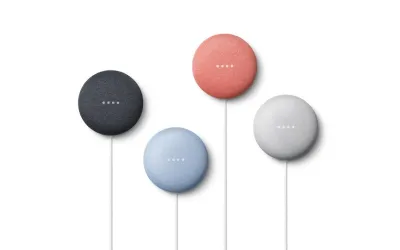
I picked up a Google Nest Mini to compare against the HomePod Mini I already had in the living room. Three months later, the Nest Mini mostly gathers dust on the bedroom nightstand. The hardware itself is perfectly adequate -- a compact, decent-sounding little speaker that does what you ask. The problem isn't the device. The problem is Google.
Google's smart home ecosystem has been in a slow decline for years now, marked by app redesigns that remove features, product lines killed without warning, and a general sense that the company's attention has permanently shifted to AI and search. Buying a Nest Mini in 2025 means betting that Google will stick with smart home long enough to justify your investment, and based on everything I've seen, that's a bet I'm not comfortable making.
Design & Build
Credit where it's due: the Nest Mini is a pleasant little object. The fabric-covered puck measures just 98mm across and 42mm tall -- small enough to sit on a nightstand without dominating the space. The recycled plastic construction feels solid enough, and the knit fabric finish gives it a warmer, more approachable look than the cold plastic of many competing speakers. I went with the Chalk (white) colorway, which blends into our light-colored bedroom decor. It also comes in Charcoal, Coral, and Sky, so there's a reasonable range of options.
The wall-mount slot on the back is a thoughtful design touch. A built-in screw slot lets you hang the Nest Mini on a wall like a small picture frame, freeing up surface space entirely. I haven't used this feature in practice, but I can see it being useful in a kitchen or bathroom where counter space is precious.
Touch controls on top handle volume (tap left or right side) and play/pause (tap center). The capacitive sensors work reliably, and subtle LED dots illuminate as your finger approaches to show where to tap. It's intuitive after a day or two of use. The physical microphone switch on the side provides a hardware-level mute, which I appreciate from a privacy standpoint -- when the switch is orange, the mic is electrically disconnected, not just software-disabled.
Features
Google Assistant handles the basics competently. Music playback through Spotify, YouTube Music, or other supported services works fine. Weather, timers, calendar events, unit conversions, quick factual questions -- all handled without issue. The voice recognition is good enough to hear me from across the bedroom, even when speaking at a normal conversational volume.
The Nest Mini includes a Thread border router, which is its most forward-looking feature. Thread is the low-power mesh protocol underlying Matter, and having border routers scattered through your home strengthens the network for Thread-enabled devices like Nanoleaf bulbs and Eve accessories. If you're building a Thread mesh, the Nest Mini's border router capability adds genuine value regardless of how you feel about Google's ecosystem.
Here's where my concerns begin. The Google Home app went through a widely criticized redesign in 2023 that removed features, broke automations, and introduced bugs that persisted for months. Two years later, the app has improved somewhat but still feels rough compared to Apple Home or even the Amazon Alexa app. Routines -- Google's equivalent of automations -- are more complex to set up than they should be, and occasionally fail to trigger without any indication of why.
More fundamentally, Google has a track record of killing smart home products and APIs without adequate notice. They shut down the Works with Nest API, discontinued the Nest Secure alarm system, killed the Nest x Yale lock support for certain features, and generally behave like a company that views smart home as a side project rather than a commitment. Compare this to Apple, who's been methodically building out HomeKit, Matter, and the Home app, or even Amazon, who continues to invest heavily in Alexa and Ring. Google feels like the least committed of the three major players.
Performance
Sound quality from the Nest Mini is mediocre, which is about what you'd expect from a $50 speaker this size. Google improved the bass response over the original Home Mini, and for voice responses, podcasts, and casual news listening, it's perfectly serviceable. The Ambient IQ feature adjusts volume based on background noise, which is a nice touch for a bedroom speaker -- it quiets down at night and speaks up when there's daytime noise.
For actual music listening, though, the Nest Mini falls short. It sounds thin and hollow compared to the HomePod Mini, which produces noticeably fuller, richer audio from a similar form factor. If music quality matters to you, the Nest Mini isn't the right choice at any price. It's fundamentally a voice assistant speaker that also plays music, not a music speaker with a voice assistant.
Voice recognition is decent in practice. It hears me reliably from about 15 feet away in our bedroom, even when I'm speaking at normal volume. Occasionally it triggers on phrases that sound vaguely like "Hey Google" during TV shows or conversation, which is annoying but not constant. Response time for queries and smart home commands is acceptable -- not as snappy as newer Alexa devices, but not frustratingly slow either.
The real performance problem isn't the hardware -- it's the ecosystem. Routines occasionally fail to trigger. Connected devices sometimes show as "unresponsive" in the Google Home app even when they're working fine from other platforms. Smart home commands sometimes take 3-4 seconds instead of the expected 1-2 seconds. None of these issues are catastrophic individually, but the cumulative effect is a platform that feels unreliable in small, persistent ways. Death by a thousand paper cuts.
Ease of Use
Initial setup is simple enough. Plug in the Nest Mini, download the Google Home app, connect to your WiFi network, and assign the speaker to a room. The app guides you through voice training and connecting your music services. Start to finish, you're up and running in about five minutes. No complaints there.
Day-to-day operation for basic tasks is fine. My wife uses it as a kitchen timer and alarm clock without any issues. "Hey Google, set a timer for 12 minutes" works every time. Playing music by voice works. Asking about the weather works. For these simple interactions, the Nest Mini is perfectly usable.
The Google Home app, however, is where the experience degrades. After the much-maligned redesign, settings are still buried in unintuitive places. Want to change the default music service? That's in the speaker's settings, not the app's global settings. Want to edit a routine? The routine editor is functional but more complex than Apple's or Amazon's equivalents. Finding device controls requires tapping through multiple screens that could be consolidated. Google has improved the app since the worst of the redesign fallout, but it still feels like a work-in-progress compared to the competition.
Setting up automations (routines) is where things get particularly frustrating. The trigger options are limited compared to Home Assistant or even HomeKit, the condition logic is basic, and debugging a routine that fails silently requires guesswork. If you're used to the flexibility of a platform like Home Assistant, Google Home routines will feel constraining.
Value
The Nest Mini retails for around $50, though it's frequently on sale for $25-30 during promotions, which makes it one of the cheapest smart speakers available. At the sale price, it's hard to argue with the hardware -- you get a decent voice assistant speaker with a Thread border router built in. As a standalone kitchen timer and weather checker, it's fine.
But value isn't just about the sticker price. It's about what you're investing in long-term. Buying a Nest Mini means buying into Google's smart home ecosystem, and that ecosystem carries real platform risk. Google has discontinued the Nest Secure, the Works with Nest API, the Google Home developer program for third-party hardware, and various other products and services. Every device you add deepens your dependence on a company that has demonstrated, repeatedly, that it will walk away from products when priorities shift.
The HomePod Mini costs $99 and sounds significantly better, integrates more reliably with HomeKit and Matter, and is backed by a company that appears genuinely committed to the smart home space. The Amazon Echo Dot is similarly priced to the Nest Mini and connects to the largest smart home ecosystem by device count. Both feel like safer long-term investments. If you're already deep in Google's ecosystem and just want a cheap speaker for a secondary room, the Nest Mini fills that role adequately. If you're starting fresh and choosing a platform, I'd spend the extra money on something backed by a more committed company.
Pros
- Affordable price (especially on sale)
- Built-in Thread border router
- Decent voice recognition
- Wall-mountable design
Cons
- Mediocre sound quality
- Google Home app is a mess
- Google appears to be deprioritizing smart home
- Platform risk - products get killed without warning
- Ecosystem feels neglected compared to Apple/Amazon
Final Grade
The Google Nest Mini is adequate hardware undermined by Google's apparent disinterest in the smart home market. The speaker works, the voice assistant works, and the Thread border router is genuinely useful. At $30 on sale, the hardware is a reasonable deal. But every purchase in a smart home ecosystem is a long-term bet on the company behind it, and Google has given me no confidence that they're committed to this space.
If you're already deeply invested in Google Home and just need another speaker for a secondary room, the Nest Mini is fine. If you're building a new smart home from scratch and choosing a platform to grow with, look at Apple or Amazon first. Google's smart home division feels like it's running on autopilot while the company chases AI breakthroughs elsewhere, and that's not a foundation I'd want to build on.