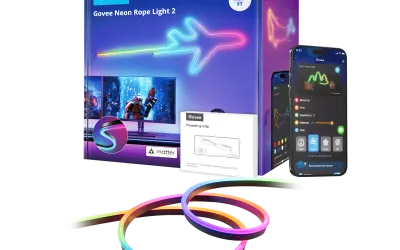
I wanted accent lighting for my home office that would look good on camera during video calls without breaking the bank. Nanoleaf and Philips Hue options start at $150 and climb quickly, so the Govee Neon Rope Light at around $50 seemed like the budget-friendly answer. After three months of use, I can confirm it delivers on aesthetics -- the neon glow effect is genuinely attractive and gets compliments from colleagues who see it in my video background. But the experience has also been a masterclass in why cheap smart home devices can cost more in frustration than they save in dollars. The WiFi connectivity issues alone have consumed more of my time than I'd like to admit.
Design & Build
The Govee Neon Rope Light is essentially a flexible LED strip encased in a silicone diffuser tube, and the diffusion is what makes it work. Unlike bare LED strips where you can see individual diodes and get harsh point-source lighting, the silicone tube softens everything into a smooth, continuous glow that genuinely resembles neon signage. It's not a perfect imitation -- real glass neon has a depth and warmth that LEDs can't fully replicate -- but from a few feet away, the effect is convincing enough for decorative purposes. The rope is flexible enough to bend into curves, letters, and geometric shapes, and it holds its shape once mounted with the included adhesive clips.
I created a simple angular design on the wall behind my desk, and the mounting process was straightforward if a bit fiddly. The adhesive clips hold well on smooth painted drywall, though I'd be cautious about textured surfaces. The rope itself is about 10 feet long, which was sufficient for my design but might feel limiting for larger installations. Build quality is acceptable for the price -- the silicone tube is durable and the overall construction feels solid enough. The controller box, however, is a cheap plastic unit with a single physical button and a power cable. It's small enough to hide behind furniture but not exactly elegant. The power adapter is a standard barrel connector that's neither remarkably long nor inconveniently short.
Features
The RGBIC technology is the headline feature here, allowing different segments of the rope to display different colors simultaneously. This enables gradient effects, flowing color transitions, and multi-color scenes that single-color strips can't achieve. The Govee Home app offers 99+ preset scenes ranging from subtle warm glows to aggressive rainbow animations, plus a DIY mode where you can assign specific colors to specific segments. The color range covers the full RGB spectrum with decent saturation, though the blues and purples are noticeably more vivid than the warm whites, which can lean slightly green.
Music sync mode uses the controller's built-in microphone to react to ambient audio, pulsing and changing colors with the beat. It's a fun party trick, but the sync isn't tight enough to feel rhythmically connected to music -- there's a perceptible lag and the color changes feel more random than musical. I turned it on twice for novelty and haven't used it since. Scheduling and timer features work through the app for automated on/off at specific times.
The significant limitation is the complete dependence on Govee's cloud infrastructure. There is no local control option whatsoever. If Govee's servers go down -- and they do, occasionally -- you lose app control entirely. The physical button on the controller provides basic power toggle and a preset mode cycle, but no color selection or brightness control. Alexa and Google Assistant integration works for basic commands like power and brightness, but those also route through Govee's cloud. For Home Assistant users, integration is available through a cloud-based unofficial plugin, but it's neither fast nor reliable enough for anything beyond casual control. The lack of any local API or Matter support is disappointing, and the newer Govee Neon Rope Light 2 adds Matter -- a tacit admission that the original falls short on this front.
Performance
When the Govee Neon Rope Light is connected and working, the visual output is genuinely nice. Colors are vibrant, the diffusion is smooth and even along the length of the rope, and the brightness is sufficient for accent lighting without being overwhelming. It won't light a room on its own, nor is it meant to -- this is mood lighting, and it does that job well. The RGBIC segment control creates attractive gradients that look far better than a static single-color strip.
The problem is the "when it's connected and working" caveat. In three months of use, the rope has gone offline in the Govee app more times than I can count -- easily three to four times per week during the worst stretches. The pattern is always the same: the app shows the device as offline, the light is either stuck on its last setting or unresponsive, and the fix is to unplug the controller, wait ten seconds, and plug it back in. After reconnection, it works fine until the next dropout. I've tried every troubleshooting step: assigning a static IP, moving the controller closer to my router, ensuring it's on a dedicated 2.4GHz network, updating firmware. Nothing fully resolves the issue.
The root cause appears to be the controller's weak WiFi radio. Even with my router fifteen feet away with clear line of sight, the signal strength reported by my router shows the Govee controller at the bottom of the connected device list. Firmware updates have been their own adventure -- I've had updates fail midway through, requiring multiple retry attempts before finally completing. Govee's infrastructure feels like it was built for scale rather than reliability, and the individual device experience suffers as a result. For pure decorative lighting that you manually toggle on and off, these issues are an annoyance. For anything automated or relied upon, they're a dealbreaker.
Ease of Use
Physical installation is the best part of the Govee experience. Unbox the rope, plan your design on the wall, stick the mounting clips at regular intervals, and press the rope into the clips. The whole process took me about thirty minutes, including time spent adjusting my layout. The adhesive clips adhered well to my painted drywall and have held firmly for three months without any sagging or detachment. If you're not satisfied with your design, the clips peel off without damaging the paint, which gives you some freedom to experiment.
App setup is initially simple -- install the Govee Home app, add the device, connect it to your 2.4GHz WiFi network (5GHz is not supported), and you're controlling colors within a few minutes. The app itself is functional and the scene browser is genuinely fun to explore. However, the Govee Home app is aggressively promotional. Every session greets you with banners for other Govee products, promotional events, and social media content from the Govee community. The actual device controls work fine once you navigate past the marketing.
The ongoing ease of use is where things fall apart. Because of the frequent offline issues, I've developed a routine of power-cycling the rope before expecting it to respond to commands. My wife has completely given up on the app and just uses the physical button for on/off, which defeats the purpose of a "smart" light. The troubleshooting cycle of power-cycling, waiting for reconnection, and hoping it stays connected has become so routine that I barely register it anymore -- which is either a sign of acceptance or Stockholm syndrome. For a device that's supposed to simplify lighting, it adds a surprising amount of friction.
Value
At $50-60 for a 10-foot rope, the Govee Neon Rope Light is significantly cheaper than premium alternatives. The Philips Hue Gradient Lightstrip starts at roughly $180 and requires a $60 Hue Bridge. Nanoleaf Lines begin around $200 for a starter kit. Even other Govee products like the Neon Rope Light 2 with Matter support command a premium over this original model. On pure aesthetics-per-dollar, the Govee Neon Rope is hard to beat. The neon effect looks great in photos and on video calls, and fifty dollars for decorative wall lighting is objectively reasonable.
But value isn't just about purchase price -- it's also about the ongoing cost of your time and patience. If I factor in the minutes I've spent power-cycling, troubleshooting, and re-connecting this device over three months, the real cost is higher than the sticker suggests. For purely decorative lighting in a setting where reliability doesn't matter -- a gaming setup you toggle on manually, a party decoration, a background element for video calls -- the Govee Neon Rope is fine value. You'll get a good-looking light at a low price and learn to live with its quirks.
For anything where you want consistent smart home automation -- lights that turn on at sunset via a routine, accent lighting that responds reliably to voice commands, integration with a broader smart home system -- spending more on a reliable product will save frustration in the long run. The old adage applies: buy nice or buy twice. The Govee Neon Rope Light is the definition of "you get what you pay for."
Pros
- Affordable decorative lighting
- Good color range and effects
- Flexible design for custom shapes
- Music sync feature (if you want it)
- Works with Alexa/Google Assistant
Cons
- Frequent WiFi disconnections
- Cloud-dependent with no local control
- App filled with promotions
- Weak WiFi radio in controller
- Firmware updates unreliable
- Budget reliability matches budget price
Final Grade
The Govee Neon Rope Light delivers attractive neon-style accent lighting at a price that undercuts every premium competitor by a wide margin. The visual effect is genuinely good -- smooth diffusion, vibrant colors, and enough flexibility to create custom designs on your wall. If aesthetics were the only metric, this would be an easy recommendation. But three months of living with it has meant three months of WiFi dropouts, power cycling, and a growing acceptance that "smart" is generous branding for a device that loses its connection multiple times a week. The weak WiFi radio in the controller is the fundamental problem, and no amount of firmware updates has fixed it. If you want fun, affordable decorative lighting and you're willing to manage its connectivity tantrums, the Govee Neon Rope is a reasonable purchase. If you want lighting you can depend on for automations and daily smart home routines, spend more on something that actually stays connected. Pretty and unreliable is a frustrating combination.