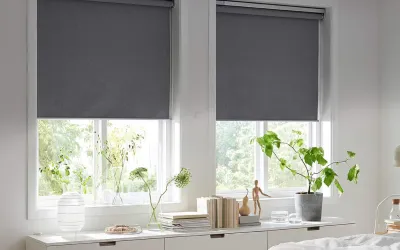
Motorized blinds have always felt like a luxury reserved for people with professional home automation budgets. Most options from established brands like Lutron and Hunter Douglas start at $300-500 per window -- multiply that across a house and you're looking at a small renovation budget just for window coverings. IKEA's FYRTUR promised to change that equation: motorized blackout blinds at roughly half the price, with Zigbee connectivity and Matter support through their DIRIGERA hub. After six months of living with FYRTUR blinds on three bedroom windows, I can report that the hardware mostly delivers on its promise while the software experience will test your patience. If you're a Home Assistant user who can bypass IKEA's ecosystem entirely, these are a genuinely good value. If you're planning to rely on IKEA's native app and hub, prepare for frustration.
Design & Build
The FYRTUR blinds look like normal blackout roller blinds, and that's one of their best qualities. The neutral fabric options (white, gray, and dark gray) match most bedroom decor without announcing "I'm a smart device" to anyone who walks in. Guests have never noticed that our bedroom blinds are motorized until they watch them move. The motor housing at the top of the blind is reasonably compact -- about the same diameter as a standard roller blind tube -- and hidden behind the blind fabric when fully extended. From across the room, you'd never know there's a motor in there.
The biggest design limitation is sizing. IKEA offers FYRTUR in a handful of fixed widths ranging from about 23 inches to 48 inches. No custom sizes, no trimming to fit. I measured my three bedroom windows carefully and two were close enough to standard sizes that the fit looks fine. The third window is an awkward width, and I had to go with a blind that's about 1.5 inches narrower than the window frame. There's a visible light gap on each side that partially defeats the "blackout" purpose. For a company that builds an entire business model around modular furniture that fits various spaces, the rigid sizing feels like a missed opportunity. Competitors like Lutron Serena offer custom sizing -- at three times the price, admittedly.
Battery life and charging deserve mention. Each blind runs on a rechargeable battery pack that connects via USB-C. IKEA claims six months of battery life; I've averaged closer to 3-4 months with daily use (blinds open in the morning, close at night, occasional mid-day adjustments). Recharging takes about 6-8 hours via any USB-C cable. The battery pack pops out of the blind without removing it from the window, so recharging is painless if mildly inconvenient. I keep a long USB-C cable near each window for charging in place. Build quality of the blinds themselves is typical IKEA -- functional, not luxurious. The fabric blocks light effectively, the mechanism feels adequate, and the end caps and mounting brackets are plastic but sturdy enough.
Features
Feature-wise, the FYRTUR is straightforward: motorized up/down/stop control with percentage positioning via Zigbee. You can command a blind to 0% (fully closed), 100% (fully open), or any position in between. That's the core of it. There's no tilt control (it's a roller blind, not a venetian), no light sensing, no built-in scheduling on the blind itself. All the intelligence comes from whatever hub and app you connect it to.
IKEA's ecosystem requires either the newer DIRIGERA hub ($60) or the older TRADFRI gateway for smart control. The included wireless remote provides basic up/down/stop without any hub, which is useful as a fallback. Through the DIRIGERA hub, the blinds gain Matter compatibility, which means control through Apple Home, Google Home, Amazon Alexa, and Samsung SmartThings. On paper, this is excellent. In practice, the implementation is inconsistent -- more on that in performance.
The IKEA Home Smart app provides scheduling, grouping (sync multiple blinds together), and basic automation triggers. The scheduling works for simple time-based routines: open at 7 AM, close at 9 PM. But the automation capabilities are bare-bones compared to what you'd get from dedicated platforms. You can't trigger blinds based on sunrise/sunset calculated for your location, you can't create conditional logic, and integration with non-IKEA devices is limited to whatever Matter exposes.
For Home Assistant users, the FYRTUR blinds work beautifully through Zigbee2MQTT or ZHA. Bypass IKEA's hub entirely by pairing the blinds directly with a Zigbee coordinator like the SONOFF Zigbee 3.0 Dongle. Through Home Assistant, you get proper sunrise/sunset automations, integration with presence detection, conditional logic, and grouping with any other smart home device regardless of brand. My blinds open gradually over 15 minutes starting at sunrise, close automatically when nobody's home, and respond to a "goodnight" routine that also locks the doors and dims the lights. None of that is possible through IKEA's native app. Home Assistant is the experience these blinds deserve.
Performance
The physical performance of the FYRTUR motor is genuinely good. The blinds move smoothly and quietly -- quiet enough that they don't wake my partner when they open gradually at sunrise. Full travel from closed to open takes about 20-25 seconds depending on the blind size, which feels unhurried but not frustratingly slow. The motor has enough torque to operate reliably at any position; I've never had a blind stall or struggle during operation.
Positioning accuracy is solid. When I command a blind to 50%, it consistently lands at what looks like 50%. The positioning repeats well over time without calibration drift -- unlike some smart blinds I've read about, I've never had to recalibrate the endpoints. The motor knows where fully open and fully closed are, and every position in between is proportionally accurate.
Response time is where the experience diverges depending on your control method. Through IKEA's Home Smart app and DIRIGERA hub, there's a consistent 2-3 second delay between tapping the button and the blind starting to move. It's sluggish enough to make you wonder if the command registered. Through Home Assistant via Zigbee2MQTT, the delay drops to under one second -- the blind begins moving almost immediately after I tap the control. The included wireless remote is the fastest of all, with essentially zero perceptible delay. If you're using the native IKEA ecosystem, the latency is a constant minor irritation.
Reliability is mostly good but not perfect. About once a week, a blind fails to respond to the first command -- I send it and nothing happens, then a second command works. I suspect this is a Zigbee mesh issue related to my network topology rather than a blind hardware problem, because it improved after I added more Zigbee router devices (smart plugs that act as repeaters) near the bedrooms. Battery life, as mentioned, runs 3-4 months with daily use rather than IKEA's claimed six months. The USB-C recharging is convenient enough that this isn't a major issue, but it means you'll be plugging in each blind quarterly rather than biannually.
Ease of Use
Physical installation is standard roller blind territory. Mount the brackets at the top of the window frame (inside or outside mount), click the blind into the brackets, done. IKEA includes clear pictographic instructions and all necessary hardware. I installed three blinds in about 45 minutes total, with most of that time spent on measuring and leveling the brackets. If you've ever installed any kind of window covering, you'll have no trouble. If you haven't, it's still manageable with a drill, a level, and a pencil.
Smart setup is where IKEA drops the ball. The IKEA Home Smart app is clunky, slow, and occasionally confusing. Adding the DIRIGERA hub to the app required three attempts before it connected. Pairing each blind to the hub worked on the first try but took about 2-3 minutes per blind. The app's user interface is functional but poorly organized -- settings are spread across multiple screens, automation creation requires navigating through several menus, and the visual design feels like an afterthought compared to IKEA's typically thoughtful product design. Firmware updates push through the app and are mandatory for certain features; I've had one update fail mid-way and require a retry, which was nerve-wracking for a device I'd rather not have to re-pair.
My wife's experience is telling. She tried using the IKEA Home Smart app for about two weeks, then gave up. "It's too slow and confusing," she said. Now she uses one of two methods: the physical remote (instant, reliable, zero learning curve) or Siri through Apple Home (when the Matter integration is behaving). The app has become my domain exclusively, and I only open it for firmware updates. For the Home Assistant path, pairing via Zigbee2MQTT was actually easier than the IKEA app -- the blinds were discovered automatically, and I was controlling them within minutes. If you have a Zigbee coordinator and Home Assistant, I'd strongly recommend skipping the DIRIGERA hub entirely and going direct.
Value
FYRTUR blinds run $130-180 depending on size, which is roughly 40-60% the cost of comparable motorized blackout blinds from Lutron Serena ($250-350) or Hunter Douglas PowerView ($300-500). That price advantage is the reason these blinds exist and the primary reason to consider them. For a household with four or five windows to cover, the savings add up to hundreds of dollars. You do need to factor in the DIRIGERA hub at $60 if you want smart control and don't have a Zigbee coordinator, bringing a single-blind setup to $190-240.
The value equation depends heavily on which path you take. If you're a Home Assistant user with an existing Zigbee setup, the FYRTUR blinds are an outstanding value: $130-180 per window for motorized blackout blinds that integrate seamlessly into your automation system, no additional hub required. The hardware performs well, the Zigbee integration is solid, and you bypass all of IKEA's software limitations. I'd give the value an A in this scenario.
If you're using IKEA's native ecosystem, the value proposition weakens. The DIRIGERA hub adds cost, the app experience is frustrating, the automation capabilities are limited, and the Matter integration through DIRIGERA is inconsistent enough to undermine the smart features you're paying extra for. In this scenario, you're getting decent motorized blinds with mediocre smart home integration -- still cheaper than Lutron, but the gap narrows when you account for the time you'll spend wrestling with IKEA's software. For users who want a polished, reliable smart blind experience out of the box and don't mind paying more, Lutron Serena with a Caseta bridge is the more refined option.
Pros
- Affordable motorized blinds
- Quiet, smooth operation
- Works with Home Assistant via Zigbee
- USB-C rechargeable battery
- Standard appearance (not obviously \"smart\")
Cons
- IKEA Home Smart app is frustrating
- Limited size options (no custom)
- Requires IKEA hub for smart features
- Battery life shorter than claimed
- Occasional command failures
- Slow response time through native app
Final Grade
IKEA FYRTUR blinds make motorized window coverings accessible to households that can't justify Lutron or Hunter Douglas pricing. The hardware is genuinely good -- quiet motor, smooth operation, effective blackout fabric, rechargeable USB-C battery, and reliable Zigbee connectivity. For Home Assistant users who pair them directly via Zigbee, bypassing IKEA's ecosystem entirely, these are an excellent value with seamless automation potential. The problems are all on IKEA's software side: the Home Smart app is slow and confusing, the DIRIGERA hub adds cost and complexity, Matter integration is inconsistent, and the automation capabilities through IKEA's native platform are bare-bones. My wife abandoned the IKEA app within two weeks. Battery life runs about 3-4 months rather than the claimed six. And the fixed sizing means you may have to accept an imperfect fit for non-standard windows. If you have Home Assistant, buy these blinds without hesitation. If you're relying on IKEA's native ecosystem, proceed with open eyes and lowered expectations. The price is right, but you're trading money for patience.