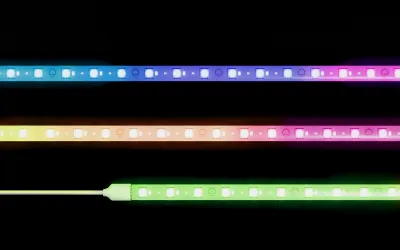
I wanted accent lighting behind my TV without adding another hub or bridge to my already-crowded network closet. The LIFX Lightstrip's WiFi-direct approach seemed ideal -- just plug it in, connect to your network, and start enjoying bias lighting. After four months of use, I can report that the colors are genuinely gorgeous when the strip is working. Unfortunately, "when the strip is working" has turned out to be an uncomfortably frequent qualifier.
The LIFX Lightstrip is a frustrating product because its strengths are real and its weaknesses are equally real. The color quality, brightness, and multi-zone capability rival anything on the market at any price. But the WiFi connectivity is unreliable enough that I've spent more time troubleshooting this strip than enjoying it, and that's a damning indictment for an $80 product that's supposed to simplify my life.
Design & Build
The strip itself is well-constructed, with a flexible but sturdy silicone-coated backing that resists kinking and twisting. The LEDs are densely packed and evenly spaced, producing smooth, consistent illumination without the visible hot spots that plague cheaper strips. The adhesive on the back is strong -- perhaps too strong. Once you commit the strip to a surface, repositioning is essentially impossible without risking damage. I attached mine to the back of my 55-inch TV in a rectangular pattern, and the adhesive has held perfectly for four months without any sagging or peeling.
At 2 meters (about 6.5 feet), the strip is the right length for most TV backlighting setups up to about 65 inches. You can cut the strip shorter at designated cut points if you need less length, but you cannot extend it -- there's no extension kit available for this model, which limits its usefulness for longer runs behind entertainment centers or under cabinets. If you need more than 2 meters, you'll need to look at other options or buy a second kit.
The controller box is reasonably compact, about the size of a deck of cards, and tucks behind the TV easily. No external hub or bridge is required -- just a power cable to an outlet and a WiFi connection. The minimalist hardware footprint is one of LIFX's genuine advantages over hub-dependent systems like Philips Hue, which requires a $60 bridge that needs to be plugged into your router.
Features
Color quality is where the LIFX Lightstrip genuinely excels, and it's the reason I keep tolerating the connectivity issues. The range of colors spans the full 16-million-color spectrum, and the quality of those colors is noticeably superior to cheaper strips from Govee or other budget brands. Reds are deep and saturated, blues are vivid without looking neon, and greens are rich and natural. The tunable white range extends from a very warm 1500K (candlelight) to a very cool 9000K (daylight), with high color rendering (90+ CRI) that makes illuminated surfaces look accurate rather than washed out.
The polychrome multi-zone technology is the other standout feature. The strip has 8 individually addressable zones, meaning you can display different colors simultaneously across its length. Gradient effects, flowing rainbow animations, and custom multi-color scenes are all possible and genuinely look impressive. This is something cheaper single-zone strips simply cannot do -- they're one color at a time, period. The multi-zone capability transforms TV backlighting from a simple ambient glow to a dynamic lighting experience.
Platform compatibility covers the major ecosystems: Apple HomeKit, Amazon Alexa, Google Home, and Samsung SmartThings. There's no hub required -- the strip connects directly to your 2.4GHz WiFi network. The LIFX app provides extensive customization including zone-level color control, animated effects, themes, and a basic music visualization mode that pulses colors to ambient sound. The app is functional but not exceptional -- scene creation works, scheduling works, but the interface feels slightly dated compared to competitors.
One notable absence: there's no Matter support as of this writing. LIFX has discussed Matter compatibility, but no concrete timeline has been published. In a market where Nanoleaf and others are already shipping Matter-certified products, this is a meaningful gap for forward-looking buyers.
Performance
Here's where the review turns sour. The LIFX Lightstrip regularly becomes unresponsive in HomeKit, showing "Updating..." or "No Response" in the Apple Home app. When this happens, the only reliable fix is power cycling -- unplugging the strip, waiting 10 seconds, and plugging it back in. This happens approximately once or twice per week in my experience. Sometimes more frequently, occasionally less, but consistently enough that I can't trust the strip to work on the first try when I want to use it.
When it is working, the experience is excellent. Response time to commands is good (not Thread-fast, but acceptable for WiFi), dimming is smooth across the full range, and the colors look fantastic. The brightness at maximum output (1400 lumens) is genuinely impressive for a light strip -- bright enough for functional under-cabinet lighting, not just ambient accent use. But "when it's working" is doing an enormous amount of heavy lifting in that sentence.
The fundamental issue is WiFi reliability. WiFi-based smart home devices are inherently less stable than Zigbee or Thread alternatives because they compete for bandwidth and airtime on the same crowded 2.4GHz spectrum as your laptops, phones, and tablets. The LIFX seems particularly susceptible to this -- more so than my other WiFi smart home devices (a couple of TP-Link Kasa plugs that rarely drop). I've tried assigning a static IP, reserving DHCP, and adjusting my router's WiFi channel with minimal improvement. The strip seems to lose its connection during periods of higher network activity and then fails to reconnect automatically.
I've read forum posts from other LIFX users reporting identical issues, so this isn't an anomaly specific to my network. WiFi smart lighting has a reliability problem that Thread and Zigbee have largely solved, and the LIFX Lightstrip is Exhibit A in that argument.
Ease of Use
Initial setup is straightforward enough. Download the LIFX app, plug in the strip, and follow the prompts to connect it to your 2.4GHz WiFi network. Add it to HomeKit by scanning the code on the controller box. The whole process takes about five minutes. Physical installation is simple if you plan your layout carefully before committing -- remember, that adhesive is essentially permanent. I measured and marked the path on the back of my TV with painter's tape first, then applied the strip in one clean pass.
Day-to-day operation, when the strip is online, works well. My wife uses it for "movie mode" via Siri, which dims the strip to a warm amber glow behind the TV. She's also set up a couple of scenes in the Home app for different moods. The controls are intuitive -- brightness slider, color picker, scene selection. Nothing confusing about the interface.
The problem is the recurring unresponsiveness. When my wife says "Hey Siri, set movie mode" and the HomePod responds with "Some of your accessories aren't responding," it undermines the entire smart home experience. She's gone from enthusiastic to annoyed to simply walking over and manually power-cycling the strip before trying again, which defeats the purpose of a smart device. The troubleshooting ritual -- unplug, wait, replug, wait for reconnection, retry command -- takes about 30-45 seconds each time. That doesn't sound like much, but when it happens multiple times a week, the cumulative frustration is real. A smart device that regularly requires manual intervention isn't meaningfully smarter than a dumb device with a remote control.
Value
The LIFX Lightstrip 2m Starter Kit costs around $80, placing it squarely in the premium tier of smart light strips. The color quality and multi-zone capability justify a premium over budget strips -- a $30 Govee strip can't match the LIFX's color accuracy or produce multi-zone gradient effects. But premium pricing demands premium reliability, and the LIFX doesn't deliver that.
The competitive landscape puts the LIFX in an awkward position. Cheaper strips from Govee ($25-35) work more consistently despite inferior color quality, making them a better value for anyone who prioritizes reliability over color perfection. The Philips Hue Lightstrip ($80-90 plus $60 bridge) is more expensive all-in but offers rock-solid Zigbee reliability through the Hue Bridge, plus deep integration with the mature Hue ecosystem. If you already own a Hue Bridge, the Hue strip is the obvious choice. If you don't, the total cost is prohibitive, but the reliability is in a different league.
At $80, I expected a product I could set and forget. Instead, I got a product I troubleshoot weekly. The colors are gorgeous -- truly best-in-class -- but I can't enjoy them half the time because the strip is offline. If LIFX fixes the WiFi reliability issues through firmware updates (or eventually ships a Thread-enabled version), this would be an easy A-tier product. As it stands, you're paying a premium price for an inconsistent experience, and that's not a value proposition I can endorse without significant caveats.
Pros
- Excellent color quality and range
- No hub required
- Native HomeKit, Alexa, Google Home support
- Individually addressable zones
Cons
- Regular HomeKit connectivity issues
- WiFi dependency causes reliability problems
- Can't extend the strip
- Premium pricing for inconsistent experience
- Requires frequent power cycling
Final Grade
The LIFX Lightstrip produces some of the most beautiful smart lighting colors I've seen. The multi-zone gradient effects look stunning behind a TV, the brightness is impressive, and the color quality exceeds every budget strip on the market. When this product works, it's exceptional. The problem is that it doesn't work reliably enough to justify its $80 price tag.
Weekly connectivity drops, unresponsive HomeKit sessions, and forced power cycles have turned what should be a set-and-forget accent light into a recurring troubleshooting project. If you prioritize color quality above all else and have a high tolerance for occasional WiFi flakiness, the LIFX Lightstrip might be worth the gamble. If you want lighting that simply works every time you ask it to, look at Zigbee or Thread-based alternatives -- even if the colors aren't quite as stunning, the reliability will save you far more frustration than the colors will bring you joy.