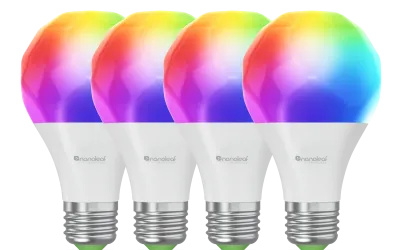
I've been slowly replacing my older smart bulbs with Thread-enabled options over the past year, and the Nanoleaf Essentials A19 was one of my first purchases in that migration. After five months of daily use across two living room lamps and a bedroom fixture, these have become my default recommendation when anyone asks me what smart bulb to buy.
The smart bulb market has been a mess of proprietary bridges, flaky WiFi connections, and ecosystem lock-in for years. Thread and Matter have changed that equation entirely, and the Nanoleaf Essentials line is one of the best examples of why. You get responsive, reliable bulbs that work with every major platform, no hub required beyond the Thread border router you probably already own. At around $20 per bulb, the days of paying $50+ for a single Hue bulb and a mandatory bridge feel like ancient history.
Design & Build
The Nanoleaf Essentials A19 looks like a slightly futuristic regular light bulb -- a frosted dome on top for even light diffusion and a sleek matte white base with subtle geometric facets. It's a good-looking bulb, but more importantly, it doesn't scream "smart device" when screwed into a lamp. My wife was skeptical of the whole smart bulb concept, and the fact that these look reasonably normal helped sell her on the idea.
One thing to note: these are slightly larger than a standard A19 incandescent. Not dramatically so, but enough that they might not fit in every fixture. I had no issues with my table lamps and bedroom ceiling fixture, but a friend with a tight-clearance pendant lamp had to swap back to a standard bulb. If your fixture has a narrow harp or globe, measure before buying.
Color quality is genuinely excellent. The whites are clean across the full 2700K to 6500K range -- warm enough for cozy evenings and cool enough for focused work lighting. The color spectrum covers 16 million colors, and while I'm not going to pretend I can distinguish all of them, the reds, blues, and greens are rich and vibrant without looking garish or washed out. My wife initially hated the idea of "colored" bulbs until she saw how a warm sunset scene looks in the living room at 8 PM. Now she requests it nightly. At 1100 lumens, these are a 75W-equivalent bulb -- bright enough for primary task lighting, not just accent use.
Features
Thread connectivity is the headline feature, and it absolutely delivers on the promise. These bulbs join your Thread mesh network and respond to commands with sub-second latency -- we're talking virtually instantaneous response when you tap a switch in the Home app or issue a voice command. If you have an Apple TV 4K or HomePod Mini acting as a Thread border router, the bulbs connect directly to the mesh with no additional hardware needed. No bridge, no hub, no extra box plugged into your router.
The full RGBW color range plus tunable white from 2700K to 6500K opens up a lot of automation possibilities. I run circadian-style lighting that shifts from cool 5000K in the morning to warm 2700K in the evening, and the transition is completely seamless. The bulbs also support HomeKit Adaptive Lighting, which automates this color temperature shift throughout the day with zero configuration beyond flipping a toggle.
Matter support is the other major selling point. These bulbs work natively with Apple HomeKit, Google Home, Amazon Alexa, Samsung SmartThings, and Home Assistant. There's no ecosystem lock-in, no proprietary app requirement for basic functionality. If you switch from one platform to another, your bulbs come with you. After years of being locked into the Hue bridge ecosystem, this kind of freedom is refreshing.
The Nanoleaf app provides additional features like Screen Mirror (syncing colors with your computer display), dynamic animated scenes, and firmware updates. It's a nice companion but not required for daily operation, which is exactly how a smart bulb app should work.
Performance
Response time is noticeably faster than my old WiFi bulbs and even my previous Hue setup. Tap a button in the Home app or issue a Siri command, and the light changes before the words have finished leaving your mouth. The Thread mesh network eliminates the cloud round-trip that plagues WiFi bulbs and the bridge bottleneck that can slow down Hue. It's the most responsive smart lighting experience I've used.
Reliability over five months has been outstanding. I'm running five Nanoleaf bulbs across my apartment, and I've had exactly zero connectivity issues. No unresponsive bulbs, no "Updating..." messages in HomeKit, no need to re-pair anything. They just work, day after day. Coming from years of troubleshooting WiFi bulbs that would drop off the network weekly, this level of reliability feels almost luxurious.
Color accuracy is solid -- what you see in the app's color picker is essentially what you get from the bulb. The dimming range is excellent, going all the way down to about 1% brightness without any flickering or color shift. At minimum brightness, these make a perfect nightlight in a hallway or bedroom. The transition between brightness levels is smooth and gradual, with none of the stepping or jumping I've seen with cheaper smart bulbs.
One minor note: like all smart bulbs, these need constant power to the fixture. If someone flips the wall switch off, the bulb loses power and drops off the network until the switch is turned back on. This is an inherent limitation of smart bulbs, not a Nanoleaf-specific issue, but it's worth mentioning if you have family members prone to hitting physical switches. A smart switch is the alternative approach that avoids this problem entirely.
Ease of Use
Setup through HomeKit was about as painless as it gets. Screw in the bulb, flip the power on, open the Home app, and scan the HomeKit code printed on the bulb's packaging. The entire process took under a minute per bulb, and they appeared on my Thread network immediately. No firmware updates required before first use, no lengthy onboarding wizard, no account creation. Just scan and go.
Adding them to Home Assistant via the Matter integration was equally straightforward. I commissioned the bulbs through Apple Home first, then shared them to Home Assistant via Matter. The whole process took a couple of minutes and exposed all the expected controls -- on/off, brightness, color temperature, and full RGB color.
Day-to-day control works exactly as you'd expect across platforms. My wife manages everything through Siri and the Apple Home app without any issues. The controls are intuitive -- a brightness slider, a color temperature slider, and a color wheel. She's set up a few scenes ("Movie Night" dims to 20% warm white, "Reading" goes to 80% cool white) and switches between them with voice commands or a couple of taps. I've never once heard her complain about the bulbs not responding or being confusing to operate, and in our household that's the ultimate usability benchmark.
Value
At around $20 per bulb, the Nanoleaf Essentials A19 sits in the mid-range of the smart bulb market. You can find basic WiFi bulbs from Wyze or Govee for $8-10, and premium Hue color bulbs run $50+ each (before the mandatory $60 bridge). The Nanoleaf threads the needle between those extremes -- offering premium features at a reasonable price point.
The value comparison against Philips Hue is particularly striking. A Hue starter kit with four color bulbs and the bridge runs around $180-200. Four Nanoleaf Essentials bulbs cost roughly $80, and the Thread border router you need (a HomePod Mini or Apple TV 4K) is something most Apple households already own. Even if you need to buy a HomePod Mini, the total system cost is still $50-70 less than the Hue equivalent, and you get a smart speaker out of the deal.
The long-term value proposition is even stronger. There's no subscription fee, no proprietary bridge that becomes e-waste if the company stops supporting it, and no ecosystem lock-in. Matter compatibility means these bulbs will work with whatever smart home platform dominates five years from now. You're buying a bulb, not renting access to a walled garden. At this price point with these features and this level of reliability, the Nanoleaf Essentials A19 is the best value in smart lighting today.
Pros
- Thread connectivity for instant response
- Matter support works with all major platforms
- No hub required (with Thread border router)
- Excellent color quality and temperature range
- HomeKit Adaptive Lighting support
- Much cheaper than Hue for similar quality
Cons
- Slightly larger than standard A19 bulbs
- Need a Thread border router for best experience
- Nanoleaf app could be more polished
Final Grade
The Nanoleaf Essentials A19 is what I recommend to everyone who asks about smart bulbs in 2025. Thread makes them fast and reliable. Matter makes them compatible with everything. The color quality rivals bulbs costing twice as much. And the price -- around $20 per bulb with no hub required -- makes the old guard look overpriced and outdated.
After five months of daily use, these bulbs have been completely trouble-free. No dropped connections, no re-pairing, no frustrated family members unable to turn on a light. They just work, every time, with every platform I've thrown at them. If you're starting a smart home from scratch or upgrading from older WiFi or Zigbee bulbs, Thread/Matter bulbs like these represent the future of smart lighting -- and the future is already here.