I wanted smart pathway lighting for our apartment's small patio area -- something that could do more than just turn on and off, ideally with color options for entertaining. The Philips Hue Calla bollard lights were the obvious choice in the smart outdoor lighting space, and after four months of use through rain and temperature swings, I can confirm they deliver genuinely premium quality. The catch, predictably, is that premium quality comes with a premium price that makes scaling up eye-wateringly expensive.
Outdoor smart lighting is a niche that doesn't get as much attention as indoor bulbs and smart speakers, but it can dramatically transform how you use your outdoor space. Color-changing pathway lights that sync with sunset, shift to warm amber for dinner parties, or pulse red for Halloween create effects that traditional landscape lighting simply can't match. The Hue Calla does all of this beautifully -- the question is whether it's worth three to four times the cost of conventional landscape lighting.
Design & Build
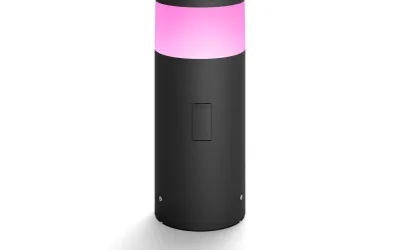
The Calla is a sleek, cylindrical bollard light that stands about 10 inches tall with a 4-inch diameter. The black aluminum body with a frosted diffuser lens looks like it belongs in a professionally designed landscape installation, not a DIY smart home setup. I've had neighbors ask who did our landscape lighting, which tells you everything about the design quality. The silver finish option is also available, though the black blends better with most outdoor settings.
The diffuser distributes light evenly in a 360-degree pattern without hot spots or harsh glare -- you see a soft glow emanating from the bollard rather than a bright point source. This makes the light comfortable to look at directly, which matters for pathway bollards at eye level when you're seated on a patio. Light output is 600 lumens (roughly equivalent to a 49-watt incandescent), which is appropriate for pathway illumination without being overbearing.
Build quality is excellent. The aluminum construction with IP65 weather resistance has held up through four months of rain, humidity, and direct sun exposure without any discoloration, corrosion, or moisture intrusion. IP65 means the fixture is completely dust-tight and protected against water jets from any direction, so sprinkler overspray or heavy rain are non-issues. The included aluminum ground stake provides solid anchoring in soil, and extension cables with weatherproof connectors link multiple fixtures cleanly.
The low-voltage system design is both a feature and a constraint. A single power supply unit (PSU) can drive up to five Calla lights, with cable runs extending up to 100 feet. This simplifies installation compared to line-voltage landscape lighting, and the low voltage (24V DC) is inherently safer for outdoor burial. However, the PSU itself is indoor-rated and needs a weather-protected outlet location -- a covered porch outlet or a weatherproof outlet box. Running the cable from an indoor PSU through a wall or window to outdoor fixtures requires some planning.
Features
The Calla offers the full Philips Hue color spectrum: 16 million colors plus the complete range of white temperatures from warm candlelight (2000K) to cool daylight (6500K). Color accuracy is excellent and matches indoor Hue lights, meaning scenes and color recipes you've set up inside translate faithfully to the outdoor fixtures. I've set up a "dinner party" scene with warm 2700K white for the pathway, shifting to deep amber when triggered by a button press, and the transition is smooth and attractive.
Integration with the Hue ecosystem is seamless. The Calla connects via Zigbee to your Hue Bridge (required, sold separately if you don't already have one) and appears alongside your indoor lights for unified control. Hue scenes, rooms, zones, automations, and schedules all work identically to indoor fixtures. Sunset/sunrise triggers are particularly useful for outdoor lights -- mine turn on at sunset at 30% brightness and ramp up to full as it gets darker, then dim to 10% at midnight for security presence.
The Hue outdoor motion sensor (sold separately) adds triggered illumination -- pathway lights that activate when someone approaches and dim back down after a configurable timeout. This is genuinely useful for energy savings and for the cool factor of lights that respond to movement. Voice control through Alexa, Google Assistant, Siri/HomeKit, and Home Assistant all work through the Hue integration, and response time is fast -- under a second for on/off and color changes.
What the Calla lacks is any standalone smart capability. Without the Hue Bridge and a working home network, these are inert aluminum tubes. There's no physical switch, no Bluetooth fallback, and no local scheduling. Your entire outdoor lighting setup depends on the Hue Bridge staying connected and your Zigbee mesh reaching the outdoor fixtures. In my testing, the Zigbee signal reached my patio (about 30 feet from the bridge through one exterior wall) without issues, but larger properties may need a Hue outdoor extension to bridge the gap.
Performance
Light output is well-calibrated for pathway illumination. The 600 lumens through the frosted diffuser provides enough light to safely navigate a path at night without creating the harsh, over-lit look of security floodlights. Color rendering is accurate -- plants and landscaping look natural under white light, and colors are vivid and saturated when using the color spectrum. The transition between colors and brightness levels is smooth, without the flickering or stepping you sometimes see in cheaper smart lights.
Weather resistance has been thoroughly tested through four months of typical outdoor conditions -- rain, humidity up to 90%, direct afternoon sun, and temperatures ranging from the 30s to the 90s Fahrenheit. No issues whatsoever. The fixtures show no signs of moisture intrusion, UV degradation, or connector corrosion. The extension cables have remained firmly connected despite being partially buried in mulch and occasionally stepped on. Philips rates the LED at 25,000 hours, which translates to roughly 8-10 years of typical outdoor use -- but the LEDs are non-replaceable, so the fixture's lifespan is the LED's lifespan.
Responsiveness to commands is excellent. On/off commands from the app, voice assistants, or automations execute within about half a second -- noticeably faster than WiFi-based outdoor lights I've tested. This is the Zigbee advantage: the mesh network protocol provides low-latency, reliable communication without depending on WiFi signal strength in outdoor areas where coverage may be weak. Over four months, I've had zero missed commands or unresponsive fixtures, which is remarkable reliability for outdoor smart devices.
The one performance note is power consumption. Each Calla draws 8 watts at full brightness, and a five-light installation runs 40 watts total. That's modest compared to traditional halogen landscape lighting but meaningful if the lights run from sunset to sunrise. My four-light setup costs roughly $2-3/month in electricity running six hours per night, which is reasonable but worth factoring into the total cost of ownership.
Ease of Use
Installation is the Calla's most demanding aspect. Unlike indoor Hue bulbs that screw into existing fixtures, outdoor bollard lights require actual landscape work. Each light needs to be positioned, staked into the ground, and connected via extension cables back to the power supply unit. If you want clean results, that means trenching a shallow channel (2-3 inches deep) to bury the cables, which involves digging along your pathway, laying cable, and backfilling with soil or mulch. I spent about two hours installing four lights along a 20-foot patio pathway, including cable burial. Not difficult, but it's real outdoor labor.
The electrical side is simple -- the low-voltage cables use plug-in weatherproof connectors that snap together without tools or wire stripping. The power supply plugs into a standard outlet. Cable routing from the PSU (which needs to be in a weather-protected location) to the first outdoor fixture requires some planning, especially if you're running through a wall or under a door. I routed mine under a sliding glass door seal, which works but isn't the most elegant solution.
Once physically installed, the Hue app configuration is straightforward. The bridge discovers the new lights within seconds, and you assign them to a room or zone. Setting up scenes, schedules, and automations uses the same familiar Hue interface as indoor lights. If you've ever set up a Hue bulb, outdoor fixtures are identical from the software side. The entire software setup took about ten minutes, and that was mostly deciding on my preferred scenes and schedule.
Value
Here's where the Calla's premium positioning becomes painful. A single Calla base kit (one light plus power supply and cable) runs around $130-150. Additional extension kits (one light plus extension cable) are $110-130 each. A typical four-light pathway installation costs roughly $460-520 for the lights alone, plus $60-80 for the Hue Bridge if you don't already have one. All in, you're looking at $520-600 for a basic four-light pathway setup. That's a lot of money for outdoor path lighting.
For context, a conventional low-voltage landscape lighting kit with four to six path lights, a transformer, and cable runs $100-200 at any home improvement store. You lose smart features and color control, but you gain a lot of light for a fraction of the price. Even compared to other smart outdoor lights, the Hue premium is significant. The Govee outdoor pathway lights offer color-changing WiFi control for under $100 for a multi-light set, though with notably lower build quality and light output.
The Hue Calla's value proposition rests on three pillars: build quality that justifies the premium materials, seamless integration with the broader Hue ecosystem, and Zigbee reliability that WiFi outdoor lights can't match. If you're already invested in Hue with a bridge and indoor lights, adding outdoor Calla fixtures extends your existing system elegantly. If you'd need to buy into the Hue ecosystem from scratch just for outdoor lighting, the total cost becomes very difficult to justify.
My honest recommendation: the Calla is worth it for small installations of two to four lights in high-visibility areas like a front entrance or entertaining patio, where the quality and smart features are most appreciated. For larger landscapes, driveways, or garden borders where you need eight or more fixtures, the cost is prohibitive and conventional landscape lighting makes more financial sense.
Pros
- Excellent build quality
- Full-color outdoor lighting
- Professional appearance
- Reliable Hue integration
- IP65 weather resistant
- Safe low-voltage system
Cons
- Very expensive per light
- Requires Hue Bridge
- Power supply needs protected location
- Installation requires outdoor work
- Scaling up costs add quickly
Final Grade
The Philips Hue Calla is the best outdoor smart pathway light available -- the build quality is genuinely premium, the color accuracy matches indoor Hue fixtures, and the Zigbee reliability means your outdoor lights respond instantly every time. After four months of outdoor exposure, the aluminum construction and IP65 sealing have proven their worth without a hint of degradation. If you want your pathway to shift from cool white for evening arrivals to warm amber for patio dinners to festive colors for parties, the Calla delivers that vision flawlessly.
But the pricing makes scaling impractical for most budgets. A four-light installation pushes past $500, and larger landscapes multiply that quickly. The Calla is best suited for targeted, high-impact installations where a few premium lights create a dramatic effect -- not for lining an entire 50-foot driveway. If the price aligns with your budget and your outdoor ambitions are modest in scale, these are outstanding lights. If you need broader coverage, consider whether the smart features justify three to four times the cost of traditional landscape lighting.