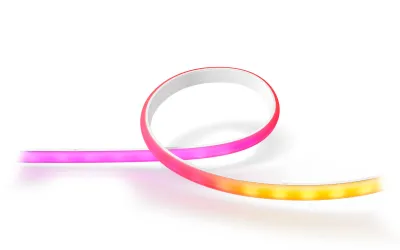
Behind every TV, there's a wall begging for better lighting. I've tested basic LED strips, budget Govee options, and standalone bias lights, but the Philips Hue Gradient Lightstrip exists in a different category entirely. This is the only consumer lightstrip I've used that can display multiple colors along its length simultaneously, creating smooth flowing gradients that basic strips simply cannot replicate. After four months behind my 65-inch TV, I can say without hesitation that the visual effect is genuinely impressive -- it's the kind of lighting that makes visitors ask how it works. The caveat, as with everything in the Hue ecosystem, is the price. By the time you have a full immersive setup with the Sync Box, you'll have spent more on lighting than many people spend on the TV itself.
Design & Build
The Gradient Lightstrip is physically well-constructed. The strip sits inside an opaque silicone sleeve that diffuses the LEDs into smooth color blending without visible hotspots or individual diode points. This is a meaningful step up from cheaper strips where you can see each LED as a distinct bright spot -- the diffusion here produces a professional, uniform glow that looks deliberate rather than DIY. The strip is flexible enough to bend around corners at up to 90 degrees, which matters for mounting along the edges of a TV where you need to navigate tight turns.
The adhesive backing is strong -- perhaps too strong. Once you've placed it, repositioning requires real effort, and you risk damaging the adhesive layer if you pull it off and reapply. I'd recommend dry-fitting the strip with painter's tape first to confirm your positioning before committing to the permanent adhesive. The 2-meter length fits most 55-65 inch TVs well, and Hue offers additional lengths and extensions for larger displays. The connector end and power cable are neatly designed, with a low-profile power adapter that doesn't demand excessive outlet space. Compared to the Govee Neon Rope Light or basic LED strips, the Gradient Lightstrip looks and feels like a premium product from the moment you unbox it.
Features
The gradient technology is the defining feature and the reason this strip costs what it does. Multiple individually addressable LED zones along the strip can display different colors simultaneously, creating smooth transitions that flow from one hue to the next. A single strip might display a warm amber on one end, transition through pink in the middle, and settle into deep blue on the other -- all blending seamlessly. This enables scene modes that basic single-color or even RGBIC strips cannot achieve. The Hue app includes dozens of pre-built gradient scenes, and creating custom gradients is intuitive through the scene editor.
The real showpiece feature requires the Hue Sync Box (sold separately at around $230), which analyzes your TV's HDMI signal in real time and translates the on-screen colors into corresponding lighting effects behind the TV. Watching a sunset scene in a nature documentary will wash your wall in warm oranges and golds. An action movie explosion triggers dynamic reds and yellows. It sounds gimmicky, but in practice the immersive effect is genuinely remarkable -- it extends the perceived screen size and pulls you into the content in a way that static backlighting never achieves. Gaming with the Sync Box is particularly impressive, with fast enough response times that the lighting feels connected to the action.
Full Hue ecosystem integration means the Gradient Lightstrip works with the Hue Bridge (required for anything beyond basic Bluetooth control of 10 lights in one room), HomeKit, Alexa, Google Home, Home Assistant, and the entire range of Hue accessories including dimmer switches, motion sensors, and tap dials. Scenes, schedules, and automations all work as expected. The Zigbee connectivity through the Hue Bridge is rock-solid -- I've never experienced a dropped connection or failed command in four months. This reliability is the quiet advantage of the Hue ecosystem that's easy to take for granted until you use a WiFi-dependent competitor that drops offline regularly.
Performance
Color reproduction is excellent across the spectrum. Reds are rich, blues are deep, greens are vivid, and the warm whites range from a cozy 2000K candlelight to a crisp 6500K daylight. The gradient transitions between colors are smooth and artifact-free -- there's no visible stepping or banding between zones. At 1800 lumens, the strip is bright enough to cast a strong wash of color across the wall behind a TV, which is exactly what you want for bias lighting and ambient effects. Brightness can be dimmed smoothly down to a subtle glow for nighttime viewing without any flickering.
When synced with TV content through the Sync Box, the responsiveness is impressive. There's a slight delay -- maybe 100-200 milliseconds -- between an on-screen color change and the corresponding lighting shift, but it's fast enough that the effect feels connected rather than lagging. For movies and TV shows, the sync is immersive and natural. For fast-paced gaming, the slight latency is occasionally perceptible but not distracting. Music mode reacts to audio through the Sync Box and creates dynamic light shows that, while not perfectly beat-synced, are visually engaging for ambient listening.
The Zigbee connectivity through the Hue Bridge deserves specific praise. Response times are essentially instant -- when I trigger a scene from the Hue app, the strip transitions within a fraction of a second. Reliability over four months has been flawless. Not a single dropped connection, not a single failed command, not a single instance of the strip being unavailable. After testing budget smart lights that disconnect weekly, the Hue system's reliability feels like a luxury. HomeKit integration is equally responsive, and Home Assistant picks up the strip as individual light segments for granular automation control.
Ease of Use
Installation is straightforward assuming you already have a Hue Bridge set up. Clean the back of your TV, plan your strip placement, peel the adhesive backing, and stick the strip along the edges. Connect the power cable, add it to the Hue app, and you're producing colorful light within fifteen minutes. If you're new to the Hue ecosystem and need to set up a Bridge first, add another ten minutes. The Hue app handles device discovery reliably and walks you through room assignment and initial configuration.
The Hue app is one of the best smart home apps available. Scene creation for the Gradient Lightstrip is particularly well-implemented -- you can pick colors for different zones along the strip, preview the gradient effect, and save custom scenes for quick access. The app is clean, logically organized, and mercifully free of the promotional clutter that plagues competing apps from brands like Govee. Rooms, zones, and automation creation are intuitive. The learning curve is gentle even for users who aren't technically inclined.
If you add the Sync Box for TV integration, setup complexity increases. The Sync Box sits between your HDMI source and TV, which means reconfiguring your entertainment center's cable routing. The Hue Sync app requires calibrating which lights correspond to which areas of the screen, and getting the intensity and responsiveness settings dialed in takes some experimentation. Once configured, though, it runs automatically -- turn on the TV and the sync starts. My wife, who has zero interest in configuring smart home devices, appreciates that the ambient lighting just works every time we watch TV without any manual intervention.
Value
The Philips Hue Gradient Lightstrip costs roughly $180-230 depending on the length, and that's just the beginning. A Hue Bridge runs $60 if you don't have one. The Sync Box for TV content matching is another $230. A complete immersive TV lighting setup -- strip, bridge, and Sync Box -- exceeds $450. If you want additional Hue Play light bars to supplement the effect on the sides of your TV, add $130 for a two-pack. A full premium setup can easily approach $600. That's an eye-watering amount of money for accent lighting.
For context, a basic bias lighting strip costs $15-20 and provides static white or single-color backlighting. A Govee RGBIC strip with multi-color capability runs $30-40. Even Govee's own TV backlighting kits with camera-based content sync cost around $70-100. The Hue Gradient setup costs four to six times more than the closest Govee equivalent. The question is whether the quality difference justifies the price premium.
Having used both budget and premium options, I'd say the Hue Gradient Lightstrip is genuinely better in every measurable way -- smoother gradients, more accurate colors, dramatically better reliability, superior app experience, and far more responsive sync performance. Whether "better" translates to "worth 4-6x the price" depends entirely on your priorities and budget. For a dedicated home theater where immersive lighting enhances every viewing session, the investment has felt worthwhile to me. For casual TV watching in a living room, basic bias lighting accomplishes 80% of the visual benefit at a fraction of the cost. The Hue Gradient Lightstrip is the best at what it does. Whether you need the best is a personal question.
Pros
- Stunning multi-color gradient effects
- Excellent build quality
- Seamless Hue ecosystem integration
- Great with Sync Box for immersive TV
- Reliable Zigbee connectivity
Cons
- Very expensive for a lightstrip
- Requires Hue Bridge
- Sync Box adds significant cost
- Overkill for basic backlighting needs
Final Grade
The Philips Hue Gradient Lightstrip produces lighting effects that nothing else in the consumer market can match. The multi-color gradients are smooth and vibrant, the build quality is excellent, the Zigbee connectivity through the Hue Bridge is perfectly reliable, and the TV sync experience with the Sync Box creates genuinely immersive ambient lighting that enhances movies, shows, and gaming. After four months, it remains the most impressive piece of smart lighting I own. But the cost is impossible to ignore. A complete immersive setup approaches $500-600, which is hard to justify for most households. If you're building a dedicated home theater or media room and want the best ambient lighting available, the Hue Gradient system delivers. For everyone else, basic bias lighting or a budget RGBIC strip provides most of the visual benefit at a fraction of the price. The Hue Gradient Lightstrip is outstanding -- and outstandingly expensive. Both things are simultaneously true.