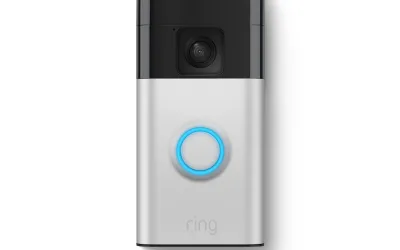
I wanted a battery-powered video doorbell without running wires to my apartment door, and the Ring Battery Doorbell Pro was the obvious candidate with its head-to-toe video and radar-powered motion detection. After five months of daily use, I can confirm the hardware is genuinely impressive -- some of the best video quality I've seen from any doorbell camera. But like every Ring product, the experience is hollowed out without a subscription, and Amazon's relentless push toward recurring revenue continues to leave a bad taste.
Ring dominates the video doorbell market for a reason: the app is polished, the ecosystem is deep, and the Alexa integration is seamless if you're already in Amazon's orbit. But dominance doesn't mean the business model deserves a pass. I've tested doorbells from eufy and Reolink that deliver solid video with local storage and zero monthly fees. Ring asks you to pay more upfront and then keep paying forever. That context matters throughout this review.
Design & Build
The Ring Battery Doorbell Pro is one of the better-looking doorbells I've tested. The slim, rounded profile sits flush against the mounting bracket without the bulky protrusion you get from some competitors. It comes in Satin Nickel, and optional faceplates let you customize the look -- a small touch, but appreciated when this thing is the first thing visitors see at your door.
The 1536p Head-to-Toe video uses a 1:1 aspect ratio that captures a much taller field of view than traditional 16:9 doorbells. In practice, this means I can see packages on my doorstep and a visitor's face in the same frame without any panning or cropping. The 150-by-150-degree viewing angle is wide enough to catch anyone approaching from the sides, and the image doesn't have the warped fisheye distortion that plagued older Ring models.
Build quality is solid -- the matte finish resists fingerprints, and after five months of exposure to rain, direct sun, and temperature swings, there's no discoloration or degradation. The quick-release battery pack is a smart design choice: you pop the battery out for charging without removing the entire doorbell from the mount. I keep a spare battery on the charger and swap them in about 30 seconds. Battery life runs roughly six to eight weeks depending on how many motion events you get and whether you use live view frequently. If you have existing doorbell wiring, you can hardwire it for continuous power, though the voltage requirements mean not all existing wiring will work.
Features
The headline feature is the 1536p Head-to-Toe video, and it genuinely delivers. The tall aspect ratio captures everything from the top of a visitor's head to packages sitting on the ground, which is exactly what you want from a doorbell camera. Bird's Eye View uses the built-in radar sensor to map motion paths on an overhead view of your property, showing you where a visitor came from before they reached your door. I found this surprisingly useful for understanding delivery driver routes and figuring out which neighbor's dog keeps triggering my alerts.
Color Pre-Roll captures a few seconds of video before the motion event actually triggers, so you get context on what happened leading up to the alert. Two-way audio with Ring's Audio+ noise cancellation is noticeably cleaner than the standard Ring doorbells -- street traffic and wind are reduced, making conversations actually intelligible rather than shouting matches.
But here's where it falls apart, and it's the familiar Ring problem: without Ring Protect ($3.99/month per device or $9.99/month for unlimited cameras), you lose video recording, event history, person detection, Bird's Eye View snapshots, and basically every feature that makes a video doorbell useful. Without the subscription, you're left with live view only -- you have to physically open the app at the exact moment someone is at your door to see them. No recording, no playback, no event timeline. It's a $230 doorbell that functions like a $30 peephole camera without the subscription.
Alexa integration is deep and genuinely useful if you have Echo devices. Motion announcements on Echo speakers, live view on Echo Show displays, and Alexa Greetings that can answer your door for you when you're busy are all well-implemented. Home Assistant integration exists through the Ring integration, but it's entirely cloud-dependent with noticeable latency -- commands take two to four seconds to execute, and there's no local API access. For a Home Assistant household, that's frustrating compared to devices with local control.
Performance
Video quality during the day is excellent -- among the best I've tested in battery doorbells. The 1536p resolution produces sharp, detailed images where you can clearly read text on packages and identify facial features from several feet away. HDR handling is competent, balancing bright sunlight and shaded porch areas without blowing out highlights. Night vision uses a combination of infrared and color night vision (when ambient light is sufficient), and the results are decent though not as crisp as the daytime footage.
The 3D Motion Detection with radar is a genuine step up from the PIR sensors used in cheaper Ring models. It accurately distinguishes between people walking up the driveway and cars passing on the street, which dramatically reduced my false alerts compared to the Ring Video Doorbell 4 I had previously. Motion zones are configurable, and the radar-based detection lets you set precise boundaries rather than the vague rectangular zones of PIR-based systems.
That said, alert latency remains an issue. From the moment someone presses the doorbell to when my phone buzzes, there's a delay of three to six seconds -- sometimes longer. This is a persistent Ring complaint across their entire product line, and it means I occasionally miss the first few seconds of a visitor interaction. The cloud-processing pipeline adds unavoidable delay that local-processing doorbells don't have.
Battery drain is moderate. With about ten to fifteen motion events per day plus occasional live views, I'm recharging every six to eight weeks. Heavy live view usage or a busy front door will drain it faster. WiFi connectivity has been stable on my 2.4GHz network, with no dropouts or disconnections over the testing period, though the initial setup required my router to be within about 25 feet for a reliable signal.
Ease of Use
Setup is straightforward and well-guided. Download the Ring app, create or sign into your account, charge the battery (takes about five hours from empty), mount the bracket with the included screws and anchors, snap the doorbell on, and connect to WiFi. The app walks you through each step with clear illustrations. Total setup time was about twenty minutes, not counting the initial battery charge. I mounted mine on a wooden door frame, but Ring includes a wedge kit for angled surfaces, which is a thoughtful inclusion.
The Ring app itself is well-designed and responsive. The timeline view of events is intuitive, live view connects within a few seconds most of the time, and adjusting motion zones and sensitivity is visual and easy to understand. My wife uses the app daily to check on deliveries and has never needed my help navigating it. The shared user feature lets multiple household members access the doorbell without sharing a single login, which is a basic feature but one that some competitors still get wrong.
Where the experience sours is the relentless upselling. Every interaction with the Ring app is peppered with prompts to subscribe, upgrade, or buy additional Ring products. Open the app? Banner ad for Ring Protect. Check a motion event? Prompt to upgrade your plan. Browse settings? Suggested accessories. It's exhausting and it cheapens what is otherwise a polished app experience. Ring's parent company Amazon clearly prioritizes subscription conversion above user experience, and it shows in every corner of the software.
Value
The Ring Battery Doorbell Pro retails for around $229.99. To actually use it as a video doorbell -- meaning to record and review footage -- you need Ring Protect Basic at $3.99/month or Ring Protect Plus at $9.99/month for the whole household. Let's do the honest math: in year one, you're paying $278 for a single doorbell with basic recording. Over three years, that's $374. Over five years, it's $470. If you have multiple Ring cameras (and the ecosystem is designed to push you toward that), the Plus plan at $120/year covers all of them, but that's still a significant ongoing commitment.
Compare that to the Reolink Video Doorbell WiFi at around $80-100 with local microSD storage and no subscription, or the eufy Video Doorbell Dual at around $160-200 with local storage and HomeBase. Yes, Ring's video quality is arguably better and the Alexa integration is deeper, but the eufy and Reolink options deliver complete functionality the day you buy them. You own what you paid for.
The subscription model fundamentally changes what you're buying. You're not purchasing a video doorbell -- you're purchasing the right to lease doorbell functionality on Amazon's terms, subject to price increases and feature changes at their discretion. Ring has already raised subscription prices once since launch. This is the direction the entire Ring product line has moved, and it's a significant reason I'm scoring value as low as I am despite the good hardware. The hardware deserves a B+. The business model deserves an F.
Pros
- Excellent head-to-toe video quality
- Easy battery-powered installation
- Good Alexa integration
- Polished app experience
- Bird's Eye View feature
Cons
- Subscription required for basic recording
- Expensive hardware plus ongoing fees
- Battery requires regular recharging
- Motion alerts sometimes delayed
- Amazon data collection concerns
- Aggressive upselling
Final Grade
The Ring Battery Doorbell Pro delivers genuinely excellent video quality, smart radar-based motion detection, and a polished app experience wrapped in hardware that installs in minutes without any wiring. If you evaluate it purely on technical merits, it's one of the best battery doorbells available. But I can't separate the hardware from the business model, and Ring's subscription-gated approach means you're buying an intentionally incomplete product that requires ongoing payment to function as advertised.
If you're already deep in Ring's ecosystem with a Protect Plus subscription and multiple Echo devices, the Battery Doorbell Pro is an excellent upgrade that takes full advantage of what you're already paying for. But if you're starting fresh and evaluating video doorbells on total cost of ownership and actual functionality out of the box, competitors like eufy and Reolink offer much better value without the subscription trap. The smart home market is slowly moving toward local processing and subscription-free models, and Ring is firmly on the wrong side of that trend.