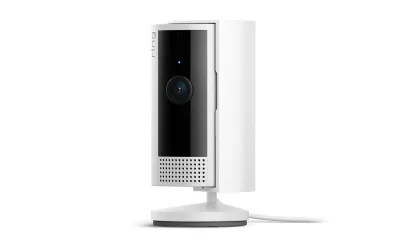
I picked up a Ring Indoor Cam (2nd Gen) about three months ago, mainly for peace of mind when my wife and I are away from the apartment. We wanted something simple to keep an eye on things -- check in on the cat, basic security. Three months later, I'm frustrated, and not because of the hardware. The Ring Indoor Cam is perfectly competent camera equipment that's been crippled by Amazon's subscription-first business model.
Without a Ring Protect subscription, this $60 camera can show you a live feed and literally nothing else. No recording, no event history, no meaningful notifications. It's a surveillance device that refuses to surveil unless you pay monthly rent on features that competitors include for free.
Design & Build
Credit where it's due: the physical design is genuinely good. The camera is compact -- noticeably smaller than the first generation -- and its clean white housing blends unobtrusively into most rooms. The swiveling mount lets you angle it in virtually any direction. Mine sits on a bookshelf pointed at our front door, and visitors rarely notice it.
The physical privacy shutter is the standout feature. Sliding it closed physically blocks the lens at the hardware level -- no software toggle, no trust required. When we're home and don't want recording, we close the shutter with certainty. Every indoor camera should include this.
Power comes via USB-C with a reasonably long cable, though placement depends on outlet proximity since there's no battery option. The camera snaps onto its mount magnetically -- easy to reposition but secure enough to survive our cat's investigations (tested extensively). Build quality is adequate without being exceptional, appropriate for a $60 product.
Features
The camera captures 1080p HD video with a reasonably wide field of view. Image quality is fine for indoor monitoring -- clear enough to see faces and identify what's happening. Color Night Vision maintains color accuracy in dim conditions instead of defaulting to black-and-white infrared. Two-way audio is clear enough for quick conversations.
Now for the feature that defines this product: Ring Protect. Without the $4/month per camera subscription ($10/month for unlimited cameras), the camera is reduced to live view only. No recorded clips, no event history, no person detection, no ability to save or share footage. You bought a security camera that has no memory of what happened five seconds ago.
Consider: someone breaks in while you're at work. Without a subscription, you have no footage. The camera saw it but recorded nothing because you hadn't paid Amazon's monthly fee. Over five years, you'll spend $240 in subscriptions on top of the $60 hardware -- $300 total for one indoor camera.
Alexa integration is solid -- "Alexa, show me the living room" on an Echo Show works within seconds. Motion-triggered announcements on other Alexa devices are useful. But ecosystem integration doesn't offset the fundamental problem. Competitors like eufy offer local storage with no subscription at similar prices. Wyze cameras include free cloud clips at $30. Ring's approach is a deliberate business decision to extract recurring revenue.
Performance
Setting aside the subscription issue, the camera performs well. Motion detection is responsive and accurate. Customizable motion zones reduce false alerts from areas with constant movement -- windows, ceiling fans. The sensitivity slider lets you find a sweet spot, and I settled on a middle setting that catches humans without constant cat notifications.
Pet detection is surprisingly good. Our cat triggers far fewer notifications than expected. When she does trigger one, it's usually something dramatic enough that I'd want to know -- jumping on counters, knocking things over. Human detection (subscription only) adds another filtering layer, but basic motion detection handles most scenarios.
Video streaming is quick -- live feed loads in 2-3 seconds. Night Vision switches automatically when light drops, producing clear footage even with just a nightlight. Quality degrades slightly in very low light but remains identifiable.
WiFi connectivity has been stable for three months with no dropouts. The camera sits about 30 feet from my router with one wall between them, and signal has never been an issue. Firmware updates apply automatically without disruption. The hardware is perfectly capable of being a good security camera -- Amazon's business model prevents it from being one without payment.
Ease of Use
Setup is genuinely easy. Download the Ring app, plug in the camera, scan the QR code, connect to WiFi. Five minutes total, including account creation. My wife set it up entirely on her own without asking a single question -- gold standard for consumer onboarding.
The Ring app is well-designed and intuitive. Live view launches quickly, settings are logical, and motion zone configuration is visual -- drag rectangles on the camera view. My wife checks the feed regularly with no difficulty.
Here's where ease-of-use praise stops: the aggressive upselling. The app constantly pushes subscriptions, additional devices, and monitoring upgrades. Open the app? Subscription banner. Check the timeline? A pitch to subscribe so you can actually see events. It feels less like a camera interface and more like a storefront with a video feed attached. For a product already paid for, this commercial pressure is obnoxious.
Privacy is also worth considering. All video processing happens on Amazon's servers. Your indoor camera feed passes through Amazon's infrastructure. Ring has had documented controversies including employees accessing customer feeds. The physical shutter helps when you're home, but when active, you're trusting Amazon with intimate footage of your living space.
Value
The Ring Indoor Cam costs $60, but that number is misleading. The true cost is $60 plus $48/year for as long as you own it, because without Ring Protect, you own a camera that cannot record. Over three years: $204. Over five years: $300. For one indoor camera.
The competitive landscape makes this painful. eufy Indoor Cam 2K costs $50 with local microSD storage -- no subscription, higher resolution. Wyze Cam v4 is $30 with free cloud clips. Reolink offers indoor cameras with local recording for $35-50. All of these do more for less money without ongoing fees.
The Ring Protect family plan ($10/month unlimited cameras) improves per-camera economics if you're outfitting multiple rooms. But this deepens the lock-in -- $120/year for permission to use cameras you've purchased. Stop paying, and every camera reverts to live-view-only simultaneously.
I regret not researching subscription-free alternatives before buying. The hardware is fine, the $60 price seems reasonable in isolation. But the subscription model transforms a purchase into a perpetual expense, and the camera is deliberately crippled without it. For anyone shopping fresh, eufy, Reolink, or Wyze offer equal or better hardware with local storage and no monthly fees.
Pros
- Compact design with physical privacy shutter
- Reliable motion detection with good pet filtering
- Excellent Alexa integration
- Easy setup and user-friendly app
Cons
- Subscription required for basic recording features
- No local storage option whatsoever
- Aggressive upselling throughout the app
- Cloud-dependent - Amazon sees everything
- Poor value compared to subscription-free alternatives
Final Grade
The Ring Indoor Cam (2nd Gen) is frustrating because the hardware is genuinely competent -- decent video, reliable motion detection, physical privacy shutter, easy setup. If it included local storage and basic recording, it would be a solid $60 recommendation. But it doesn't.
Without Ring Protect, you own a camera that shows live video and nothing else. No recordings, no history, no useful notifications. Competitors prove local storage and subscription-free recording are entirely possible at this price. Unless you're committed to the Ring ecosystem and accept paying $4+/month indefinitely, look elsewhere. The Ring Indoor Cam represents the worst trend in smart home products: hardware deliberately incomplete without a subscription.