I've been through the robot vacuum gauntlet. A Roomba that got stuck under furniture daily. A budget Ecovacs that mapped my apartment like a confused tourist. A mid-range Roborock that vacuumed well but had a mop that smeared dirty water around. Each one promised autonomous cleaning and delivered some version of supervised frustration. The Roborock S8 MaxV Ultra is the first robot vacuum I've owned that genuinely works as advertised. After four months in our two-bedroom apartment with mixed hardwood and carpet, I can count on one hand the number of times I've needed to intervene. That's not marketing copy -- it's my actual experience. The catch? It costs roughly $1,400-1,600, which is an enormous amount of money for a vacuum. But after years of wasting money on cheaper robots that disappointed, this one actually does the job it claims to do.
Design & Build
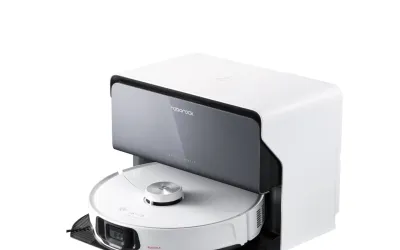
The S8 MaxV Ultra robot itself looks like most premium robot vacuums -- a circular disc about 14 inches in diameter and 4 inches tall, finished in dark gray with a LiDAR turret on top and dual cameras on the front bumper. It's not particularly distinctive visually, but robot vacuums aren't decorative objects. What matters is that it's low enough to fit under most furniture (my couch, bed frame, and TV stand all accommodate it) and the bumper design protects walls and furniture legs from scuffs during navigation.
The dock is where the design story gets interesting -- and complicated. The all-in-one RockDock Ultra handles automatic dust bin emptying, mop pad washing with hot water, mop pad drying with hot air, and water tank refilling from an onboard reservoir. It consolidates what would otherwise be four separate maintenance tasks into a single station. The trade-off is size: the dock occupies a footprint roughly 17 inches wide, 20 inches deep, and 18 inches tall. That's a substantial piece of equipment that needs a dedicated floor area, ideally against a wall near a power outlet. In our apartment, it lives in a corner of the living room, and while it's not exactly inconspicuous, the alternative -- manual mop cleaning, dust bin emptying, and water refilling -- is far more disruptive to daily life.
Build quality throughout is excellent. The robot feels solid and well-assembled, the dock materials are quality plastics with a matte finish that resists fingerprints, and every moving part -- the brush assembly, mop pad mechanism, dust bin -- clicks into place with satisfying precision. After four months of daily operation, nothing has worn out, cracked, or loosened. This feels like a product that was engineered to last, which is important given the investment.
Features
The feature list reads like a spec sheet from a product that's trying too hard, but in practice, every major feature here pulls its weight. LiDAR navigation creates accurate, multi-room maps on the first full cleaning run, and subsequent runs refine the map further. You can name rooms, set per-room cleaning preferences (suction level, mop intensity, number of passes), create no-go zones, and define invisible walls -- all through the Roborock app. The map accuracy is genuinely impressive. Our apartment layout, including furniture positions and doorway transitions between rooms, is represented with high fidelity.
ReactiveAI 2.0 obstacle avoidance uses the dual front cameras with AI processing to recognize and avoid common household obstacles. I've deliberately tested this by leaving shoes, charging cables, a dog bowl, a backpack, and (yes) a sock on the floor in the robot's path. It identified and navigated around all of them. The cameras recognize the object type and display it in the app's cleaning log, which is both useful and slightly unnerving. The obstacle avoidance isn't perfect -- very small or very dark objects can be missed -- but it's dramatically better than any robot vacuum I've previously used and eliminates the need to "robot-proof" your floors before a cleaning cycle.
The VibraRise 2.0 mopping system is a genuine innovation. The mop pad vibrates at high frequency for effective cleaning on hard floors, and when the robot encounters carpet (detected via ultrasonic sensors), the mop assembly physically lifts several millimeters to avoid dampening the carpet. This means you can vacuum and mop in a single pass across mixed-floor layouts without worrying about wet carpet edges -- a problem that plagued every previous mop-equipped robot I've tried. The dock's hot water mop washing and hot air drying prevents the mildew smell that manual mop cleaning often produces.
Smart home integration is solid. The Roborock app handles day-to-day control well, and the robot works with Alexa and Google Assistant for voice commands like starting, stopping, or sending the robot to specific rooms. Home Assistant integration through the Roborock component provides local control and enables automation triggers -- I have mine set to start a full clean when everyone leaves the house, detected via phone presence. The dual cameras also enable a remote video monitoring feature through the app, which I've used exactly once to check on the apartment while traveling. It works, though the camera angle (floor-level, wide-angle) provides a perspective that's more useful for checking on pets than security monitoring.
Performance
Cleaning performance is where the S8 MaxV Ultra justifies its existence. The 6,000 Pa suction combined with dual rubber brush rollers handles everything I've thrown at it -- crumbs, tracked-in dirt, pet hair from visiting dogs, cereal spills, and fine dust. The rubber brushes are a significant advantage over bristle brushes because they don't wrap and tangle with hair, which means I've never had to cut hair out of the brush assembly in four months. On carpet, the robot automatically increases suction to maximum, and the carpet edges come out visibly cleaner after each pass. On hardwood, the combination of vacuum and vibrating mop leaves floors noticeably clean -- the mop applies enough pressure and vibration to handle dried drips and light stains, though it won't replace a manual mop for heavy messes.
Navigation is precise and efficient. The S8 MaxV Ultra cleans in methodical parallel lines rather than random bouncing, covers the full floor area without missing spots, and transitions between rooms smoothly. In four months of near-daily operation, I've needed to rescue the robot from a stuck position exactly twice -- once when it wedged itself under a low shelf I've since added to the no-go zone, and once when a charging cable fell across its path and tangled in the brush. Both times were my fault, not the robot's. For context, my previous Roomba needed rescue three to four times per week.
Battery life comfortably covers our entire 900-square-foot apartment in a single charge with battery to spare. For larger homes, the robot returns to the dock to recharge and then resumes cleaning where it left off. The dock's auto-empty function activates after each cleaning session and is loud -- comparable to a handheld vacuum running for about ten seconds -- but it's brief and predictable. The mop washing and drying cycle runs quietly in the background and takes about two hours to complete, after which the pads are clean, dry, and ready for the next session. Noise during cleaning is moderate -- louder than a Roomba on standard mode but quieter than an upright vacuum. We usually run it while we're out, so noise isn't a practical concern.
Ease of Use
Initial setup requires about an hour of hands-on time, but it's well-guided. Unbox the dock (which involves removing a surprising amount of packaging), fill the clean water tank, add the cleaning solution, place the robot on the dock, and let it charge fully. The Roborock app walks you through WiFi connection and then prompts you to run a first mapping clean. This initial mapping run takes longer than subsequent cleanings because the robot is learning your layout, but once complete you have a detailed multi-room map that you can customize with room names, cleaning preferences, and zones.
The Roborock app is one of the better robot vacuum apps I've used. The map interface is clean and responsive, and setting per-room preferences is intuitive -- tap a room, adjust suction and mop intensity, set the number of passes, done. Creating no-go zones and virtual walls is a simple drag-and-draw operation. Scheduling is flexible -- you can set different rooms to clean on different days at different times, which is useful if you want the kitchen cleaned daily but the bedrooms only twice a week. The app does require an internet connection for most functions, which means there's a cloud dependency that privacy-conscious users should consider, though the robot will run scheduled cleanings offline once configured.
Day-to-day operation is where the S8 MaxV Ultra earns its keep. Once configured, it simply runs on schedule and handles its own maintenance. I check the dock's water reservoir and dust collection bag roughly every two weeks, and I've replaced the mop pads once in four months. That's the sum total of my ongoing involvement. My wife, who was skeptical of yet another robot vacuum after our string of disappointing ones, now considers it one of our best household purchases. The floors are consistently clean, and neither of us has to think about vacuuming or mopping anymore. That's the entire value proposition, and it delivers.
Value
At $1,400-1,600 depending on promotions, the Roborock S8 MaxV Ultra is one of the most expensive robot vacuums on the market. That's a significant investment by any standard -- you could buy a quality upright vacuum, a steam mop, and a basic robot vacuum for less than the S8 MaxV Ultra alone. The price demands justification, and whether it's justified depends entirely on how you calculate the value of your time and the cost of frustration with cheaper alternatives.
If you've been through the cycle of buying $300-500 robot vacuums that underperform -- getting stuck, missing areas, smearing dirty mop water, requiring constant maintenance -- the S8 MaxV Ultra breaks that cycle. It actually works. The cleaning is thorough, the navigation is reliable, the obstacle avoidance prevents the stuck-under-furniture problem, and the dock eliminates the manual maintenance that makes cheaper robots feel like more work than they save. Over a three-year lifespan, the cost works out to roughly $1.30-1.50 per day for a consistently clean home. For a dual-income household where time is scarce, that math works.
For budget-conscious buyers, Roborock's own lineup offers more affordable alternatives. The Roborock S8 provides excellent vacuuming at a lower price point with a simpler dock, and the Q-series models offer solid performance under $500. The S8 MaxV Ultra is the premium option for people who want the best available cleaning with the least possible maintenance. If that description fits your priorities and budget, this is the robot vacuum to buy. If $1,500 for a vacuum feels excessive regardless of the time savings, the lower tiers of Roborock's lineup -- or competitors like the Dreame L20 Ultra -- offer strong performance at lower prices with some trade-offs in autonomy and cleaning capability.
Pros
- Excellent cleaning performance
- Reliable obstacle avoidance
- Auto-mop lifting on carpet
- Self-maintaining dock
- Precise LiDAR navigation
- Good Home Assistant integration
Cons
- Very expensive
- Dock takes significant floor space
- App requires internet (no local control)
- Learning curve for optimal configuration
Final Grade
The Roborock S8 MaxV Ultra is the first robot vacuum I've owned that genuinely delivers on the promise of autonomous cleaning. After four months of near-daily operation in our apartment, it has required virtually no intervention. The LiDAR navigation maps accurately, the obstacle avoidance works on real household clutter, the VibraRise mop lifts cleanly off carpet, and the all-in-one dock handles dust emptying, mop washing, and drying without my involvement. The cleaning results are consistently good across both hardwood and carpet, and the dual rubber brushes eliminate the hair-tangling problem that plagues bristle-brush robots. The price is the unavoidable caveat. At $1,400-1,600, this is a premium purchase that demands either a high value on your time or a history of disappointment with cheaper alternatives (I had both). If you can afford the investment and want a robot vacuum that actually works without babysitting, the S8 MaxV Ultra is the one to buy. It earned back its price in reclaimed time and eliminated frustration within the first month.