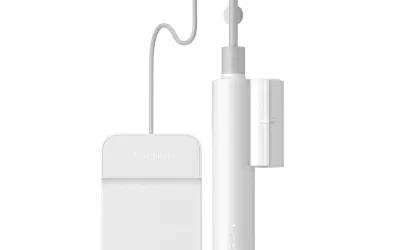
Motorized blinds are one of those smart home upgrades that sound fantastic in theory but price out most people in practice -- replacement motorized blinds can run $300 or more per window, and a house full of them becomes a small renovation project. The SwitchBot Blind Tilt takes a different approach: clip a small motor onto your existing horizontal blinds' tilt wand, and you've got smart-controlled light and privacy management for about $70. It's a clever, affordable idea that I genuinely wanted to love. After four months on two windows in my home office, I can report that it mostly works -- the motor tilts the blinds, the scheduling is useful, and the solar charging means I've never had to recharge the batteries. But "mostly works" is a loaded phrase in the smart home world, and the reliability inconsistencies, Bluetooth limitations, and calibration drift have tempered my enthusiasm considerably.
Design & Build
The SwitchBot Blind Tilt is a small, rectangular device that clips directly onto the tilt wand of standard horizontal blinds. At roughly 4.5 inches long, it's compact enough to be unobtrusive -- you'll notice it if you look for it, but it doesn't dominate the window the way a full motorized blind system would. Available in white and black to match common blind colors, my white units blend reasonably well with my white faux-wood blinds. The clip attachment mechanism is simple and secure, gripping the wand firmly without damaging it.
The integrated solar panel on the front face is a thoughtful design choice. Positioned on the outward-facing side where it catches daylight, the panel provides supplemental charging that, in my south-facing office windows, has kept both units running continuously without ever needing a USB-C recharge in four months. For windows that don't get direct sunlight, the rechargeable battery provides several months of operation on its own, with USB-C charging when needed. Build quality is acceptable -- the plastic housing feels durable if not luxurious, and the motor mechanism inside is well-protected from dust and debris. The overall aesthetic is unobtrusive enough that visitors don't notice the devices unless I point them out, which is exactly what you want from a retrofit smart home accessory.
Features
It's important to set expectations clearly: the Blind Tilt controls tilt angle only. It rotates your horizontal blinds between open and closed positions, with adjustable stops for any angle in between. It does not raise or lower blinds. For many use cases -- managing sunlight, maintaining privacy, reducing glare on screens -- tilt control is sufficient and arguably more useful than full raise/lower since you can maintain airflow while blocking direct sun. But if you need your blinds fully raised and lowered, this isn't the product for you.
Out of the box, the Blind Tilt operates via Bluetooth only, which means your phone needs to be within Bluetooth range (realistically about 20-30 feet through walls) to send commands. For remote access, voice assistant integration (Alexa, Google Assistant, Siri), and meaningful automation capabilities, you need the SwitchBot Hub 2 or Hub Mini -- sold separately at around $40-50. This is a common and frustrating pattern in SwitchBot's product line: the headline price gets you in the door, but full functionality requires additional purchases. With the hub, you gain WiFi connectivity, Matter support for HomeKit integration, and the ability to include the Blind Tilt in broader smart home routines.
The built-in light sensor is one of the more useful features. You can configure the blinds to automatically tilt based on ambient brightness -- closing when direct sunlight hits the window and opening when it passes. In my home office, this automatic light management genuinely reduces screen glare during afternoon sun without any manual intervention. Scheduling by time and sunrise/sunset offset is also available and works reliably through the hub. Home Assistant integration works via the SwitchBot API through the hub, enabling inclusion in more complex automations alongside other smart home devices. You can also group multiple Blind Tilt units for synchronized operation, which is useful for rooms with several windows.
Performance
When the SwitchBot Blind Tilt receives a command and executes it, the result is smooth and impressively quiet. The motor operates at under 40dB -- quieter than a typical conversation -- and tilts the blinds through their full range in about two seconds. Sitting at my desk while the blinds adjust themselves is a genuinely satisfying smart home moment. The light sensor automation, in particular, creates an almost magical experience when the blinds quietly tilt closed as the afternoon sun hits the window and then open again as the sun moves past.
The problem is the space between "receives a command" and "executes it." Reliability is inconsistent in ways that erode trust. Bluetooth commands from my phone fail maybe one in five times when I'm in the same room, and the failure rate increases significantly from an adjacent room. The command simply doesn't register -- no error message, no feedback, the blinds just don't move. With the Hub 2, reliability improves, but I still experience occasional missed commands, especially during periods where the Bluetooth connection between the hub and the Blind Tilt seems to drop momentarily. I'd estimate commands succeed about 90% of the time through the hub, which sounds high but means roughly one failure per day with regular use.
Calibration drift is the other persistent issue. The Blind Tilt establishes its "fully open" and "fully closed" positions during initial calibration, but these positions drift over time. After about three weeks, I noticed that what the app considered "closed" left the blinds slightly open -- not dramatically, but enough that privacy wasn't complete. Recalibrating takes about 30 seconds in the app, so it's not a major inconvenience, but needing to do it every few weeks is a reminder that this is a retrofit solution with inherent limitations compared to purpose-built motorized blinds. Temperature changes seem to contribute to the drift, likely because the tilt wand and mechanism expand and contract slightly with seasonal conditions.
Ease of Use
Installation is genuinely straightforward and is the strongest part of the Blind Tilt experience. Clip the device onto your tilt wand, open the SwitchBot app, add the device via Bluetooth, and run the calibration routine that establishes the open and closed positions. The entire process takes about ten minutes per blind, and the app guides you through each step clearly. You don't need any tools, drilling, or technical knowledge. Anyone who can operate a smartphone can install these.
The SwitchBot app is functional but cluttered. Finding the controls you need requires navigating through a busy interface packed with SwitchBot's broader product ecosystem, promotional banners, and community content. The actual Blind Tilt controls are simple -- a slider for tilt angle, schedule setup, and light sensor configuration -- but getting to them requires more taps than it should. Setting up automations through the app works but isn't as intuitive as competing platforms. The Hub 2 setup process adds another layer of configuration that, while not difficult, contributes to the overall complexity.
The real ease-of-use question is whether the automation justifies the setup and maintenance for your household. My wife's verdict is telling: after the initial novelty wore off, she found it easier to just tilt the blinds manually with the wand than to pull out her phone, open the app, wait for the Bluetooth connection, and send a command that might or might not work on the first try. The light sensor automation is the exception -- that runs independently without any user interaction and is the feature she actually values. For pure schedule-based and sensor-based automation, the Blind Tilt is convenient. For on-demand control, the friction of the app and Bluetooth connection often makes the manual alternative faster.
Value
At roughly $70 per unit, the SwitchBot Blind Tilt is dramatically cheaper than replacing horizontal blinds with motorized alternatives, which typically start at $200-300 per window for budget options and climb rapidly for brands like Lutron or Hunter Douglas. For a full house of eight windows, the SwitchBot approach costs around $560 plus the hub ($40-50), compared to $2,000+ for motorized replacements. That cost advantage is the Blind Tilt's strongest argument and the reason it exists.
The hidden costs, however, add up. The Hub 2 or Hub Mini is effectively mandatory for real smart home functionality -- without it, you're limited to Bluetooth control from the same room, which defeats much of the purpose. Each Blind Tilt unit requires occasional recalibration, which isn't costly in dollars but is in attention and patience. And the reliability inconsistencies mean you're trading some convenience for frequent minor annoyances. Compared to just tilting your blinds manually -- a task that takes approximately one second and has a 100% success rate -- the smart alternative introduces complexity and failure modes for an admittedly mundane task.
The value is strongest for specific use cases: managing sun glare on a home office monitor during the workday, maintaining privacy on a schedule, or integrating blind control into broader smart home routines where manual intervention isn't practical. For those scenarios, $70-110 per window (including hub cost spread across multiple units) is reasonable for the convenience gained. For general "wouldn't it be nice" automation of blinds you adjust once or twice a day, the math is harder to justify. The SwitchBot Blind Tilt occupies a niche that's narrower than its marketing suggests.
Pros
- Automates existing horizontal blinds
- Solar panel charging option
- Quiet motor operation
- Light sensor automation useful
- Much cheaper than blind replacement
Cons
- Tilt only - doesn't raise/lower
- Requires hub for full functionality
- Reliability is inconsistent
- Bluetooth range is limited
- Calibration drifts over time
Final Grade
The SwitchBot Blind Tilt is a clever retrofit solution that delivers on its core promise with meaningful caveats. The motor is quiet, the solar charging works well, and the light sensor automation is genuinely useful for managing sun glare and privacy without manual intervention. The price point makes motorized blind control accessible in a way that purpose-built alternatives cannot match. But four months of use has revealed the gaps between the concept and the execution. Bluetooth reliability is inconsistent, commands fail often enough to erode trust, and calibration drift requires periodic attention. The hub requirement for full functionality adds cost and complexity that the headline price doesn't advertise. For the specific use case of automated sun management in a home office -- which is how I use mine -- the Blind Tilt has earned its place. For general-purpose blind automation across a whole house, the inconsistencies would likely generate more frustration than convenience. It's a good idea that needs another generation or two of refinement to become a great product.