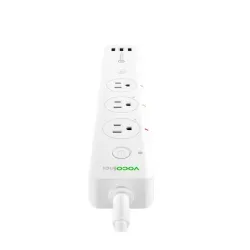
I bought the VOCOlinc VP3 smart plugs because I wanted HomeKit-compatible smart outlets without paying the premium that brands like Eve or Hue command. On paper, they checked every box: native HomeKit support, energy monitoring, Alexa and Google compatibility, all for under $25 per plug. After four months of daily use, the reality is more complicated. They work most of the time, but the cloud dependency that undermines HomeKit's local control promise has made me question whether cheap HomeKit accessories are worth the reliability trade-off.
The smart plug market is crowded with options at every price point, and HomeKit compatibility is the key differentiator for Apple households. The promise of HomeKit is local control -- your devices should work through your Apple Home Hub (Apple TV, HomePod, or iPad) without routing through a manufacturer's cloud server. That means faster response times, better privacy, and continued operation during internet outages. The VOCOlinc VP3 nominally supports this, but in practice, the implementation falls short of that promise in ways that matter.
Design & Build
The VP3 is a compact rectangular plug that inserts into a standard outlet without blocking the adjacent socket -- a basic requirement that a surprising number of smart plugs fail. The white plastic body matches standard wall plates, and the overall profile is slim enough that you can use both outlets in a duplex receptacle, though stacking two VP3s vertically is a tight fit. It's not the smallest smart plug I've tested (that honor goes to the Meross Mini), but it's well within acceptable dimensions.
A small status LED on the front indicates power state -- white when on, off when off. It's subtle enough not to be distracting in a bedroom but visible enough to confirm state at a glance. A physical button on the face provides manual on/off control, which is essential for those moments when your smart home system decides not to cooperate. I've used the physical button more often than I'd like, which foreshadows the reliability issues I'll discuss later.
Build quality is acceptable for the price point. The plastic doesn't creak, the prongs fit firmly in outlets without wobbling, and the internal relay clicks with a satisfying certainty when switching. There's nothing about the construction that raises safety concerns -- it's UL listed and the plug doesn't generate noticeable heat even under moderate loads. For a $20-25 smart plug, the physical design is perfectly competent. You won't mistake it for a premium product, but you also won't be embarrassed by it.
Features
The feature set looks strong on paper. Native HomeKit support means it appears in Apple Home without any bridge or additional hardware -- scan the HomeKit code on the plug, and it shows up in your Home app ready for automation, scheduling, and Siri voice control. It also supports Amazon Alexa and Google Assistant through the VOCOlinc app, making it one of the more platform-flexible smart plugs at this price point.
Energy monitoring is a genuine differentiator at under $25. The VOCOlinc app shows real-time power consumption in watts and cumulative energy usage in kilowatt-hours for each plug individually. I've used this to identify that my home office monitor draws 45 watts in use and 3 watts in standby, and that my coffee maker pulls 900 watts during brewing -- useful data for understanding energy usage and calculating costs. The energy data is accessible only through the VOCOlinc app, not through HomeKit, which limits its integration with Apple Home automations.
Here's where the feature set breaks down in practice: despite HomeKit support, these plugs require internet connectivity for reliable operation. HomeKit's architecture should allow your Apple Home Hub to control accessories locally over WiFi without any cloud involvement. In my testing, the VP3 plugs frequently become unresponsive in HomeKit during internet outages -- showing the dreaded "No Response" status even though my local network is functioning normally. This suggests the plugs are routing control through VOCOlinc's cloud servers even for HomeKit commands, which defeats one of HomeKit's primary advantages.
Home Assistant integration is available through the HomeKit Controller integration (local) or through cloud-based integrations, but the same cloud dependency issues affect reliability. For users building a local-first smart home on Home Assistant, a Shelly plug with native local API support is a fundamentally better architecture at a similar price point, even if it requires adding HomeKit support through the Home Assistant bridge.
Performance
When the plugs are working -- which is the majority of the time -- performance is acceptable. Commands from HomeKit execute in one to two seconds, voice commands through Siri take about the same, and scheduled automations trigger reliably. Energy monitoring readings update in near-real-time and appear consistent with my Kill A Watt meter's readings, within about 5% accuracy. For basic on/off control of lamps, fans, coffee makers, and similar devices, the VP3 does its job.
The reliability problems are intermittent but persistent. Over four months, I've experienced the "No Response" state in HomeKit approximately once or twice per week across three plugs. Sometimes it resolves itself within minutes; sometimes it requires power-cycling the plug (unplugging and replugging it) to restore connectivity. There's no obvious pattern -- it happens regardless of network load, time of day, or which plug is affected. The VOCOlinc app typically still shows the plugs as connected even when HomeKit reports them as unresponsive, which confirms the issue is in the HomeKit communication path rather than a WiFi connectivity problem.
During the two internet outages I experienced over the testing period (one planned maintenance, one ISP issue lasting about four hours), two of my three VP3 plugs became completely unresponsive through HomeKit. I could not control them via Siri, the Home app, or HomeKit automations. The physical button still worked, which prevented any real problems, but the whole point of smart plugs is remote and automated control. A truly local HomeKit device -- like the Eve Energy -- continues operating normally during internet outages because control routes through the Home Hub locally. The VP3's failure in this scenario is a fundamental architectural shortcoming.
One positive performance note: the plugs have been electrically reliable. No unexpected shutoffs, no overheating, no tripped circuits. The relay has handled my coffee maker's 900-watt inrush current without issue. The hardware works well; it's the software connectivity that lets the product down.
Ease of Use
Initial setup through the VOCOlinc app is straightforward. Download the app, create an account, plug in the VP3, and follow the pairing prompts to connect it to your WiFi network. The app then offers to add it to HomeKit, which involves scanning the HomeKit code printed on the plug's label. Total setup time was about five minutes per plug, and all three paired successfully on the first attempt. The process is simpler than many smart home devices I've configured.
The VOCOlinc app itself is adequate -- it handles device management, scheduling, energy monitoring, and firmware updates without any major usability issues. The interface is clean enough, though it lacks the polish of apps from larger companies. Energy monitoring data is presented clearly with daily, weekly, and monthly views. I'd rate it as functional but forgettable -- you'll spend most of your time controlling the plugs through HomeKit, Alexa, or Google rather than the native app.
Day-to-day usage in my household revolves around Siri and HomeKit automations. "Hey Siri, turn off the office lights" works reliably when the plugs are responsive, and HomeKit automations (turn on the coffee maker at 6:30 AM, turn off the desk lamp at midnight) execute as expected most of the time. My wife controls her reading lamp plug exclusively through Siri and the Home app, and she's noticed the occasional "No Response" moments -- her solution is to walk over and press the physical button, which works but defeats the purpose. For less technical household members, intermittent unresponsiveness creates distrust in the smart home system as a whole, which is worse than the momentary inconvenience of a single failed command.
Value
At $20-25 per plug, the VOCOlinc VP3 is competitively priced for a HomeKit-compatible smart plug with energy monitoring. The Eve Energy, which offers true local HomeKit control via Thread, costs $40-50. The Meross Smart WiFi Plug Mini runs $15-20 but lacks energy monitoring. On raw features per dollar, the VP3 looks attractive.
But value isn't just features divided by price -- it's about whether the product reliably delivers on its promises. The VP3's cloud dependency undermines the HomeKit local control that Apple users are specifically paying a premium for. If you wanted cloud-dependent smart plugs, you could buy Kasa or Tapo plugs for $10-15 each with excellent app experiences and rock-solid cloud reliability. The VP3 occupies an awkward middle ground: HomeKit-branded but not truly local, priced above commodity plugs but not delivering the reliability that justifies the premium.
For comparison, Shelly smart plugs cost $15-25 and offer true local control through their own API, MQTT, and Home Assistant integration. They don't natively support HomeKit, but if you're running Home Assistant, you can expose them to HomeKit through the HomeKit Bridge integration with genuine local control. It's more setup work, but the result is fundamentally more reliable. If you're an Apple-only household without Home Assistant, the Eve Energy at $40-50 with Thread support is the correct choice for reliable local HomeKit control -- it costs more, but it actually works the way HomeKit is supposed to.
The energy monitoring feature does add genuine value at this price point and is the VP3's strongest differentiator. If you primarily want to monitor power consumption of specific devices and the occasional HomeKit hiccup is tolerable, the VP3 delivers useful data for a reasonable price. Just go in with realistic expectations about reliability.
Pros
- Native HomeKit support
- Energy monitoring included
- Compact design
- Reasonable price
- Works with major voice assistants
Cons
- Cloud-dependent despite HomeKit
- Unreliable during internet outages
- Occasional HomeKit connectivity issues
- VOCOlinc app is mediocre
- Local control doesn't work as expected
Final Grade
The VOCOlinc VP3 is a mixed bag that illustrates the gap between HomeKit compatibility on a spec sheet and HomeKit reliability in practice. The hardware is fine, the energy monitoring is a useful feature at this price point, and when everything is working, the plugs perform their basic function without complaint. But the cloud dependency that causes intermittent HomeKit unresponsiveness -- especially during internet outages -- undermines the core value proposition of choosing HomeKit in the first place.
For casual smart home users who want basic scheduling and voice control and can tolerate occasional connectivity hiccups, the VP3 is an acceptable budget option. For anyone building a reliability-focused smart home where lights and appliances need to respond every time without fail, spend the extra money on Eve Energy plugs with Thread, or invest in Shelly plugs with Home Assistant for true local control. The VP3 taught me that with smart plugs, the cheapest HomeKit option isn't always the best value -- sometimes paying more for a product that actually works locally saves you far more in frustration.