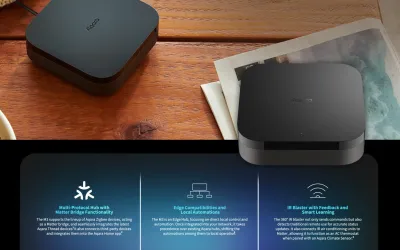
After being burned by cloud-dependent smart home products that turned into paperweights when companies pivoted or servers went down, I had a short list of requirements for my next hub: local processing, Matter support, and a Zigbee radio that could handle a growing device fleet. The Aqara Hub M3 checked every box on paper. Three months into daily use with over 30 connected devices, it's become the central nervous system of my smart home -- and one of the rare products where the reality lives up to the marketing. That said, the Aqara app experience holds it back from perfection, and prospective buyers should know what they're getting into.
Design & Build
The M3 is a compact rounded rectangle, roughly the size of a hockey puck, with a fabric-covered speaker grille on the front and an aluminum base that adds welcome heft. It looks more like a small Bluetooth speaker than a smart home hub, which is exactly what you want -- this thing sits on my living room shelf between a plant and a stack of books, and no visitor has ever identified it as the brains of my home automation. The matte white finish is understated and picks up minimal dust compared to the glossy plastic housings on competing hubs.
Build quality is a meaningful step up from Aqara's previous hubs. The aluminum base provides thermal mass for heat dissipation -- the M3 runs warm but never hot, even during heavy automation processing. Status LEDs on the front are subtle and configurable; I run mine dimmed to 20% brightness at night through an automation, and they're invisible from across the room. You can also disable them entirely if even a faint glow bothers you.
The back panel has a USB-C port for power (and mini-UPS support -- plug in a power bank for backup during outages), an Ethernet port with Power over Ethernet capability, and a reset button. I'm running mine over PoE through an Ethernet cable, which eliminates one power adapter from my already-crowded shelf. The PoE option is a thoughtful inclusion that most competitors skip, and it makes placement far more flexible since you only need a single cable run. The built-in speaker is loud enough for announcements and alarm sirens -- I tested it at the rated 95dB and it's genuinely attention-getting.
Features
The M3's killer feature is its role as a Matter bridge for Zigbee devices. Every Aqara sensor, switch, and controller connected to the hub gets exposed as a Matter device to any Matter-compatible controller -- Apple Home, Google Home, Samsung SmartThings, Amazon Alexa. This means my $15 Aqara door sensors show up natively in Apple Home without any workarounds, cloud dependencies, or Homebridge hacks. For anyone who's spent hours configuring Homebridge plugins to get Zigbee devices into HomeKit, this is transformative.
Local automation processing is the other headline feature. Automations configured in the Aqara app execute on the hub itself, not in the cloud. I've tested this by unplugging my router: motion sensor triggers still fire lights, door sensors still trigger alerts through the built-in speaker, and scheduled automations keep running. This is how smart home automation should work -- your lights shouldn't stop responding because your ISP is having a bad day. The edge computing approach also means lower latency; my motion-to-light automations execute in under 200 milliseconds consistently.
The built-in IR blaster is surprisingly capable. It's a 360-degree, two-way unit that both transmits IR commands and detects when conventional remotes are used, keeping device states synchronized. I'm using it to control my mini-split AC and living room TV, effectively turning dumb appliances into smart ones without any additional hardware. The hub can even function as an AC thermostat when paired with an Aqara temperature sensor, maintaining a target temperature by sending IR commands to your air conditioner.
Thread border router capability, support for up to 127 Zigbee/Thread devices, 8GB of encrypted local storage, and seamless hub migration from older Aqara hubs round out a feature set that's hard to match at any price. Home Assistant integration works through both the native Aqara integration and Matter, giving you flexibility in how you incorporate the hub into your broader automation stack. I'm running it alongside Home Assistant -- the M3 handles Aqara-specific automations locally while HA manages cross-platform orchestration.
Performance
Zigbee performance is excellent across the board. I have 34 Aqara devices connected -- a mix of door/window sensors, motion sensors, temperature sensors, smart plugs, and wall switches -- and response times are consistently fast. Sensor state changes propagate to the hub and trigger automations in under 200 milliseconds. My hallway motion sensor activates the light so quickly that the light is on before I've taken two steps past the sensor. Compared to my old SmartThings hub, where the same automation had a noticeable half-second delay, the improvement is dramatic.
The Matter bridge has been rock-solid. My Aqara devices appear in Apple Home and respond to commands within about 300-400 milliseconds -- slightly slower than native HomeKit devices, but well within acceptable range. I've had zero dropped devices or phantom "No Response" errors in three months, which is better than I can say for some native HomeKit accessories I've owned. The Thread border router functionality has also improved the responsiveness and reliability of my Eve Energy Thread devices by adding another border router to the mesh.
Uptime has been essentially perfect. In three months, the hub has required one restart -- after a firmware update that added new Matter device type support. Otherwise, it's been continuously operational. I monitor it through Home Assistant and the longest unresponsive period I've logged was about 8 seconds during that firmware update. The PoE connection eliminates the possibility of accidentally unplugging it, and I have a UPS on my network switch, so even during a brief power outage last month the hub kept running without interruption.
My one performance caveat: the IR blaster range tops out at about 8 meters with line of sight. My living room is large enough that the hub can't reach the TV mounted on the far wall. I had to reposition the hub to split the difference between the AC unit and the TV. This isn't a dealbreaker, but it's worth considering during placement.
Ease of Use
Initial setup through the Aqara Home app is straightforward: plug in the hub, create an Aqara account, scan the QR code on the bottom of the hub, and wait for it to connect to your WiFi or Ethernet. The whole process took about five minutes. Migrating my devices from an older Aqara Hub M2 was seamless -- the app transferred all device pairings and automations without requiring me to re-pair 30+ sensors one by one. This alone saved me an hour of tedious setup work.
Adding new Zigbee devices is simple: put the device in pairing mode (usually by holding a button for 5 seconds), and the hub discovers it within a few seconds. The app walks you through naming the device, assigning it to a room, and setting up basic automations. For Matter setup, you add the hub to your Matter controller (Apple Home, Google Home, etc.) by scanning the Matter pairing code, then select which Aqara devices you want to expose through Matter. It's a few extra steps compared to native Matter devices, but the process is clearly documented.
Now for the honest part: the Aqara Home app is functional but not beautiful. The navigation structure is confusing -- settings are scattered across multiple menus, automation creation requires more taps than it should, and some advanced features (like IR learning) are buried in places you wouldn't intuitively look. The app has improved significantly over the past year, but it still lacks the polish of Apple Home or even the Google Home app. My wife never opens the Aqara app; she interacts with everything through Apple Home, which is the entire point of the Matter bridge. For the technical user who sets things up, the app is tolerable. For household members who just want things to work, Matter pass-through to a friendlier interface is the answer.
Value
At around $130, the M3 is priced above basic Zigbee hubs like the SONOFF Zigbee 3.0 Dongle ($25-30) or the old SmartThings hub ($60-80). But comparing the M3 to those products misses the point. This is a Zigbee hub, Matter bridge, Thread border router, IR blaster, announcement speaker, and local automation processor in a single device. Buying those capabilities separately would cost significantly more and create a messy stack of single-purpose devices.
There are no subscription fees. No premium tiers. No features locked behind monthly payments. Local processing means you're not renting your automation from Aqara's cloud -- you own it. If Aqara shut down their servers tomorrow, your local automations would continue running on the hub. That's a value proposition that cloud-dependent systems like SmartThings or Amazon Alexa can't match.
The total ecosystem cost is worth considering too. Aqara's sensors and switches are competitively priced -- $15-20 for door sensors, $20-25 for motion sensors, $30-40 for wall switches. Building out a 20-30 device network with the M3 as the hub lands you in the $500-700 range for a comprehensive home automation system with local processing and Matter compatibility. That's exceptional value compared to going all-in on Thread/Matter native devices, which tend to run $30-50+ per sensor. For anyone building a serious smart home on a budget without sacrificing local control, the M3 is hard to beat.
Pros
- Excellent Matter bridge for Zigbee devices
- Local automation processing
- Thread border router built in
- IR blaster for AC/TV control
- Supports 128 Zigbee devices
- No subscription fees
Cons
- Aqara app could be more polished
- Premium price compared to basic hubs
- Setup has multiple steps for Matter
- Best with Aqara-branded devices (some third-party Zigbee works)
Final Grade
The Aqara Hub M3 is the Zigbee-to-Matter hub I'd recommend to anyone building a smart home in 2025 or beyond. Local automation processing gives you true ownership of your smart home -- no cloud dependency, no subscription fees, no risk of a company sunset killing your setup. The Matter bridge brings your Zigbee devices into every major ecosystem seamlessly, and the extras -- IR blaster, Thread border router, 95dB speaker, PoE support -- are genuinely useful additions rather than marketing bullet points. The Aqara app needs continued polish, and the learning curve for advanced features is steeper than it should be. But those are software complaints that can improve over time. The hardware foundation here is excellent, the protocol support is future-proof, and the price-to-capability ratio is outstanding. If you're investing in a Zigbee-based smart home and want Matter flexibility without compromise, the M3 is the hub to buy.