Design & Build
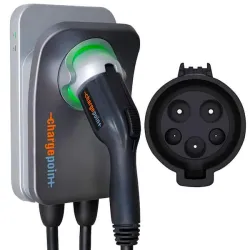
The ChargePoint Home Flex is a compact, wall-mounted unit that measures roughly 15 x 7 x 6 inches -- smaller than many competitors, which matters in a tight garage. The housing is a light gray plastic with the ChargePoint logo and a ring LED on the front that changes color to indicate charging status: blue for plugged in and ready, green for actively charging, and red for a fault condition. The LED ring is visible from across a two-car garage and provides instant status without checking the app.
Build quality is solid but not exceptional. The NEMA 4 rated enclosure handles indoor and outdoor installation, which means it can withstand rain, dust, and temperature extremes from -22°F to 122°F. The housing feels sturdy enough, though the plastic construction doesn't convey the same premium feel as the metal enclosures on the Wallbox Pulsar Plus or the Grizzl-E. For a charger that will likely be mounted in a garage and rarely looked at, this is a reasonable trade-off for weight savings and cost.
The 23-foot charging cable is one of the longest in the category and reaches comfortably to charge ports on both sides of a vehicle, even when parked nose-in. The cable itself is thick and well-insulated, rated for outdoor use, and stays flexible even in cold temperatures -- a real consideration if your charger is mounted outside or in an unheated garage. The J1772 connector has a satisfying click when it seats in the vehicle's port and a thumb release button that works smoothly.
My biggest design complaint is the lack of integrated cable management. The 23 feet of thick cable need to go somewhere when not in use, and ChargePoint doesn't include a hook or holster. You can buy third-party cable hooks, but this feels like an oversight on a charger at this price point. The Wallbox Pulsar Plus, by comparison, has a built-in cable wrap that keeps things tidy. The connector holster on the side of the unit works fine for parking the plug, but the cable itself just hangs or coils on the floor.
Features
The ChargePoint app is the primary interface for the Home Flex's smart features, and it's functional if not particularly polished. The headline feature is charge scheduling, which lets you set the charger to begin and end at specific times. This is critically important for EV owners with time-of-use electricity rates -- in many markets, off-peak rates (typically 9 PM to 6 AM) are 30-50% cheaper than peak rates. Scheduling your charging sessions to run during off-peak hours can save $20-40 per month depending on your driving habits and local rates.
Energy monitoring is built in and tracks electricity consumption per session, cumulative usage over time, and estimated cost based on your configured electricity rate. The data is presented in simple charts that show daily, weekly, and monthly trends. It's not as detailed as a dedicated energy monitor, but it provides enough information to understand your EV's impact on your electricity bill. You can also set charging reminders that notify you if the car hasn't been plugged in by a certain time -- useful for building the habit of plugging in every night.
The charger is compatible with Amazon Alexa for voice control, so you can start and stop charging sessions and check status by voice. There's no native Google Home or Apple HomeKit integration, which is disappointing. Home Assistant users can integrate it through the ChargePoint integration, but it requires some setup and doesn't expose all features. For a connected home device in 2026, the limited smart home ecosystem support feels like a gap.
ChargePoint's app also ties into their public charging network, which is a unique advantage. Your Home Flex charging history, energy usage, and costs are tracked alongside any public ChargePoint sessions, giving you a unified view of your total EV charging activity. If you travel frequently and use public ChargePoint stations, this consolidated tracking is genuinely convenient. The app also supports multiple vehicles and multiple Home Flex units if you have a multi-EV household.
Performance
Charging performance is where the Home Flex earns its reputation. At the maximum 50A configuration (which requires a 60A breaker and appropriate wiring), it delivers approximately 37 miles of range per hour of charging for most EVs. That's fast enough to fully charge a depleted 60 kWh battery overnight with time to spare, and it means you can top up meaningfully even with just a couple hours of plugged-in time.
The adjustable amperage is a genuinely useful feature that most budget chargers lack. If your electrical panel can't support a 60A breaker, you can set the Home Flex to draw 32A, 24A, or as low as 16A to match your available capacity. This is configured via rotary dial inside the unit during installation. It means you can buy the Home Flex now and use it at 32A, then upgrade your electrical panel later and bump it up to 50A without buying a new charger. That kind of future-proofing is worth paying for.
In six months of daily use, I've had zero failed charging sessions. The charger starts reliably every time the connector is plugged in, maintains consistent power delivery throughout the session, and stops cleanly when the vehicle signals a full battery. Temperature management is handled well -- the unit gets warm during extended 50A sessions but never hot enough to trigger thermal throttling in my climate-controlled garage. Outdoor installations in extreme heat may see the unit reduce amperage to protect itself, which is a safety feature rather than a flaw.
WiFi connectivity is the one performance weak spot. The Home Flex connects via 2.4GHz WiFi only, and the signal strength through my garage's drywall and insulation is marginal. I've had the app report the charger as offline several times, requiring an app restart or occasionally a breaker cycle to reconnect. The charger continues to function perfectly when WiFi drops -- it just charges without smart features. ChargePoint could improve this with a WiFi antenna upgrade or by adding a Bluetooth fallback for local control, but for now, strong WiFi coverage in your garage is a prerequisite for reliable smart features.
Ease of Use
Installation complexity depends entirely on which route you choose. The NEMA 14-50 plug option is the easier path -- if you already have a 240V outlet in your garage (common for electric dryers or welding equipment), you can literally plug it in and start charging in minutes. The app walks you through WiFi setup and initial configuration, and the whole process takes about 15 minutes from unboxing to first charge.
Hardwired installation is the recommended approach for the full 50A capability and is required in some jurisdictions. This means running a 6-gauge wire from your electrical panel to the charger location and connecting it directly. Unless you're comfortable with electrical work at this scale, you'll need a licensed electrician. Costs vary widely by region and panel location -- I paid $350 for my installation, which included a new 60A breaker and about 25 feet of conduit run. Some homeowners report paying $200 for simple installs or $800+ for panel upgrades.
The ChargePoint app handles day-to-day operation well. Starting a charge is automatic when you plug in (unless you've set a schedule), and the app shows real-time charging status, estimated completion time, and current power draw. The interface is clean but feels like it hasn't been updated in a while -- the fonts, icons, and navigation patterns feel circa 2022 compared to the more modern interfaces from Emporia and Wallbox. It works, but it doesn't delight.
Ongoing maintenance is essentially zero. There are no filters to clean, no moving parts to service, and firmware updates happen automatically over WiFi. The 23-foot cable is durable and the connector has held up well through daily use without any signs of wear on the contacts or the release mechanism. ChargePoint's 3-year warranty covers manufacturing defects, and their customer support has been responsive the one time I needed to reach out about a WiFi connectivity question.
Value
The ChargePoint Home Flex retails for around $549-599, which puts it at the upper end of the Level 2 home charger market. Compare that to the Emporia Smart Level 2 at $399, the Grizzl-E Classic at $399, or the Lectron V-Box at $349. You're paying a $150-250 premium for the ChargePoint name, the smart features, and the 50A capability. Whether that premium is justified depends on your priorities.
The smart scheduling feature provides tangible cost savings that can offset the price premium over time. If off-peak scheduling saves you $25/month on electricity compared to unscheduled charging, the additional cost pays for itself within 6-10 months. The energy monitoring helps you quantify these savings and optimize your charging habits further. For EV owners in markets with significant time-of-use rate differentials, this is the strongest argument for the Home Flex over a dumb charger.
The 50A capability is another value driver. Most budget chargers max out at 32A or 40A, which is fine for today's EVs but may feel slow as battery capacities increase. The Home Flex's 50A output delivers roughly 37 miles of range per hour -- enough to fully charge even the largest consumer EV batteries overnight. Buying a 50A charger now avoids the cost of upgrading later, though you will need the electrical infrastructure to support it.
Federal tax credits and local utility rebates can significantly improve the value equation. The Home Flex qualifies for the federal 30% EV charger tax credit (up to $1,000 for residential installations), which covers both the hardware and installation costs. Many utilities also offer rebates of $200-500 for smart EV charger installations. With these incentives, the effective cost of the Home Flex can drop below $300 -- at which point it's a no-brainer compared to any competitor. Check your local utility's rebate programs before purchasing.
Pros
- Adjustable amperage from 16A to 50A accommodates different electrical panel capacities
- ChargePoint app enables off-peak charging schedules that can save $20-40/month on electricity
- Works with every EV sold in North America via standard J1772 connector
- Built-in energy monitoring tracks charging costs and electricity consumption per session
- UL Listed and ENERGY STAR certified with a 3-year warranty
- NEMA 14-50 plug or hardwired installation options provide flexibility
Cons
- Price is $50-100 more than comparable Level 2 chargers from competitors
- Hardwired installation requires a licensed electrician, adding $200-500 to total cost
- WiFi connectivity occasionally drops and requires app restart to reconnect
- No built-in cable management -- the 23-foot cable can be messy without a separate hook
- App interface feels dated compared to newer EV charger apps from Emporia and Wallbox