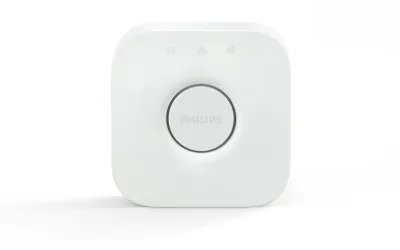
The Philips Hue Bridge has been sitting in my network closet for about eight months now, humming along behind a tangle of Ethernet cables. It was one of my first smart home purchases, and it shaped my expectations for what smart lighting should feel like -- instant, reliable, predictable. The Hue ecosystem earned its reputation for a reason.
But eight months has also given me perspective. As I've expanded with Thread devices, Home Assistant, and alternatives from Aqara, I've come to see the Hue Bridge less as a premium product and more as an expensive toll booth. The reliability is real. The ecosystem lock-in is equally real. And the pricing feels increasingly hard to justify as the industry moves toward open standards.
Design & Build
The Hue Bridge is a small white disc about the size of a coaster that you plug into your router and promptly forget about. There's not much to say about the design because invisibility is the entire point. It sits flat, generates no appreciable heat, and runs silently 24/7. Three small indicator LEDs provide status information that's helpful during setup but otherwise stays out of your peripheral vision.
The wired Ethernet requirement is both a strength and limitation. A wired connection means rock-solid communication without competing for WiFi bandwidth -- important since it's managing your entire Zigbee mesh. But it means the bridge must live near your router or wherever you have Ethernet access. My apartment was fine, but people in older homes without structured wiring sometimes need long Ethernet runs or powerline adapters.
Build quality is solid -- the plastic housing feels durable, and after eight months of continuous operation it shows zero wear or heat-related degradation. It's infrastructure, and it looks the part.
Features
The Hue ecosystem is mature and comprehensive. The bridge supports up to 50 lights and 12 accessories, using Zigbee Light Link to create a dedicated mesh network separate from your WiFi. This separation matters -- your lights don't compete with your Netflix stream for bandwidth, and the mesh self-heals around failed nodes.
What I appreciate most is the reliability. Tap a button, light changes. Trigger a scene, everything responds simultaneously. Set a sunset automation, it executes precisely. After experimenting with flaky WiFi bulbs early on, Hue's responsiveness felt like stepping from a dirt road onto a highway.
HomeKit integration is excellent -- the bridge exposes all lights to Apple Home without configuration, enabling Siri control and automations out of the box. I primarily control my Hue lights through Home Assistant, and that integration is equally smooth. The bridge also functions as a Matter controller, making connected devices visible to other Matter ecosystems.
The fundamental problem: it's a proprietary hub for a proprietary ecosystem. Want to add a $10 third-party Zigbee bulb? Not possible. Want to mix in an Aqara bulb at half the price? You need a separate coordinator. With Matter establishing cross-ecosystem compatibility, this closed approach feels like a relic designed to protect revenue.
Performance
Performance is where the Hue Bridge earns its reputation. Response times are essentially instantaneous -- well under 200ms from command to execution. In eight months of daily use, the system has never gone down unexpectedly, lost connection to a light, or failed an automation. Not once. That reliability sounds boring, but when lights are your most-used smart devices, boring is exactly right.
The Zigbee mesh handles my apartment without coverage concerns. Lights in every room respond consistently regardless of distance from the bridge. The mesh self-heals -- remove a routing node and it finds an alternative path within seconds. This resilience is a genuine advantage over WiFi systems.
Firmware updates happen automatically and have never caused problems. Maybe three updates in eight months, all seamless. Contrast this with products where firmware updates are an anxiety-inducing gamble -- Hue's process is refreshingly boring.
The 50-device limit is worth noting. For apartments and small houses, it's plenty. I'm at about 25 with headroom to spare. But power users in larger homes could hit this ceiling and face the complications of adding a second bridge.
Ease of Use
Setup is genuinely simple. Plug in Ethernet and power, download the app, press the big button on top. Adding bulbs: screw in, power on, the app discovers them. Ten minutes from unboxing to controlling your first light, mostly waiting for firmware updates. My wife can add and move lights without my help.
The Hue app organizes lights into Rooms and Zones that map naturally to how people think about their homes. Creating scenes is intuitive -- pick colors or temperatures, save with a name. Schedules and geofencing work as expected. For non-technical users, this is about as approachable as smart lighting gets.
Where I'd temper the praise is broader ecosystem integration. Running Hue alongside Home Assistant adds a management layer -- you're maintaining both systems. Automations can live in either, creating confusion about which controls what. I eventually moved all automations to Home Assistant and use the bridge purely as a Zigbee coordinator, but that took deliberate reorganization.
Voice control through Siri, Alexa, or Google Assistant is solid. "Turn off the bedroom lights" works reliably through all three. The bridge responds with zero delay, making voice commands feel natural rather than like issuing orders to a computer.
Value
Here's where my opinion takes a sharp turn. The bridge is around $60 -- tolerable for networking infrastructure. But it's just the entry fee. Hue color bulbs run $50+ each. White ambiance are $25+. A starter kit with bridge and four bulbs exceeds $200. Color bulbs throughout a living room and kitchen? Easily $400-500 just for lights.
This pricing was justifiable when Hue was the only reliable game in town. It isn't anymore. Aqara T2 Thread bulbs deliver comparable quality for roughly $20 each, no proprietary bridge required. Nanoleaf Essentials are similarly priced. Even within Zigbee, brands like Sengled offer quality bulbs at a fraction of Hue's prices.
The "you're paying for reliability" counterargument doesn't hold up anymore. I've had equally reliable experiences with cheaper alternatives through Home Assistant. My Aqara Thread bulbs haven't had a single dropout in six months. Hue's premium is largely brand tax at this point.
With Matter making proprietary bridges increasingly obsolete, I struggle to recommend new users buy into this expensive ecosystem. If you already own Hue products, the bridge is essential and does its job well. If you're starting fresh, spending $60 on a proprietary bridge plus $25-50 per bulb feels like paying for the past.
Pros
- Rock-solid reliability - commands always work
- Excellent app and ecosystem maturity
- Seamless HomeKit and Home Assistant integration
- Zigbee mesh is self-healing and responsive
Cons
- Absurdly expensive bulbs and accessories
- Proprietary ecosystem locks you in
- Requires wired Ethernet connection
- Limited to 50 lights
- Increasingly obsolete as Matter matures
Final Grade
The Philips Hue Bridge delivers on reliability -- eight months of flawless operation, instant commands, self-healing Zigbee mesh. The app is approachable, and integrations with HomeKit, Home Assistant, and voice assistants are well-implemented. As smart home infrastructure, it's excellent.
But the ecosystem it represents has a pricing problem. You're paying 2-3x more per bulb than alternatives for the privilege of proprietary lock-in, at a time when the industry is moving toward open interoperability. If you already own Hue products, the bridge is essential. If you're starting fresh, Thread/Matter alternatives deliver the same reliability without the premium or the lock-in. The Hue Bridge is the best version of a product category that's becoming obsolete.