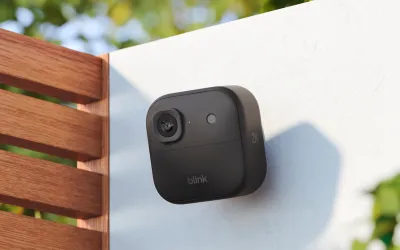
The Blink Outdoor 4 occupies the budget end of the outdoor security camera market with a straightforward pitch: reliable home monitoring at a price point that makes it accessible to almost anyone. At roughly $79.99 for a single camera (and significantly less per unit in multi-camera bundles), it undercuts virtually every name-brand competitor. The trade-off is clear from the spec sheet — 1080p video in a world that has moved to 2K and 4K, and a feature set that prioritizes simplicity over sophistication.
We deployed the Blink Outdoor 4 alongside premium cameras from Arlo, Ring, and Google over a five-week testing period, monitoring the same areas simultaneously to provide direct comparisons. The goal was to answer a question that many budget-conscious shoppers ask: is the Blink Outdoor 4 good enough? The answer, as with most budget products, depends entirely on your expectations and what compromises you are willing to accept.
Design & Build
The Blink Outdoor 4 is one of the smallest outdoor security cameras on the market, measuring just 2.8 x 2.8 x 1.4 inches. It is a compact square with rounded corners, finished in matte white plastic with a black camera lens area on the front. It does not look like much — and that is actually an advantage. Mounted under an eave or on a fence post, the Blink Outdoor 4 is discreet enough that most visitors will not notice it, which can be desirable depending on your monitoring philosophy.
The included mounting bracket attaches to any flat surface with two screws and allows basic tilt adjustment. It is functional but bare-bones — there is no ball joint, no magnetic mount, and no quick-release mechanism. Once you find the right angle, you tighten a thumbscrew and leave it. The camera detaches from the mount with a press-and-slide motion for battery changes. Build quality is adequate for the price. The plastic shell does not feel premium, but it carries an IP65 weather resistance rating and survived five weeks of outdoor exposure including heavy rain and temperatures down to 20°F without issues.
The battery compartment on the back houses two AA lithium batteries (included in the box). The compartment cover is secured with a small screw, which adds a minor theft-deterrent element and prevents accidental opening. Using standard AA batteries is one of the Blink Outdoor 4 strongest design decisions — when the battery dies two years from now, you replace it with batteries available at any store for a few dollars, rather than charging a proprietary battery pack or buying an expensive replacement.
The Sync Module 2 is a separate device that plugs into a USB power adapter and connects to your router via Wi-Fi. It serves as the communication bridge between your Blink cameras and the cloud, and it provides a USB-A port for local storage on a flash drive. The module itself is small and unobtrusive, but it is an additional piece of hardware that needs to live near your router and occupy a power outlet.
Features
The Blink Outdoor 4 takes a minimalist approach to features, which is both its strength and its limitation. Without any subscription, you get live view on demand, two-way audio, motion-triggered alerts, and the ability to record clips to local storage via the Sync Module 2 USB port. That baseline is more generous than what Arlo or Ring offer without a subscription, and for many users, it is genuinely all they need — clip recording and alerts without monthly fees.
The Blink Subscription Plan ($2.99/month per camera or $9.99/month for unlimited cameras) unlocks cloud storage for the past 60 days, person detection, and the ability to share clips easily. Person detection is the most meaningful addition — without it, you get alerts for every motion event including cars, animals, and tree branches. With it, you can filter alerts to only notify you when a person is detected. The accuracy is reasonable but not as refined as the AI detection on Arlo or Google cameras. We saw occasional false negatives where a person walking quickly through the edge of the frame was classified as general motion.
Smart home integration is limited to Amazon Alexa, which is expected given that Amazon owns Blink. You can view the live feed on Echo Show devices and Fire TV, arm and disarm the system with voice commands, and include Blink cameras in Alexa routines. There is no Google Home, Apple Home, or SmartThings support. If you are not in the Alexa ecosystem, the Blink Outdoor 4 is a standalone system managed entirely through the Blink app.
The Sync Module 2 supports up to 10 Blink cameras, which makes it cost-effective for multi-camera setups. A USB flash drive (not included) plugged into the module provides local storage without any subscription fees. Clips are saved automatically and can be viewed in the Blink app or by removing the flash drive and accessing the files directly. The module also enables a feature called Local Storage Only mode, which prevents any video data from reaching Amazon's cloud — a meaningful privacy option for users who want monitoring without cloud dependency.
Performance
Let us address the elephant in the spec sheet: 1080p video in 2026 is below the standard set by most competitors. The Arlo Pro 5S shoots 2K, the Ring Stick Up Cam Pro does 1080p HDR with significantly better processing, and several sub-$100 cameras from Reolink and Eufy now offer 2K or even 4K resolution. The Blink Outdoor 4 captures acceptable 1080p footage that is perfectly adequate for seeing what is happening in your yard but noticeably soft when you try to zoom in on details like faces or license plates at a distance.
In well-lit daytime conditions, the image quality is decent. Colors are reasonably accurate, exposure is handled competently, and there is enough detail to identify people you know and general activity in the scene. Where it falls short is in challenging lighting — high-contrast scenes with bright sky and deep shadows tend to lose detail in one or both extremes. There is no HDR processing to speak of, so you get a flat exposure that favors the highlights.
Night vision uses infrared LEDs and produces the expected grayscale image. Range is adequate to about 20 feet, with detail dropping off noticeably beyond that. There is no color night vision option and no integrated spotlight on the base model (the Blink Outdoor 4 Floodlight variant adds this at a higher price). The infrared image is serviceable for confirming that someone is in your yard but will not help you identify a stranger in most cases.
Motion detection is basic but reliable. The camera uses a passive infrared (PIR) sensor rather than pixel-based motion analysis, which means it detects heat signatures from people and animals effectively but can miss vehicles at a distance since they produce less concentrated heat. Detection range is about 20 feet, and sensitivity is adjustable across a 1-9 scale in the app. We found a setting of 5-6 to be the sweet spot for front-yard use — low enough to ignore distant cars and pedestrians on the sidewalk, high enough to catch anyone approaching the house. Motion zones are available to further refine trigger areas.
Ease of Use
Setup begins with the Sync Module 2, which you connect to power, link to your Wi-Fi network via the Blink app, and register to your Amazon account. Once the module is online, adding cameras is quick — you scan a QR code on the back of each camera, and the app pairs it to the module within about 30 seconds. The entire process for one camera and the Sync Module took us about 8 minutes. Adding additional cameras takes about 2 minutes each.
The Blink app is surprisingly clean and intuitive for a budget product. The home screen displays thumbnail previews from each camera, and tapping one opens the live view. Settings are organized logically, with motion detection sensitivity, clip length, retrigger time, and activity zones all accessible without excessive menu diving. The app loads quickly and live view connects in about 3-4 seconds, which is faster than several more expensive competitors we have tested.
Battery management is essentially a non-issue, which is one of the Blink Outdoor 4 strongest practical advantages. The camera uses two AA lithium batteries that Blink rates for 2 years of use, and in our testing, the battery indicator has not moved from full after five weeks of moderate use (8-12 events per day). Real-world reports from long-term users consistently confirm 18-24 months of battery life, which means you install the camera and essentially forget about it until you get a low-battery notification two years later. This is dramatically better than the 3-6 month recharge cycles of most battery-powered competitors.
Physical installation is simple but basic. The two-screw mount works on wood, vinyl siding, stucco, and brick (with included anchors). There is no adhesive option and no tool-free mounting system. You need a drill, a screwdriver, and about 5 minutes per camera. The limited tilt adjustment means you should plan your mounting location carefully — you cannot make dramatic angle changes after installation without remounting the bracket.
Value
Value is the Blink Outdoor 4 defining characteristic, and it delivers on that front convincingly. At $79.99 for a single camera or $179.99 for a three-pack (roughly $60 per camera), it is the most affordable name-brand outdoor security camera available. When you factor in the subscription-free local storage via the Sync Module 2 ($34.99 separately or included in starter kits), the total cost of ownership over three years is dramatically lower than any competitor.
Consider the math: a three-camera Blink Outdoor 4 system with the Sync Module 2 and a USB drive for local storage costs about $200 total with no recurring fees. A comparable three-camera Arlo Pro 5S system costs $540 for hardware plus $215/year for the Arlo Secure unlimited plan — over $1,180 over three years. Even the budget-priced Ring Stick Up Cam Battery at $99.99 per camera plus $100/year for Ring Protect Plus adds up to $600 for three cameras over three years. The Blink system costs $200. Period.
The question is what you give up for that savings. The answer is 2K resolution, advanced AI detection without a subscription, color night vision, broad smart home platform support, and the build quality and polish of premium devices. For a single camera monitoring your front door where you need clear facial identification of strangers, those trade-offs may be too significant. For covering your backyard, side gate, garage, and driveway — locations where you primarily need to know that something happened rather than identify exactly who — the Blink Outdoor 4 is more than adequate.
The 2-year battery life adds hidden value that is easy to overlook. Not having to climb a ladder every 3-4 months to recharge a camera battery is worth real money in convenience and avoided frustration. And when the batteries do eventually die, a pack of AA lithium cells costs about $8. There is no proprietary battery to source and no risk of the manufacturer discontinuing the battery format. For budget-conscious buyers who want reliable outdoor monitoring at the lowest possible total cost, the Blink Outdoor 4 is the obvious recommendation.
Pros
- Exceptional 2-year battery life on two AA lithium batteries — best in class
- Extremely affordable, especially in multi-camera bundles
- Subscription-free basic features including live view, two-way audio, and motion alerts
- Local storage available via USB on the Sync Module 2 — no cloud fees required
- Compact, lightweight design is easy to mount almost anywhere
Cons
- 1080p resolution looks soft compared to 2K and 4K competitors
- Person detection requires a Blink Subscription Plan ($2.99/mo per camera)
- Blink Sync Module 2 required — cannot operate standalone on Wi-Fi alone
Final Grade
The Blink Outdoor 4 is the best budget outdoor security camera available in 2026, and it is not particularly close. The combination of a sub-$100 price, 2-year battery life on standard AA batteries, and subscription-free basic operation makes it uniquely accessible. Local storage via the Sync Module 2 eliminates recurring cloud fees for users who want simple, no-cost monitoring after the initial purchase.
The limitations are real but proportional to the price. The 1080p video lacks the sharpness of 2K competitors, person detection is locked behind a subscription, and the Sync Module 2 requirement adds a step to setup. If you need crystal-clear facial recognition, advanced AI detection, or integration with Apple Home, look elsewhere. But if you need reliable motion-triggered recording across multiple outdoor locations without breaking the bank, the Blink Outdoor 4 delivers exactly what it promises — and the battery life alone makes it worth considering even if your budget allows for more expensive options.