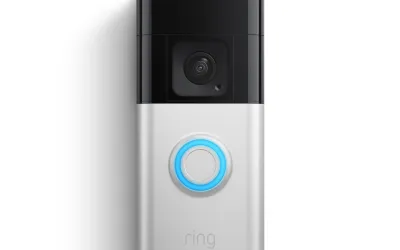
The Ring Video Doorbell 4 sits in a weird spot in Ring's lineup. It's not the budget pick -- that's the Ring Video Doorbell (2nd Gen) at $100. It's not the premium flagship -- that's the Video Doorbell Pro 2 at $250. At $150 with a rechargeable battery, it's the "just right" option for people who want better video than the base model but don't want to deal with hardwiring.
I've been running one on my front door for about eight months, through a humid summer and a cold winter. It's done its job reliably, if not spectacularly. The Ring Video Doorbell 4 is a competent doorbell camera that does exactly what you expect -- no more, no less -- and charges you a subscription to unlock the features that actually make it useful.
Design & Build
The Ring Video Doorbell 4 is a tall, slim rectangle with a satin nickel finish that blends in on most door frames. It's noticeably larger than the Ring Pro 2 but smaller than the original chunky Ring doorbell. At 5.1 x 2.4 x 1.1 inches, it protrudes from the wall about an inch -- visible but not obnoxious.
Build quality is solid. The plastic housing feels weather-resistant and durable, and the faceplate is swappable if you want a different color. Ring sells faceplates in a few finishes to match your door hardware. The camera lens sits behind a slightly recessed bezel that helps reduce glare, and the button is a large, clearly visible circle at the bottom that lights up when pressed.
The removable battery pack is the best design decision here. Pop the faceplate off, slide out the battery, charge it inside via USB-C, and slide it back in. No need to unmount the entire doorbell. Ring also sells a spare battery ($30) so you can hot-swap without any downtime. If you have existing doorbell wiring, the Doorbell 4 will use it to trickle-charge the battery, effectively making it a wired doorbell with battery backup.
The included angle mount and wedge kit handle most installation scenarios. Corner mount? Covered. Need to angle it away from a sidewalk? Covered. The mounting hardware is thoughtful and well-designed, which is something Ring has always done well.
Features
The Ring Video Doorbell 4's feature set is decent on paper but frustrating in practice because the most useful features are locked behind the Ring Protect subscription. Without the $4/month Basic plan (or $10/month Plus), you get live view and real-time notifications. That's it. No video recording history, no person detection, no package alerts, no rich notifications with snapshot previews.
With the subscription, you unlock 180 days of cloud video history, person and package detection, snapshot capture every 30 seconds to 15 minutes, and the ability to share and download clips. The Plus plan adds 24/7 professional monitoring, cellular backup, and extended warranty for all Ring devices at your location.
Ring's Alexa integration is excellent if you're in the Amazon ecosystem. "Alexa, show me the front door" on an Echo Show instantly pulls up the live feed. Motion announcements on Echo speakers tell you when someone's at the door without needing to check your phone. You can set up Alexa Routines that trigger lights or other smart home actions when the doorbell detects motion.
What's missing is broader smart home compatibility. There's no HomeKit support, no native Google Home integration, and no local API for Home Assistant. Ring operates as a walled garden within the Amazon ecosystem. If you're invested in Alexa and Ring Alarm, everything works beautifully together. If you use anything else, you'll need third-party workarounds that can break with any firmware update.
Linked recording with other Ring cameras is a nice touch -- when one camera detects motion, nearby Ring cameras start recording too, giving you multiple angles of the same event. But again, this requires the Plus subscription.
Performance
Video quality is adequate at 1080p with HDR. Daytime footage is clear with accurate colors and enough detail to identify faces at about 15 feet. The 160-degree field of view is wide enough to cover a standard porch without the extreme fisheye distortion you get from some competitors. Night vision uses infrared LEDs and produces grainy but usable black-and-white footage -- good enough to see who's there, not good enough to read a license plate across the street.
Here's the thing: 1080p was fine three years ago. In 2026, when the Arlo Essential 2K and Google Nest Doorbell offer significantly sharper video at similar price points, 1080p feels like Ring is holding back. You can still identify people and packages clearly, but side-by-side with a 2K doorbell, the difference is noticeable, especially when zooming in on recorded footage.
The Pre-Roll feature is the Doorbell 4's most compelling upgrade over the base model. It captures a low-resolution black-and-white snapshot of the 4 seconds before the motion event triggered, giving you context for what happened. Was that person walking toward your door or away from it? Pre-Roll tells you. It's not full HD video -- it's essentially a slideshow of snapshots -- but it fills a genuine gap that other battery doorbells still struggle with.
Motion detection is configurable with adjustable zones and sensitivity. Out of the box, it was triggering on every car driving past my house. After spending 10 minutes tweaking the motion zones and setting sensitivity to medium, false alerts dropped by about 80%. Person detection works well but requires a Ring Protect subscription -- without it, you get all motion alerts with no filtering, which defeats the purpose of having a smart doorbell.
Two-way audio is clear enough for brief conversations. There's a slight delay of about 1-2 seconds, which makes natural conversation awkward but works fine for telling a delivery driver to leave the package. The Quick Replies feature lets you send pre-recorded messages without picking up, which is surprisingly useful when you're in a meeting and the doorbell rings.
Ease of Use
Installation is genuinely easy and Ring includes everything you need in the box: mounting bracket, screws, wall anchors, a drill bit, a level, and even a screwdriver. The app walks you through each step with clear illustrations. From unboxing to a working doorbell took me about 20 minutes, and that included drilling into brick with the included masonry bit.
The Ring app is well-designed and responsive. The home screen shows a snapshot from each camera, and tapping into a device gives you live view, event history, and settings. Motion zone configuration is intuitive -- you draw zones on a bird's-eye view of your camera's field of vision and assign sensitivity levels. The timeline view of events makes it easy to scrub through a day's activity.
Battery management is straightforward. The app shows remaining battery percentage and sends a notification when it drops below 20%. A full charge takes about 5-6 hours via the included USB-C cable. In moderate weather (60-80°F), I get about 6-8 weeks per charge with moderate traffic (15-20 motion events per day). In winter (below 40°F), that drops to 4-5 weeks as the battery chemistry slows down.
Firmware updates happen automatically and I haven't experienced any update-related issues in eight months. WiFi connectivity has been solid on my 5GHz network -- the Doorbell 4's dual-band support is a real upgrade over older Ring models that were 2.4GHz only and constantly dropped connection.
Value
This is where the Ring Video Doorbell 4 stumbles. The $150 hardware price is reasonable for what you get, but the ongoing subscription cost changes the math significantly. At $4/month for Ring Protect Basic, you're paying $48/year just to access your own doorbell's video history and smart detection features. Over three years, that's $144 in subscriptions on top of the $150 hardware -- nearly $300 total.
Compare that to the Google Nest Doorbell (battery) at $130 with 3 hours of free cloud event history and on-device person detection that works without a subscription. Or the Arlo Essential 2K at $130 with 2K resolution, a free 30-day cloud trial, and local storage via USB on the Arlo base station. Both offer meaningful functionality without mandatory recurring fees.
The value equation improves if you're already paying for Ring Protect Plus ($10/month) for a Ring Alarm system, since that plan covers unlimited Ring cameras at your address. In that scenario, the Doorbell 4 is essentially a $150 add-on to your existing security setup with no additional subscription cost. That's a much better deal and honestly the only context where Ring's pricing makes real sense.
For someone buying their first and only smart doorbell with no existing Ring ecosystem, the subscription requirement makes competitors more attractive. You're paying more over time for a 1080p camera when rivals offer higher resolution and more free features out of the box.
Pros
- Pre-Roll video capture fills in the 2 seconds before motion triggers
- Quick Replies let you respond without picking up your phone
- Battery is removable and swappable without unmounting
- Dual-band WiFi for more reliable connectivity
- Easy DIY installation with included tools
- Integrates tightly with the broader Ring/Alexa ecosystem
Cons
- Requires Ring Protect subscription ($4/mo) for video history and person detection
- 1080p resolution feels dated when competitors offer 2K
- No local storage option -- everything goes through Ring cloud
- Battery life drops significantly in cold weather
- No HomeKit, Google Home, or Home Assistant support without workarounds
Final Grade
The Ring Video Doorbell 4 is a reliable, well-built doorbell camera that does its core job without drama. Pre-Roll video capture is a genuinely useful feature, the removable battery design is convenient, and installation is as easy as it gets. If you're already in the Ring and Alexa ecosystem with a Ring Protect plan, it's an easy recommendation -- just add it to your existing setup and move on.
But if you're starting fresh, the value proposition is harder to defend. The 1080p resolution is showing its age, the subscription requirement for basic features like video history feels increasingly out of step with competitors, and the Amazon-only ecosystem lock-in limits your future flexibility. The Ring Video Doorbell 4 is a safe, competent choice -- it just isn't the exciting one anymore.