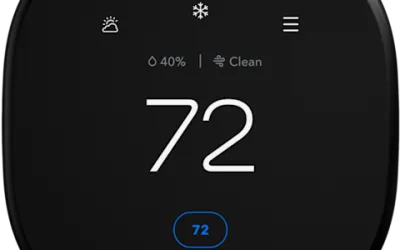
I installed the ecobee Smart Thermostat Premium about seven months ago, replacing a basic programmable thermostat that had been doing its job without complaint for a decade. The ecobee promised better comfort, energy savings, air quality monitoring, and a built-in Alexa speaker. Seven months later, it has delivered on most of those promises -- sometimes brilliantly, sometimes with caveats that the marketing materials conveniently omit.
The Premium sits at the top of ecobee's lineup at $250, competing directly with the Google Nest Learning Thermostat and above the Honeywell Home T10 Pro. At that price, it better justify itself -- and for the most part, it does, though the built-in speaker and air quality monitoring feel more like checkboxes than fully realized features.
Design & Build
The ecobee Premium is the best-looking smart thermostat you can buy. Full stop. The zinc metal faceplate with the glass touchscreen is a genuine step up from the plastic housings on the Nest and Honeywell. It catches light in a way that makes it look like an intentional design element rather than a utilitarian wall wart. My wife -- who vetoed my first smart thermostat choice because it was "ugly" -- actually complimented this one.
The touchscreen is responsive and sharp. Text is crisp, colors are accurate, and the interface is well-organized. You can see the current temperature, set point, humidity, outdoor weather, and air quality at a glance. The screen wakes with a proximity sensor as you approach, which works reliably from about three feet away. Brightness auto-adjusts to ambient light, so it's not a glowing beacon at night.
Build quality is excellent. The metal faceplate feels premium and substantial, not hollow or fragile. The backplate covers a generous area, which is helpful for hiding old thermostat screw holes and paint discoloration. The included SmartSensor is a small white capsule similar to the Ecobee SmartSensor -- unobtrusive enough to place on a shelf without anyone noticing.
My only design complaint is the speaker grille on the bottom edge. It reminds you that this thermostat wants to be a smart speaker, and it slightly disrupts the otherwise clean aesthetic. It's a minor quibble, but when you're paying $250 for what's partly a design object, every detail matters.
Features
The ecobee Premium packs more features into a thermostat than most people will ever use. The SmartSensor system is the headliner -- place sensors in different rooms, and the thermostat can prioritize temperature readings based on occupancy. My bedroom sensor takes over at night when I'm sleeping, so the thermostat responds to where I actually am instead of reading the hallway temperature. This alone solved my biggest comfort complaint with central HVAC, and it works reliably without any ongoing fiddling.
Eco+ is ecobee's energy optimization system, and it's mostly good with one major annoyance. It learns your schedule, factors in weather forecasts and utility rates, and pre-heats or pre-cools to minimize energy use during peak hours. The "feels like" adjustment accounts for humidity -- on muggy days, it'll cool slightly lower because the humidity makes 74 feel like 77. Smart, and it works. The annoyance: Eco+ sometimes overrides your set temperature by a degree or two to save energy, which can be frustrating when you just want the temperature you asked for. You can disable this, but it defaults to on, and many users won't realize their thermostat is quietly second-guessing them.
Built-in Alexa turns the thermostat into a smart speaker, and... it's fine. The speaker is adequate for voice responses and basic music, but the sound quality is closer to an Echo Dot than anything you'd choose for music. I use it occasionally for kitchen timers and quick questions, but I'm not streaming Spotify through my thermostat. If you already have Echo devices, this feature is redundant. If you don't, it's a nice bonus but not a reason to buy this thermostat.
Air quality monitoring tracks VOCs (volatile organic compounds) and CO2 levels, which sounds impressive until you realize the implementation is basic. You get a simple "good/fair/poor" indicator. No detailed readings, no historical graphs in the app, no integration with ventilation systems unless you have compatible equipment. Compared to a dedicated monitor like the Airthings View Plus, this is surface-level at best. It's there, it vaguely works, but it won't meaningfully change how you manage your home's air quality.
Smart home integration is comprehensive. HomeKit, Alexa (built-in and external), Google Assistant, SmartThings, IFTTT, and Home Assistant via the ecobee cloud API. Everything I've tested works reliably, though the Home Assistant integration adds a couple seconds of latency since it goes through ecobee's cloud rather than communicating locally.
Performance
Temperature control is where the ecobee Premium truly earns its price. The system maintains my set temperature within plus or minus one degree consistently, and the SmartSensor-based room prioritization makes a tangible difference in comfort. Before the ecobee, my bedroom would run 3-4 degrees warmer than the hallway thermostat reading. Now it stays within a degree of my target. That improvement alone justified the upgrade.
The scheduling system is flexible and smart. You can set detailed schedules with different temperatures for Home, Away, and Sleep modes, and the sensors automatically shift priority based on which rooms are occupied during each period. Geofencing detects when everyone leaves and triggers Away mode, and pre-conditions the home before your typical arrival. Over seven months, geofencing has been reliable about 95% of the time -- the occasional miss happens when my phone loses location services briefly, but it's rare.
Energy savings are real and measurable. My heating and cooling costs dropped approximately $18-22 per month compared to my old programmable thermostat, primarily from the geofencing Away mode and Eco+ optimizations. Ecobee provides monthly energy reports that break down usage patterns, which is helpful for understanding where savings come from. The reports won't change your life, but they validate that the thermostat is actually doing something beyond looking pretty.
HVAC compatibility is broad -- the Premium supports up to 2 heat/2 cool stages, heat pumps, humidifiers, dehumidifiers, and ventilation equipment. My single-stage system is straightforward, but I appreciate knowing the thermostat could handle an upgrade. The wiring compatibility checker in the app is genuinely useful during installation and correctly identified my setup on the first try.
WiFi connectivity has been rock solid. No dropouts, no disconnections, no instances of the thermostat going offline and leaving me without remote control. The app reflects real-time status accurately, and commands execute within one to two seconds whether I'm on my home network or controlling remotely.
Ease of Use
Installation is a DIY project that most handy homeowners can tackle in 30-40 minutes. The ecobee app walks you through the entire process: photograph your existing wiring, identify your system type, connect the labeled wires to the matching terminals, and mount the thermostat. The included Power Extender Kit (PEK) solves the common problem of homes without a C-wire, which is a thoughtful inclusion that competitors sometimes charge extra for or don't address at all.
The touchscreen interface is intuitive and well-designed. My wife, who has no interest in smart home technology, adjusted the temperature and changed the schedule on her first interaction without asking me anything. The home screen shows everything you need -- current temp, target temp, humidity, weather, and air quality -- without requiring swipes or menu navigation. That said, deeper settings like Eco+ configuration, sensor scheduling, and HVAC equipment settings are buried in nested menus that require some exploration.
The ecobee app is the best thermostat app I've used. It's clean, responsive, and logically organized. Schedules are easy to create and modify with a visual timeline. Sensor management is straightforward -- tap a sensor, choose which comfort settings use it, done. Energy reports are presented clearly with useful month-over-month comparisons. The app has improved steadily over the months I've used it, with a couple of updates adding quality-of-life features without breaking anything.
SmartSensor pairing is dead simple -- put in the battery, open the app, and it finds the sensor within seconds. Placement advice in the app is helpful: avoid direct sunlight, keep away from vents, place at chest height. I have two sensors (one included, one purchased separately) and both paired on the first try and have maintained consistent connections for the full seven months.
Value
At $250, the ecobee Premium is the most expensive mainstream smart thermostat. The Nest Learning Thermostat (4th Gen) matches the price but lacks room sensors in the box. The Honeywell T10 Pro comes in at $180-200 with a room sensor included. The ecobee Enhanced at $190 drops the speaker, air quality monitoring, and zinc faceplate but keeps the core thermostat functionality and sensor support.
The energy savings of $18-22/month mean the thermostat pays for itself in roughly 12-14 months, which is a solid return. After that, it's pure savings. No subscription fees for any features -- everything works out of the box without ongoing costs. In an era of subscription-dependent smart home products, this is worth appreciating.
The value question really comes down to whether you need the Premium-specific features. The built-in speaker is convenient but not essential if you already have smart speakers. The air quality monitoring is too basic to replace a dedicated sensor. The zinc faceplate is beautiful but cosmetic. If you strip away those Premium extras, the Enhanced model at $60 less delivers 90% of the same functionality.
For Apple HomeKit users specifically, the ecobee lineup is one of the best thermostat options available. HomeKit integration is native and works locally, which means it responds even without internet. Combined with the room sensors, scheduling, and geofencing, it's a compelling package for the Apple ecosystem.
Additional SmartSensors cost $40 each or $80 for a two-pack, which adds up if you want comprehensive room coverage. A typical three-bedroom setup might need two or three sensors total, pushing the total investment to $290-370. That's not cheap, but the comfort improvement from room-by-room sensing is worth it if temperature inconsistency bothers you.
Pros
- Beautiful premium design with zinc faceplate
- SmartSensors effectively solve room temperature inconsistency
- Excellent app and intuitive touchscreen interface
- Comprehensive smart home integration (HomeKit, Alexa, Google, HA)
- Measurable energy savings with no subscription fees
- C-wire Power Extender Kit included
Cons
- Premium price at $250 for features many won't use
- Built-in speaker is mediocre compared to dedicated devices
- Air quality monitoring is too basic to be actionable
- Eco+ can override your temperature settings without asking
- Home Assistant integration is cloud-dependent, not local
Final Grade
Seven months in, the ecobee Smart Thermostat Premium has earned its place on my wall. The combination of genuinely useful SmartSensors, reliable temperature control, and meaningful energy savings makes it the most capable smart thermostat available. The design is the best in its class, the app is excellent, and the breadth of smart home integration means it works with whatever ecosystem you've chosen.
The "Premium" features are a mixed bag -- the zinc faceplate is gorgeous, but the built-in speaker is forgettable and the air quality monitoring is surface-level. If those extras don't matter to you, the ecobee Enhanced at $60 less is the smarter buy. But if you want the best-looking, most feature-complete smart thermostat on the market and don't mind paying for it, the Premium delivers where it counts: keeping your home comfortable while lowering your energy bills.
Setup & Troubleshooting Guides
- ecobee Thermostat Not Connecting to WiFi or Server Troubleshooting