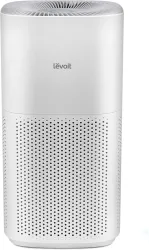
After a particularly bad wildfire season left our apartment consistently hazy with PM2.5 readings well into the "unhealthy" range, I stopped treating air purification as optional. The Levoit Core 600S was our pick for a large-room smart purifier after comparing it against the Coway Airmega 400, Blueair Blue Pure 311 Auto, and Winix 5500-2. Six months later, I can say it genuinely delivers on its core promise: the air in our 650-square-foot apartment is measurably cleaner, and the smart features integrate smoothly into our existing home automation setup.
At around $230-270 depending on when you catch it on sale, it's not cheap -- and the ongoing filter costs add up. But if you've ever watched your air quality monitor climb into triple digits while wildfire smoke seeps through every crack in your building, you'll understand why I consider this money well spent.
Design & Build
The Core 600S is a cylindrical tower standing about 23.6 inches tall and 12.3 inches in diameter -- roughly the footprint of a small kitchen trash can. It's noticeably larger than Levoit's compact models like the Core 300S, but that's the trade-off for covering spaces up to 635 square feet effectively. The white finish is inoffensive and blends reasonably well with most living room aesthetics, though it's never going to be a design piece the way a Molekule or a Blueair might be. It looks like what it is: a functional appliance.
The top panel features touch-sensitive controls and a circular air quality indicator ring that shifts from blue (good) through green, orange, and red as particle counts rise. I've found this at-a-glance indicator surprisingly useful -- a quick look across the room tells me whether the air is clean without pulling out my phone. The display brightness auto-adjusts via a built-in light sensor, dimming in dark rooms so it doesn't become a nightlight you didn't ask for.
Build quality is solid for the price bracket. The panels fit together tightly without gaps or rattling, even at higher fan speeds. Two recessed handles on the sides make it portable enough to move between rooms, which I've done during cooking sessions where I temporarily relocate it to the kitchen. The filter compartment on the bottom is secured by a twist-lock mechanism that's easy to open for filter changes but doesn't come loose during operation. My only design complaint is the power cord, which is somewhat short at about six feet -- you'll need the unit reasonably close to an outlet.
Features
At the heart of the 600S is a three-stage filtration system: a washable pre-filter that catches hair, dust, and large particles; an H13 True HEPA filter rated to capture 99.97% of particles down to 0.3 microns; and an activated carbon filter with Levoit's ARC Formula for odors, smoke, and VOCs. The pre-filter being washable is a nice touch that extends the life of the main HEPA filter, which is the expensive replacement item. I wash the pre-filter monthly under the faucet and let it dry overnight -- simple maintenance that visibly extends filter longevity.
The built-in laser particle sensor is the feature that transforms this from a dumb appliance into a smart one. It continuously monitors PM2.5 levels and displays real-time readings on the top panel. In Auto mode, the sensor drives fan speed adjustments: detect a spike from cooking, and the fan ramps up within seconds. Once the air clears, it dials back down. The VeSync app stores up to 30 days of air quality history, which is genuinely interesting data -- I can see exactly when someone cooked bacon or when outdoor smoke infiltrated the apartment.
Smart integration goes through Levoit's VeSync app, which supports both WiFi and Bluetooth connectivity. From the app, you get remote power control, fan speed adjustment, four customizable Auto modes (Default, Quiet, Eco, and Efficient), scheduling, and filter life monitoring. Voice control through Amazon Alexa and Google Assistant covers power toggling and speed changes. For Home Assistant users, the VeSync integration works but relies on cloud polling, which adds some latency -- I trigger automations based on outdoor AQI data from PurpleAir sensors to preemptively crank up the purifier before smoke arrives.
The four Auto modes deserve mention because they let you tailor the purifier's behavior to your priorities. Quiet mode keeps noise minimal at the expense of slower purification. Efficient mode prioritizes clean air regardless of noise. Default balances both. Eco mode optimizes energy consumption. I use Quiet mode in the bedroom at night and Efficient mode when the kitchen is producing particulates.
Performance
Performance is where the Core 600S earns its keep. During last summer's wildfire smoke events, I measured indoor air quality with both the 600S's built-in sensor and an independent IQAir AirVisual monitor. Our apartment's PM2.5 readings were hitting 150+ micrograms per cubic meter with windows closed and no purifier running. Within about 45 minutes of running the 600S on its highest setting, readings dropped below 10. That's a dramatic improvement, and the independent monitor corroborated the 600S's own readings to within about 15% accuracy -- close enough to trust the built-in sensor for daily monitoring.
The 391 CFM CADR rating (Clean Air Delivery Rate) puts the 600S in the upper tier for consumer purifiers in this price range. In our roughly 650-square-foot open-plan apartment, I measured about 4.5 complete air changes per hour on the medium setting, which aligns with Levoit's claimed 5x per hour for a 635-square-foot space. For context, the EPA recommends at least 4-5 air changes per hour during smoke events, so this unit just barely hits that threshold in a room near its maximum rated size. In a smaller room -- say 400 square feet -- it would exceed that recommendation comfortably.
Noise levels are reasonable but not silent. On the lowest setting (sleep mode), the 600S produces a gentle white noise hum that I measured at about 28 dB from six feet away -- quieter than a whispered conversation and actually pleasant for sleeping. The medium setting is noticeable but not disruptive for conversation or TV watching. The highest setting is loud -- I measured around 55 dB from the same distance, comparable to a normal conversation. I wouldn't run it on high during a movie, but during a smoke event, clean air takes priority over quiet. The transition between speeds is smooth rather than jarring, and the Auto mode's speed changes don't produce sudden noise spikes.
Filter longevity has been reasonable. After six months of daily operation (roughly 14 hours per day on Auto mode), the app estimates 40% filter life remaining. That tracks with Levoit's claim of 6-12 months depending on usage. I'll likely need to replace the HEPA filter around the 9-month mark given our usage pattern.
Ease of Use
Initial setup is pleasantly simple. Unbox the unit, remove the plastic wrapping from the filter (don't forget this step -- I've seen complaints from people who ran it for weeks with the filter still sealed in plastic), place the filter in the bottom compartment, plug in the power cord, and hold the power button. The unit is operational within two minutes. Connecting to the VeSync app takes another five minutes: create an account (or log in), tap add device, follow the WiFi pairing prompts. The whole process from unboxing to full smart operation took me about ten minutes.
The VeSync app is functional and reasonably well-designed, though not as polished as something like the Apple Home app. The main dashboard shows real-time air quality, current fan speed, filter life percentage, and quick-access controls. Scheduling is intuitive -- pick days, set on/off times, choose a mode. I have mine scheduled to run on Eco mode overnight and switch to Auto during waking hours. The app also sends push notifications when filter replacement is needed, which is a thoughtful touch that prevents the "I'll replace it next week" procrastination that leads to running a clogged filter for months.
Filter replacement itself is straightforward: power off, flip the unit, twist the bottom panel off, pull out the old filter, insert the new one, and reset the filter counter in the app. The whole process takes under two minutes. Replacement H13 HEPA filters run $40-50 depending on where you buy them, and Levoit also offers a pet-specific version with extra activated carbon if you have shedding animals. I budget roughly $80-100 per year for filter replacements, which is in line with other purifiers in this class -- the Coway Airmega 400's filters are similarly priced.
One minor annoyance: the VeSync app requires a cloud account, and all smart features route through Levoit's servers. There's no purely local control option out of the box. This means that if VeSync's cloud service goes down, you lose app control and scheduling (though the physical buttons on the unit still work). It's a common limitation of WiFi smart home devices, but worth noting for users who prefer local-first architectures.
Value
The Core 600S typically sells for $230-270, with occasional drops below $200 during major sales. At that price point, it competes directly with the Coway Airmega 200M (~$230), the Blueair Blue Pure 311 Auto (~$200), and the Winix 5500-2 (~$170). Against those competitors, the 600S offers the largest room coverage and the most comprehensive smart features, which justifies its position at the higher end of the range. The Winix is cheaper but covers less space and has more basic smart integration. The Blueair is simpler but lacks the detailed air quality data and Auto mode sophistication.
The real cost consideration is ongoing filter replacements. Budget $80-100 per year for HEPA and carbon filter changes, assuming moderate daily use. Over the unit's expected 5-7 year lifespan, you're looking at $400-700 in filters on top of the initial purchase price. That's the hidden cost of HEPA purification that no manufacturer likes to advertise prominently. To be fair, every HEPA purifier in this class has similar ongoing costs -- it's a category-wide consideration, not a Levoit-specific drawback.
For our household, the value calculation was straightforward: during wildfire season, the 600S made our apartment genuinely livable when outdoor AQI was in the "very unhealthy" range. You can't put a price on breathing clean air during a multi-week smoke event. Beyond emergencies, the daily reduction in dust, pollen, and cooking odors has been a quality-of-life improvement that my allergy-prone partner especially appreciates. If you live in a wildfire-prone area, have allergies, keep pets, or simply want measurably cleaner indoor air, the Core 600S delivers meaningful, verifiable results at a competitive price point.
Pros
- Effective HEPA air filtration
- Covers large rooms (635 sq ft)
- Auto mode responds to air quality
- Smart home integration
- Quiet night mode
- Good build quality
Cons
- Ongoing filter replacement costs
- Takes up floor space
- Smart features require cloud account
- Higher fan speeds audible
Final Grade
The Levoit Core 600S is a serious air purifier that backs up its smart features with genuine cleaning performance. During wildfire smoke events, it brought our indoor air quality from hazardous to healthy in under an hour -- verified by independent monitoring. The smart integration through VeSync adds practical value: auto-adjusting fan speeds based on real-time particle counts, historical air quality data, and enough scheduling flexibility to balance clean air against noise and energy consumption. The ongoing filter costs ($80-100 per year) are the main financial drawback, but that's inherent to HEPA technology, not specific to this unit. For anyone dealing with wildfire smoke, allergies, pet dander, or urban pollution, the Core 600S is a well-executed appliance that delivers measurable results. It won't win design awards, but it cleans the air effectively, and that's what matters.