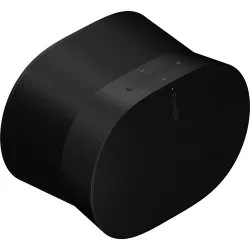
Sonos has been the gold standard for multi-room audio for over a decade, and the Era 300 represents their most ambitious speaker yet. At $449, this isn't just another bookshelf speaker — it's Sonos' answer to the spatial audio revolution, packing six drivers into an asymmetric enclosure designed specifically for Dolby Atmos playback. After living with the Era 300 for over a month, I can say the spatial audio experience is genuinely transformative. Music feels like it surrounds you rather than projecting at you, and Atmos-mixed tracks reveal layers you've simply never heard from a single speaker.
But that $449 price tag casts a long shadow, and the Sonos app overhaul of 2024 nearly ruined the experience for everyone. Is the Era 300 a glimpse of the future, or a premium product undermined by its own ecosystem? Let's dig in.
Design & Build
The Era 300's asymmetric design is unlike anything else on the market — and that's both its strength and its weakness. The curved, almost organic shape is engineered to project sound in multiple directions, with drivers firing forward, to the sides, and upward for height channels. It's a form-follows-function approach that results in a speaker that looks like it fell out of a sci-fi movie.
Whether you find it beautiful or bizarre is genuinely subjective. I've had visitors ask "what is that thing?" with equal parts curiosity and concern. The matte finish (available in black or white) is pleasant to touch and hides fingerprints well. Build quality is excellent — it feels dense and substantial at 4.47 kg. The USB-C port on the back handles the optional line-in adapter ($19 extra, which feels nickel-and-dime for a $449 speaker).
The footprint is wider than a traditional bookshelf speaker, so plan your shelf space accordingly. It's not a speaker you can tuck away discreetly — it demands to be seen, for better or worse.
Features
The feature set is comprehensive for a premium wireless speaker. Dolby Atmos support is the headline act, and it works with Amazon Music, Apple Music, and Tidal (Spotify still hasn't shipped Atmos support as of this review). WiFi 6 ensures reliable high-bandwidth streaming, and Bluetooth 5.0 is available as a fallback — though Sonos clearly wants you using WiFi for the best experience.
AirPlay 2 support means Apple users get seamless integration, and Sonos' own voice assistant is available if you don't want Alexa listening. The speaker also supports Sonos' multi-room grouping, so it plays nicely with the rest of the ecosystem.
- Trueplay room tuning — genuinely improves sound quality by calibrating to your room's acoustics, but it's iOS-only, which is a frustrating limitation in 2024.
- Touch controls — volume slider and playback controls on top work well, though the swipe-to-skip gesture takes practice.
- Line-in via USB-C — requires a $19 adapter sold separately, which feels cheap for a $449 product.
Bluetooth cannot be used as the primary connection method — it's really only there for quick guest playback, which limits flexibility compared to competitors like the HomePod that handle Bluetooth more gracefully.
Performance
This is where the Era 300 earns its keep, and frankly, where it left me genuinely impressed. The spatial audio experience from a single speaker is remarkable. With Dolby Atmos content, you get a convincing sense of width, depth, and height that I didn't think was possible without a multi-speaker setup. The four tweeters and two woofers work in concert to create a soundstage that fills a medium-sized room effortlessly.
Stereo content sounds excellent too — the Era 300 is a significant upgrade over the Era 100 and the older Sonos One in every measurable way. Bass response is punchy and controlled without being boomy, mids are clear and detailed, and highs are crisp without harshness. Cranking the volume to party levels introduces no audible distortion.
The real magic happens with Atmos-mixed music. Listening to albums like Beyoncé's Renaissance or The Beatles' Abbey Road Atmos remix, instruments and vocals separate into distinct positions around you. It's not a gimmick — it's a genuinely different listening experience. For movies and TV via AirPlay, the spatial effect adds noticeable immersion, though it can't replace a proper surround setup for cinematic use.
Trueplay calibration (iOS only, unfortunately) makes a meaningful difference, tightening the bass and improving imaging noticeably in my somewhat reflective living room.
Ease of Use
Setup is straightforward if you're already in the Sonos ecosystem — plug it in, open the app, and follow the prompts. The initial Trueplay calibration takes about two minutes of walking around your room with your iPhone, which feels silly but produces real results.
Now, the elephant in the room: the Sonos app redesign of 2024 was a catastrophe. Sonos pushed a completely rebuilt app that was missing basic features, crashed frequently, and frustrated loyal customers. While they've patched the worst issues since launch, the app still feels less polished than the old version. Setting up speaker groups, managing music queues, and adjusting EQ can be clunkier than it should be at this price point.
Touch controls on the speaker itself are responsive and intuitive once you learn the gestures. Voice control via Alexa or Sonos Voice works reliably for basic commands. The speaker integrates smoothly with Apple's ecosystem via AirPlay 2, but Android users miss out on Trueplay and have a slightly rougher experience overall.
Sonos' decision to kill legacy compatibility for older products also looms over the ecosystem — if you're investing $449, you're trusting Sonos not to abandon this hardware in a few years.
Value
At $449, the Era 300 is firmly in the premium territory, and you need to honestly assess whether spatial audio matters to you. If you primarily listen to Spotify (no Atmos support), you're paying a significant premium for capability you can't fully use. In that scenario, the $249 Era 100 delivers excellent stereo sound at nearly half the price.
For the spatial audio faithful with Apple Music or Tidal subscriptions, the calculus is different. No other single speaker at any price delivers this quality of Atmos playback. The Apple HomePod ($299) has spatial audio but doesn't match the Era 300's width and separation. The Amazon Echo Studio ($199) supports Atmos but sounds noticeably worse.
The real value question is whether a single Era 300 makes sense versus a stereo pair of Era 100s ($498 for two), which gives you true stereo separation and arguably more impressive staging for non-Atmos content. It's a closer comparison than Sonos probably wants you to make.
Sonos speakers hold their value reasonably well on the resale market, and the company has a track record of supporting products with software updates for years — the recent app debacle notwithstanding.
Pros
- Spatial audio performance is genuinely best-in-class from a single speaker
- Six-driver array fills a room with convincing width, depth, and height
- Trueplay room calibration measurably improves sound quality
- WiFi 6 ensures rock-solid streaming with no dropouts
- Premium build quality with dense, well-finished construction
Cons
- The $449 price is hard to justify if you don't actively use Dolby Atmos content
- Sonos app redesign in 2024 was a disaster that still hasn't fully recovered
- Trueplay room calibration is iOS-only, leaving Android users with a lesser experience
- Asymmetric design is polarizing — it dominates any shelf or surface it sits on
Final Grade
The Sonos Era 300 is a genuinely impressive piece of audio engineering. The spatial audio performance from a single speaker is the best I've heard, and it justifies Sonos' bold design choices. When you're sitting in the sweet spot with a Dolby Atmos track playing, it's easy to forget you're listening to one speaker.
But the Era 300 doesn't exist in a vacuum. The $449 price demands careful consideration, the 2024 app fiasco shook customer trust, and the restricted Bluetooth implementation feels unnecessarily limiting. Android users lose access to Trueplay, which is one of the speaker's genuine advantages. And if you're not actively consuming Atmos content, much of what makes this speaker special goes unused.
For spatial audio enthusiasts with an Apple Music or Tidal subscription and an iOS device, the Era 300 is the clear best-in-class choice. For everyone else, the Era 100 or a pair of HomePods may deliver better value for your listening habits.