After watching the Yeelight debacle with cloud-dependent devices (see my Yeelight 1S review), I made a deliberate decision: safety-critical devices in my home will operate locally, period. Smoke detectors and CO alarms should not depend on an internet connection, a cloud server, or a third-party company's uptime to function. The First Alert Z-Wave Plus Smoke and Carbon Monoxide Alarm fits that philosophy perfectly -- it communicates over Z-Wave directly to my Home Assistant hub, enabling smart notifications and automations without any cloud dependency whatsoever.
Six months in, these alarms have been rock-solid. They're not glamorous, they don't have a slick app or a color-coded LED ring, and they won't impress your friends. But they do exactly what safety devices should do: detect threats reliably and report to your smart home system through a protocol you control. For anyone building a serious, locally-controlled smart home, this is the smoke and CO detector to consider.
Design & Build
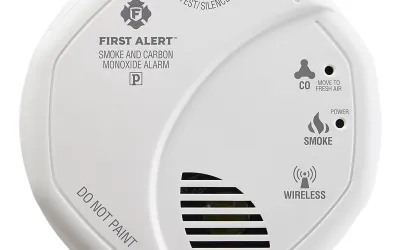
The First Alert ZCOMBO looks like a standard residential smoke detector -- a white circular housing about 5.5 inches in diameter and 1.7 inches thick. If you didn't know it had a Z-Wave radio inside, you'd never guess by looking at it. This is a feature, not a shortcoming: ceiling-mounted safety devices should disappear visually, and the ZCOMBO does that well. It's slightly larger than the X-Sense Smart Smoke Detector due to housing both smoke and CO sensors plus the Z-Wave radio, but the size difference is minimal.
The First Alert brand name embossed on the front carries weight. This is a company with decades of experience in fire safety, and that heritage matters for a device you're trusting with your family's safety. The housing feels solid and well-assembled. A test/silence button on the front is easily accessible, and a small LED indicator provides status feedback. The tamper-resistant design includes locking pins that prevent casual removal -- a feature required in some jurisdictions for rental properties and commercial installations.
The mounting system uses a standard twist-lock bracket that's compatible with most existing smoke detector mounting plates. If you're replacing an existing detector, you can often reuse the same screw holes. The battery compartment on the back accepts two AA batteries (included) and has a security feature that prevents the compartment from closing without batteries installed -- a smart design choice that ensures the unit is always powered when mounted. The overall build quality is what you'd expect from a professional-grade safety device: no frills, no sharp edges, solid construction throughout.
Features
The ZCOMBO combines two proven sensing technologies in one unit. The photoelectric smoke sensor detects smoldering fires -- the slow-burning, heavy-smoke fires that are the most common residential fire type. The electrochemical CO sensor monitors carbon monoxide levels, the same technology used in commercial and industrial CO monitoring equipment. Having both sensors in a single housing means one mounting location covers both threat types, reducing ceiling clutter and simplifying installation.
The Z-Wave Plus radio is what transforms this from a standard alarm into a smart home device. It communicates directly with any Z-Wave-compatible hub -- Home Assistant (via a Z-Wave stick), SmartThings, Hubitat, Vera, or any other Z-Wave controller. Communication is entirely local: data travels from the alarm to your hub over Z-Wave's mesh network without ever touching the internet. This means your smoke and CO detection system works during internet outages, cloud service disruptions, and DNS failures. For safety devices, this architecture is non-negotiable in my view.
The alarm reports multiple data points to your hub: smoke alarm status (clear/triggered), CO alarm status (clear/triggered), battery level percentage, and test status. In Home Assistant, these appear as binary sensors and a battery level entity, which you can use as triggers for automations. The automations I've built include: turn on every light in the house at full brightness when any alarm triggers (critical for nighttime evacuation visibility), send push notifications to all family phones with the specific alarm type and location, unlock the smart lock on the front door, and trigger a loud TTS announcement on all smart speakers identifying the threat and location. These automations have been tested multiple times and execute within 2-3 seconds of the alarm triggering.
The alarm also participates in the Z-Wave mesh network, though as a battery-powered device it operates as a sleeping node rather than a repeater. This means it wakes periodically to check in with the hub and reports events immediately when triggered, but it doesn't relay messages for other Z-Wave devices. Battery life is the trade-off for not requiring hardwiring, and two AA batteries provide 1-2 years of operation depending on Z-Wave network traffic and how frequently the unit checks in.
One notable limitation: the ZCOMBO supports wired interconnection with other First Alert alarms (using a physical wire between units), but it does not have wireless interconnection like the X-Sense. If you want all your alarms to sound simultaneously when one triggers, you either need to wire them together or use your smart home hub to trigger an automation that activates all alarms -- the latter being more flexible but requiring a functioning hub.
Performance
Safety performance is the most critical measure for this device, and the First Alert ZCOMBO delivers. I've tested the smoke sensor with aerosol test spray and the CO sensor with the test button (which simulates a CO event for the Z-Wave hub), and both respond promptly and reliably. The 85 dB alarm is loud enough to wake a sleeping person in the same room and penetrate through a closed door to adjacent rooms. The alarm tone is the standard T3 pattern for smoke (three short beeps) and T4 pattern for CO (four short beeps), following NFPA standards so that anyone familiar with standard alarm patterns can immediately identify the threat type.
Z-Wave communication has been flawless over six months. Status updates arrive at my Home Assistant hub within 1-2 seconds of a state change. Periodic check-ins (every 4 hours by default, configurable) confirm the device is alive and communicating. Battery level reporting has been accurate -- I started at 100% six months ago and I'm currently showing 89%, which projects to well over a year of battery life. I have Z-Wave repeaters (smart plugs and light switches) positioned throughout the house to ensure strong mesh coverage, and the ZCOMBO's signal strength has been consistently good.
False alarm performance has been excellent. Zero false triggers in six months across three installed units. The photoelectric sensor's inherent resistance to cooking-related nuisance alarms is a practical advantage -- my kitchen unit hasn't triggered from normal cooking activities including pan-searing, oven use, and even a minor burnt-toast incident that produced visible smoke. The electrochemical CO sensor has similarly been free of false readings. First Alert's decades of sensor calibration expertise clearly pays dividends here.
One real-world performance note: during a power outage that also knocked out my internet for about four hours, the Z-Wave network continued operating on battery backup (my Home Assistant server is on a UPS). The ZCOMBO alarms were fully operational and communicating with the hub throughout the outage. This is exactly the scenario where cloud-dependent devices fail and local Z-Wave devices shine -- your safety system doesn't go dark just because your ISP has problems.
Ease of Use
Physical installation follows the standard smoke detector process: mount the bracket with the included screws, insert batteries, twist the unit onto the bracket. The entire physical installation takes about 5 minutes per unit, assuming you already have the mounting location selected (follow NFPA guidelines for smoke and CO detector placement -- one on each level, one in each bedroom, and one near each fuel-burning appliance for CO).
Z-Wave pairing is straightforward but does require familiarity with your hub's inclusion process. In Home Assistant with Z-Wave JS, I put the controller in inclusion mode, pressed the test button on the ZCOMBO, and the device was discovered within 10 seconds. Home Assistant automatically recognized it as a smoke and CO alarm and created the appropriate entities: binary sensors for smoke and CO, a battery level sensor, and a test status indicator. SmartThings and Hubitat have similarly streamlined pairing processes. If you've ever paired a Z-Wave device before, there's nothing unusual here.
Creating automations is where the real value emerges, and this step does require some technical comfort. In Home Assistant, I created automation YAML that triggers on the smoke or CO binary sensor changing to "on" and executes a sequence of actions: lights on at 100%, push notifications, TTS announcements, and door unlock. Writing these automations took about 30 minutes of initial setup, including testing each action individually. For SmartThings or Hubitat users, similar automations can be created through their respective apps' automation builders without writing code.
The main ease-of-use caveat is that the ZCOMBO requires a Z-Wave hub to function as a smart device. Without a hub, it's a standard (perfectly functional) smoke and CO alarm with no smart capabilities. If you don't already have a Z-Wave infrastructure, adding one specifically for smoke detectors involves buying a Z-Wave controller ($30-50), installing it in your home automation platform, and learning the basics of Z-Wave device management. For people already running Z-Wave networks, the ZCOMBO drops right in. For smart home beginners, the barrier to entry is higher than a WiFi-based solution like the X-Sense.
Value
At $40-50 per unit, the First Alert ZCOMBO sits between budget options like the X-Sense Smart Smoke Detector ($35-40, smoke only) and premium options like the Nest Protect ($120, smoke + CO + pathlight + WiFi). For the price, you get combination smoke and CO detection from a trusted safety brand, plus full Z-Wave integration for local smart home control. That's a strong value proposition.
The true value of the ZCOMBO becomes apparent when you consider what local Z-Wave control enables versus cloud-dependent alternatives. Your safety automations work during internet outages. They work when a cloud service has an outage. They work when a manufacturer decides to sunset a product line. The Z-Wave protocol is a open standard with backward compatibility, meaning your investment in Z-Wave devices and automations isn't at the mercy of a single company's business decisions. For safety devices that you expect to rely on for years, this architectural resilience has real, quantifiable value.
The combination smoke and CO detection in a single unit is also a cost advantage. Buying separate smoke and CO detectors doubles the hardware cost and mounting locations. The ZCOMBO covers both threats in one device, saving both money and ceiling real estate. For a typical home requiring 5-6 detection locations, the savings versus separate devices add up to $100-150.
The ongoing cost is AA battery replacements every 1-2 years -- roughly $2-3 per unit per year. This is cheaper than the sealed-battery approach (where you replace the entire unit when the battery dies) but does require periodic ladder trips to swap batteries. It's a minor recurring cost and effort that's worth acknowledging but not a significant drawback. The lack of a sealed 10-year battery is a trade-off for the lower upfront cost and the flexibility to replace batteries rather than the entire unit.
Pros
- True local Z-Wave control
- Combination smoke + CO detection
- First Alert safety brand
- No cloud dependency
- Works with major Z-Wave hubs
- Reports battery and status
- Enables safety automations
Cons
- Requires Z-Wave hub
- More expensive than basic detectors
- Battery-powered (needs replacement)
- No built-in interconnect (wired only)
- Setup requires hub configuration
Final Grade
The First Alert Z-Wave Plus Smoke and CO Alarm is the smart safety device that serious home automation users should be buying. It combines proven detection technology from a trusted safety brand with Z-Wave local control that works regardless of internet or cloud service status. The automations it enables -- lights on during an alarm, push notifications to every family member's phone, TTS announcements identifying the threat and location, automated door unlocking for evacuation -- transform a basic alarm into a comprehensive safety response system. All of this operates locally on your Z-Wave mesh, without depending on a single external server. The trade-off is that you need a Z-Wave hub and some technical comfort to realize this potential. But if you're already running Home Assistant, SmartThings, or Hubitat, the ZCOMBO drops seamlessly into your setup and provides safety monitoring that cloud-dependent alternatives simply cannot match in reliability and independence. For local-first smart home builders, this is the right choice.