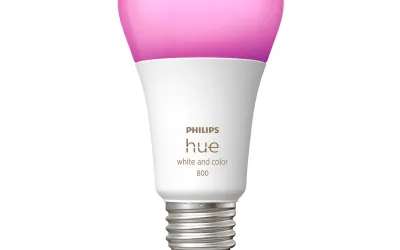
Philips Hue essentially created the modern smart bulb category, and the White and Color Ambiance A19 remains the benchmark against which every competitor is measured. At $49.99 per bulb — plus the $59.99 Hue Bridge if you don't already have one — it's also the most expensive mainstream option. That's a lot of money for a light bulb, and there are now credible alternatives from LIFX, Nanoleaf, and Wyze at half the price or less.
So why does Hue still matter? After testing these bulbs across three rooms for six weeks alongside LIFX A19 and Nanoleaf Essentials bulbs, the answer is clear: nothing else matches Hue's combination of color accuracy, reliability, third-party integration, and ecosystem depth. Whether that premium is worth it depends entirely on how seriously you take your smart lighting — and how many bulbs you need.
Design & Build
The physical bulb itself is unremarkable by design — which is exactly right. The Hue A19 looks like a standard LED bulb with a slightly larger diffuser dome that helps distribute color evenly. It fits any standard E26 socket and doesn't protrude awkwardly from lampshades or fixtures like some oversized smart bulbs do. The matte white finish is clean and unobtrusive.
At 1100 lumens, it's bright enough for primary room lighting, which wasn't always the case with earlier Hue generations. The bulb's form factor is nearly identical to a traditional 60W incandescent, making it a true drop-in replacement. Weight is slightly heavier than a standard LED at about 6.5 ounces, but not enough to cause issues with any fixture we tested.
The Hue Bridge, which is required for full functionality, is a small square puck that connects to your router via Ethernet. It's not beautiful, but it tucks behind a router easily enough. The Bridge supports up to 50 Hue devices, and with Matter support added via firmware update, it now acts as a bridge between the Zigbee bulbs and your broader Matter smart home ecosystem.
Features
The Hue Color Ambiance delivers 16 million colors with a white temperature range of 2000K to 6500K, covering everything from warm candlelight to cool daylight. The color rendering index (CRI) of 80+ is adequate, though not exceptional — dedicated task lighting bulbs from brands like Cree offer CRI 90+. For ambient and accent lighting, the color saturation and accuracy are best-in-class among smart bulbs.
The Hue ecosystem is where the real value lies. The Hue app offers granular control over individual bulbs and rooms, with the ability to create custom scenes, set schedules, and configure motion-triggered lighting with Hue sensors. Dynamic scenes that slowly shift colors throughout the day are particularly impressive and something most competitors can't replicate as smoothly.
Third-party integration is unmatched. Hue works with virtually every smart home platform: HomeKit, Google Home, Alexa, SmartThings, Home Assistant, IFTTT, and hundreds of other services. The Matter Bridge update means new platform support going forward as well. Entertainment features like Hue Sync (which matches lights to screen content) and Spotify integration add genuine fun to the ecosystem.
- 16 million colors: 2000-6500K white range with rich saturation
- Zigbee 3.0: Reliable mesh networking via Hue Bridge
- Matter compatible: Via Bridge firmware update
- 25,000-hour lifespan: Approximately 22 years at 3 hours/day
- Entertainment sync: Screen matching and Spotify integration
Performance
This is where Hue justifies its premium. In side-by-side testing with LIFX A19 and Nanoleaf Essentials bulbs, the Hue consistently produced more accurate and saturated colors, especially in the red and deep blue spectrum where cheaper bulbs tend to look washed out. White temperatures were smooth across the entire range with no visible flicker or color stepping.
Reliability is the other performance differentiator. Over six weeks with eight Hue bulbs across three rooms, we experienced exactly zero connectivity drops, failed commands, or unresponsive bulbs. Not one. The Zigbee mesh network through the Hue Bridge is remarkably stable — commands execute in under 200 milliseconds, and group commands (like "turn off all lights") happen simultaneously without the ripple effect common with WiFi bulbs.
The 1100-lumen output is consistent and doesn't dim over time like some budget smart bulbs we've tested. Transition animations between colors and temperatures are butter-smooth, with no visible stepping or flashing. The bulbs also produce virtually no buzzing or humming, even when dimmed to very low levels — a common complaint with cheaper alternatives that use lower-quality drivers.
Ease of Use
Initial setup requires connecting the Hue Bridge to your router via Ethernet, then pairing bulbs through the Hue app. The process is painless — screw in the bulb, open the app, tap "add light," and it's found within seconds. The app walks you through room assignment and basic configuration clearly. Adding bulbs to Apple Home, Google Home, or Alexa is equally straightforward once the Bridge is linked.
The Hue app itself is the best smart lighting app on the market. The interface is clean and intuitive, with easy access to individual bulb control, room grouping, scenes, automations, and entertainment features. Creating custom scenes with specific colors for each bulb in a room is actually enjoyable rather than tedious. The widget for iOS provides quick one-tap access to favorite scenes.
The one ease-of-use caveat is the physical switch problem common to all smart bulbs: if someone flips the wall switch off, the bulb loses power and becomes unresponsive to smart control. Hue's solution is the $39.99 Hue Smart Dimmer Switch that mounts over existing switches, but that's yet another cost in an already expensive ecosystem. Lutron Aurora dimmer switches are another option at $40 each.
Value
Here's where Hue takes its biggest hit. A single White and Color Ambiance A19 bulb is $49.99. A starter kit with four bulbs and a Bridge is $199.99. Outfitting a modest three-bedroom home with color bulbs in every room could easily run $500-800. That's an absurd amount of money for light bulbs, and there's no getting around it.
The competition has closed the gap significantly. LIFX A19 color bulbs are $32.99 and don't require a hub at all. Nanoleaf Essentials A19 bulbs are $19.99 and support Thread natively. Wyze Bulb Color is $11.99. All three produce decent colors and work with major smart home platforms. Are they as reliable and color-accurate as Hue? No. But they're 50-75% cheaper.
The value argument for Hue only works if you prioritize reliability, color quality, and ecosystem depth above all else — and if you plan to invest in the broader Hue ecosystem with light strips, outdoor lights, and entertainment features. For someone who just wants smart bulbs that change color, spending $50 per bulb is genuinely hard to recommend when the Nanoleaf Essentials exist at $19.99.
Pros
- Best-in-class color accuracy and saturation, especially in reds and deep blues
- Zigbee mesh networking via Bridge delivers sub-200ms response with zero dropouts
- Unmatched third-party integration: HomeKit, Google, Alexa, SmartThings, Matter, IFTTT, and more
- Hue app is the most polished smart lighting app with excellent scene and automation tools
- 25,000-hour lifespan with consistent brightness output over time
Cons
- $49.99 per bulb is 2-4x more expensive than competitors like Nanoleaf Essentials at $19.99
- Requires $59.99 Hue Bridge — bulbs are not standalone WiFi or Thread devices
- CRI of 80+ is adequate but not exceptional for color rendering accuracy
- Physical wall switches kill smart functionality — Hue's dimmer switch solution adds another $40
Final Grade
The Philips Hue White and Color Ambiance A19 remains the best smart bulb you can buy — it's just not the best value. The color accuracy, reliability, and ecosystem integration are genuinely unmatched, and the Matter Bridge update ensures Hue will remain compatible with whatever smart home platform emerges next. If you want lighting that just works, looks stunning, and integrates with everything, Hue is still the answer.
But the $49.99-per-bulb pricing plus mandatory Bridge is increasingly difficult to justify as competitors like Nanoleaf Essentials and LIFX deliver 80% of the experience at a fraction of the cost. Our recommendation: if you're building a serious smart lighting setup and want the best, invest in Hue. If you need a few smart bulbs for convenience, save your money and look at the alternatives. Your wallet will thank you.