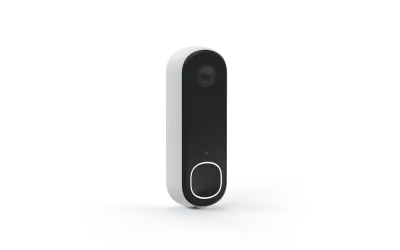
The Arlo Essential Video Doorbell (2nd Gen) enters a crowded market with a compelling pitch: 2K HDR video, a 180-degree head-to-toe field of view, wire-free installation, and — the real differentiator — Apple HomeKit support including HomeKit Secure Video. For the growing number of smart home users invested in Apple's ecosystem, that last feature alone puts the Arlo in a class that Ring and Google Nest can't touch.
At $129.99, it sits in the mid-range of video doorbells, competitively priced against the Ring Battery Doorbell Plus ($149.99) and the Google Nest Doorbell ($179.99). But the sticker price tells only half the story. After testing the Arlo Essential for two months at my front door, I've found an excellent video doorbell that Arlo is determined to monetize through subscriptions. Without the Arlo Secure plan, you're left with a significantly diminished experience that's hard to justify at this price point.
Design & Build
The 2nd Gen Arlo Essential Doorbell is a slim, rounded rectangle measuring about 5 x 1.7 x 1 inches — noticeably more compact than the first generation and slightly smaller than the Ring Battery Doorbell Plus. The white body with a dark camera lens and button provides a clean, modern look that works well on most door frames. Build quality feels solid with a matte finish that resists fingerprints and weathers well.
The 180-degree diagonal field of view is the design highlight. Unlike most doorbells that show you a visitor's face and torso, the Arlo captures a full head-to-toe view. This means you can see packages left at your feet and the full body of anyone at your door. It's a genuinely useful wide angle that Ring's standard 150-degree view can't match for package monitoring.
Wire-free installation is straightforward — the included mounting bracket angles the camera slightly downward, and the doorbell attaches with a security screw. If you have existing doorbell wiring (16-24V AC), you can wire it for continuous power and unlock features like continuous video recording and pre-roll capture. The unit is weather resistant and has handled rain, cold, and direct sunlight without issues during my testing. A built-in siren adds a security layer, though at its size the siren is more startling than truly intimidating.
Features
On paper, the Arlo Essential 2nd Gen checks nearly every box. The 2K HDR camera produces sharp, detailed video with good dynamic range — important for doorbell cameras that often face harsh lighting contrasts between a shaded porch and a bright street. Dual-band WiFi (2.4GHz and 5GHz) provides more reliable connectivity than the 2.4GHz-only competition. Two-way audio with noise cancellation works well for communicating with visitors and delivery drivers.
Smart detection includes person, animal, vehicle, and package identification — the package detection is particularly useful for triggering specific notifications when a delivery arrives. You can set up activity zones to focus detection on specific areas and ignore others, like a busy sidewalk beyond your property line.
The Apple HomeKit integration deserves special mention. The Arlo Essential supports HomeKit Secure Video, which means video is processed locally on your Apple TV or HomePod, encrypted end-to-end, and stored in iCloud without counting against your storage quota (requires iCloud+ plan). For privacy-conscious Apple users, this is the gold standard. You also get Alexa and Google Assistant support for live view on smart displays and voice-triggered actions.
Here's where the subscription conversation begins. Without Arlo Secure ($7.99/month for a single camera or $12.99/month for unlimited cameras), you lose:
- Video history — no cloud recording at all; you only get live view
- AI detection — person, package, animal, and vehicle detection disappear
- Activity zones — the ability to define specific monitoring areas is locked
- Rich notifications — thumbnail previews in notifications go away
HomeKit Secure Video mitigates some of this if you're an Apple user, but Android users are fully at the mercy of the subscription model.
Performance
Daytime video quality is excellent. The 2K HDR sensor captures crisp footage with accurate colors and impressive dynamic range. I could clearly identify faces, read delivery labels, and see license plates of cars on the street 30 feet away. The head-to-toe 180-degree view provides great context for every event, and the wider angle introduces minimal distortion — a notable improvement over the first generation.
Night vision is decent but not exceptional. The Arlo uses infrared night vision (no spotlight/color night vision in this model), which produces the typical black-and-white footage. It's clear enough to identify people at close range but loses detail beyond about 15 feet. Ring's Battery Doorbell Plus has a slight edge here with its color night vision option, though that requires its spotlight to activate.
Live view loading time is my biggest performance frustration. From tapping the notification to seeing live video, the Arlo consistently takes 5-8 seconds. In doorbell-camera terms, that's an eternity — a visitor can ring, wait, and start walking away before you even see the live feed. Ring's doorbell typically loads in 3-4 seconds, and Google Nest is similarly faster. This delay is present on both WiFi and cellular connections and seems to be an inherent limitation of the Arlo system.
Battery life on wire-free installation is the other weak point. Arlo claims "up to 6 months," but real-world usage with moderate traffic (10-15 motion events per day) drained the battery in about 10 weeks. Higher-traffic doorsteps will see even shorter life. The battery charges via USB-C and takes about 4 hours for a full charge, but removing the doorbell from the mount, charging it indoors, and remounting it every 2-3 months is genuinely annoying. If possible, wire it for a dramatically better experience.
Ease of Use
Wire-free installation is the Arlo Essential's accessibility advantage. The included mounting bracket screws into your door frame (or presses on with adhesive), the doorbell slides into the bracket, and a security screw locks it in place. From unboxing to a working doorbell took me about 15 minutes. Wired installation takes longer and requires basic comfort with low-voltage electrical work, but Arlo includes a wiring harness and clear instructions.
The Arlo app handles initial setup smoothly, walking you through WiFi connection, camera positioning, and account creation. The home screen provides a clean view of all your Arlo devices with their current status and most recent activity thumbnails. Navigating to live view, recorded events, and settings is intuitive. The app also supports widgets for iOS and Android that provide quick access to live view without opening the full app.
Where ease of use suffers is in the subscription pressure. Throughout the app, Arlo constantly nudges you toward Arlo Secure with upsell banners, locked feature indicators, and trial expiration warnings. Features that seem like they should be available — like viewing a 30-second video clip from a motion event — are gated behind the subscription. It creates a frustrating experience where you've paid $130 for a doorbell that repeatedly reminds you it could do more if you'd just pay a monthly fee. The hardware experience is great; the software experience is marred by monetization.
Value
The Arlo Essential Video Doorbell (2nd Gen) at $129.99 is competitively priced against its peers — the Ring Battery Doorbell Plus is $149.99 and the Google Nest Doorbell is $179.99. On hardware alone, the Arlo offers comparable or better specs than both. The 180-degree head-to-toe view, 2K HDR video, and HomeKit support are legitimate advantages that justify the price.
But value calculations must include ongoing costs, and this is where the Arlo's proposition weakens. Without Arlo Secure ($7.99/month per camera or $12.99/month unlimited), the doorbell loses cloud recording, AI detection, activity zones, and rich notifications. Over two years, Arlo Secure adds $191.76 (single camera) to $311.76 (unlimited), bringing the total cost of ownership to $321-441. Ring Protect Plus at $99.99/year ($200 over two years) covers unlimited cameras and includes professional monitoring. Google's subscription is $8/month.
The saving grace is HomeKit Secure Video. If you have iCloud+ ($2.99/month or higher), you get encrypted cloud video storage, on-device AI detection, and activity zones entirely through Apple's ecosystem — no Arlo Secure needed. This makes the Arlo Essential potentially the best value video doorbell for Apple users, since the "subscription" cost is the iCloud+ plan you may already be paying for. For Android users without this option, the total cost of ownership is harder to justify against Ring's more affordable subscription plans.
Pros
- 2K HDR video with 180-degree head-to-toe field of view captures more detail and context than Ring or Nest
- Full Apple HomeKit support including HomeKit Secure Video for encrypted, subscription-free cloud recording
- Wire-free or wired installation flexibility lets you choose easy setup or enhanced features
- Person, animal, vehicle, and package detection provides granular, actionable smart notifications
- Dual-band WiFi (2.4GHz and 5GHz) provides more reliable connectivity than 2.4GHz-only competitors
Cons
- Without Arlo Secure at $7.99/mo, you lose video history, cloud AI detection, activity zones, and rich notifications
- Battery life of just 10-12 weeks with moderate traffic means frequent removal and recharging
- Live view takes 5-8 seconds to load — slow enough that visitors may leave before you see them
- No color night vision in this model — infrared only, with detail falling off beyond 15 feet
Final Grade
The Arlo Essential Video Doorbell (2nd Gen) is a genuinely good video doorbell with one significant asterisk. The hardware delivers: 2K HDR video is sharp, the 180-degree head-to-toe view captures more than any competitor, wire-free installation is easy, and HomeKit support (including HomeKit Secure Video) makes it the best option for Apple households. Build quality is solid, daytime image quality is excellent, and smart detection features work reliably.
The asterisk is Arlo's aggressive subscription model. Without Arlo Secure at $7.99/month, the doorbell loses video history, AI detection, activity zones, and rich notifications — features that feel essential for a $130 device. Battery life of 2-3 months on wire-free installation adds another frustration. And the 5-8 second live view loading time means you're often watching visitors walk away. For Apple users with iCloud+, HomeKit Secure Video largely solves the subscription problem and makes the Arlo an easy recommendation. For everyone else, weigh the ongoing costs carefully against Ring and Google, whose subscriptions offer more coverage for less money.