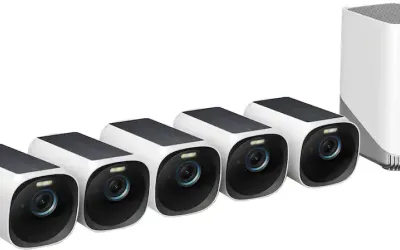
The subscription fatigue in home security is real. Ring wants $10/month per camera or $100/year for their Plus plan. Arlo charges $13/month for their Premium tier. Over five years, you can easily spend more on cloud subscriptions than the cameras themselves cost. The eufy eufyCam 3 exists to break that cycle — a 4K wire-free camera system with local AI processing, local storage, and zero monthly fees. The 2-camera kit runs $479.99, and that\'s the last check you write.
After testing the eufyCam 3 system through a full summer of use — including thunderstorms, 95°F heat waves, and one attempted package theft that it captured beautifully in 4K — I can say the no-subscription approach genuinely works. But the tradeoffs compared to cloud-first systems are worth understanding before you commit.
Design & Build
The eufyCam 3 cameras are chunky compared to something like the Arlo Pro 5S — they\'re noticeably larger due to the integrated solar panel on top. Each camera has a small photovoltaic panel that keeps the internal battery topped up, which means (in theory) you never need to dismount and charge them. The white finish blends reasonably well against most home exteriors, though the solar panel adds an industrial look.
IP67 weatherproofing means these can handle anything short of submersion. The magnetic mount makes positioning flexible, and each camera includes a wall plate with screw holes for permanent installation. A spotlight ring around the lens provides color night vision illumination.
Then there\'s the HomeBase 3 — a chunky white box roughly the size of a small router that serves as the brains of the operation. It houses the AI processing chip, 16GB of built-in eMMC storage, and an expandable SSD slot (up to 16TB). The HomeBase needs to be wired via Ethernet to your router, which limits where you can place it. It\'s not ugly, but it is another device that needs a home near your router.
Features
The feature list is where the eufyCam 3 genuinely stands apart from the competition:
- 4K recording — True 3840x2160 resolution, not upscaled. The detail difference versus 1080p cameras is dramatic, especially for identifying faces or license plates.
- BionicMind AI — On-device facial recognition that learns and identifies familiar faces over time. After about two weeks of training, it reliably distinguished between family members, regular delivery drivers, and strangers.
- Integrated solar panel — Self-charging that eliminates battery maintenance (with caveats — see Performance).
- Local storage — Everything stays on the HomeBase 3. No cloud upload, no third-party access, no subscription.
- HomeKit Secure Video — Works as a HomeKit camera, though this limits recording to 1080p through the Home app.
- Cross-camera tracking — The system can hand off a person\'s movement between cameras, creating a continuous tracking log.
You also get 2-way audio with a built-in speaker and mic, customizable activity zones, and a 100-lumen spotlight for deterrence. The system supports up to 16 cameras on a single HomeBase 3, which is generous for a residential setup.
Performance
Video quality in 4K is superb in daylight — crisp detail, accurate colors, and a wide 135-degree field of view that covers a full front porch without blind spots. Color night vision via the spotlight is effective up to about 25 feet, after which it falls off to standard infrared black-and-white. The infrared night vision extends to roughly 40 feet with reasonable clarity.
The solar panel charging works but with a big asterisk: eufy recommends 2+ hours of direct sunlight daily. In my south-facing test location, the battery held steady at 90-100% through summer. A north-facing camera under an eave, however, slowly drained to about 60% over the same period. If your mounting location is heavily shaded, treat the solar panel as a supplement rather than a complete solution — you may still need to charge every few months.
BionicMind face recognition impressed me after the initial training period. It correctly identified my family members about 85-90% of the time and reliably flagged unknown faces. Motion detection was responsive with minimal false alarms once activity zones were configured, though windy days with moving trees still occasionally triggered alerts.
The 16GB built-in storage is the system\'s weak point. At 4K resolution with moderate activity (15-25 events per camera per day), the storage filled up in roughly 5-7 days before overwriting began. Installing a 1TB SSD in the HomeBase 3 is practically mandatory for any serious use. Fortunately, the SSD slot makes this a simple upgrade.
Ease of Use
Setup is more involved than a plug-and-play Ring camera. You need to connect the HomeBase 3 via Ethernet, pair each camera, mount them, run the ADAPTiQ-style calibration for detection zones, and optionally train BionicMind with face samples. Budget 30-45 minutes for a two-camera setup versus the 10 minutes a single Ring camera takes.
The eufy Security app handles configuration and live viewing. It\'s functional but not elegant — the interface feels cluttered, with settings buried in submenus. Reviewing recorded clips is straightforward with a timeline scrubber, but downloading 4K clips to your phone can be slow over WiFi. The app has improved significantly over the past year, but it\'s still a step behind Ring\'s polished experience.
WiFi range between cameras and the HomeBase can be an issue in larger homes. My camera mounted about 50 feet from the HomeBase with one exterior wall in between occasionally dropped connection during heavy rain. Eufy recommends keeping cameras within 30 feet of the HomeBase for reliable performance, which may limit placement options. Adding a WiFi extender near the HomeBase helped in my case.
Value
Here\'s where the eufyCam 3 wins decisively. The 2-camera kit costs $479.99 — that\'s your total investment (plus maybe $30-50 for an SSD). Compare that to an Arlo Pro 5S 2-camera kit at $399 plus $13/month for Arlo Secure ($556 total over the first year, $712 by year two), or a Ring Outdoor Cam pack at $200 plus $100/year for Ring Plus ($500 by year three).
Over a typical 5-year ownership period, the eufyCam 3 saves you $300-700 compared to subscription-based alternatives. And you get 4K resolution that neither Ring nor Arlo\'s base plans fully support without premium tiers. The math is straightforward and heavily favors eufy.
The initial price is higher than entry-level cloud cameras, which can create sticker shock. But if you frame it as a 5-year cost of ownership calculation — which is how security cameras should be evaluated — the eufyCam 3 is one of the most economical serious security camera systems available. Factor in the privacy benefits of local-only storage, and it becomes even more compelling for privacy-conscious users.
Pros
- Zero subscription fees — all AI features and 4K recording included with no monthly cost
- True 4K resolution captures details that 1080p cameras miss, like license plates and facial features
- BionicMind on-device face recognition learns your household and accurately flags strangers
- Integrated solar panel keeps batteries charged with adequate sunlight exposure
- HomeKit Secure Video compatible for Apple ecosystem integration
Cons
- 16GB built-in HomeBase storage fills in under a week at 4K — SSD upgrade is essentially required
- WiFi range between cameras and HomeBase can be unreliable beyond 30-40 feet with obstructions
- Setup takes 30-45 minutes and is more complex than cloud-first alternatives like Ring
- HomeKit Secure Video downgrades recording to 1080p, negating the 4K advantage
Final Grade
The eufy eufyCam 3 is the best option for anyone who wants serious home security without ongoing subscription costs. You get genuine 4K resolution, impressive on-device AI with face recognition, and completely local storage — features that would cost $200+ per year in subscriptions from competitors. The integrated solar panel is a thoughtful touch that mostly eliminates battery maintenance.
The tradeoffs are real but manageable: setup is more complex than cloud-first cameras, the 16GB built-in storage essentially requires an SSD upgrade, and WiFi range to the HomeBase can be limiting. The eufy app works but lacks the polish of Ring or Arlo. If you\'re comfortable with a slightly more hands-on setup process and value data privacy, the eufyCam 3 is the clear choice. If you want absolute simplicity and don\'t mind monthly fees, Ring and Arlo still offer a smoother experience.