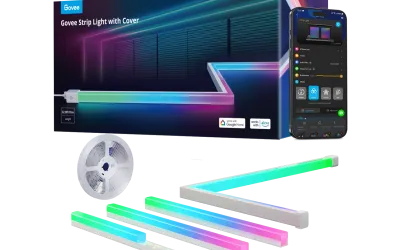
Every smart home journey has a gateway product — the device that hooks you and sends you down a rabbit hole of automations, voice commands, and app-controlled everything. For an enormous number of people, that gateway is a Govee LED strip. At $14.99-19.99 for 16.4 feet of RGBIC color-segmented LEDs with WiFi control, Alexa and Google compatibility, and music sync, these strips offer the most fun-per-dollar of anything in the smart home market.
I\'ve had the Govee RGBIC strips running behind my desk and along my entertainment center for two months. They\'ve survived a move (re-adhesion required), a firmware update, and approximately 400 instances of my kids yelling "Alexa, turn the lights rainbow." Here\'s whether they deserve their spot as the best-selling smart LED strip on the market.
Design & Build
The Govee RGBIC strip is a standard flexible LED strip — a thin, adhesive-backed ribbon of 5050 SMD LEDs at roughly 30 LEDs per meter. The strip itself is about 12mm wide, which is standard for the category. The "RGBIC" branding means each segment of the strip can display a different color simultaneously, controlled by an integrated IC chip. This is a meaningful upgrade over basic RGB strips that can only show one color at a time along their entire length.
The control box is a small rectangular unit that connects between the power adapter and the strip. It houses the WiFi and Bluetooth radios and has a single button for power and basic mode cycling. The power adapter is a standard barrel-plug type. Nothing about the physical components screams premium, but nothing feels fragile either.
The adhesive backing is the design\'s weakest point. The 3M tape holds well initially on clean, smooth surfaces. After a few weeks, especially in warm environments or on textured surfaces, sections begin to peel. This is an industry-wide problem with LED strips, but premium brands like Philips Hue use stronger adhesive and include mounting clips in the box. Govee does sell mounting clips separately, and I\'d recommend buying a pack from the start — you\'ll need them within a month or two.
Features
For something that costs less than a large pizza, the feature list is impressive:
- RGBIC segmented color — Display multiple colors simultaneously along the strip. Rainbow gradients, flowing color waves, and multi-zone effects are all possible. This is the feature that separates Govee from the $8 generic strips on Amazon.
- Music sync — A built-in microphone on the control box syncs light effects to ambient audio. The response time is surprisingly good — the lights genuinely pulse, flash, and shift with the beat.
- 60+ scene modes — Pre-programmed effects like campfire, ocean, forest, aurora, and seasonal themes. Some are cheesy, but many are genuinely atmospheric.
- DIY mode — Create custom static color layouts, choosing different colors for each segment of the strip.
- Voice control — Works with Alexa and Google Assistant for on/off, brightness, and basic color commands. "Alexa, set desk lights to blue" works reliably.
What you don\'t get: Matter support, HomeKit compatibility, or any integration beyond the Govee app, Alexa, and Google. There\'s no IFTTT support and no open API. If you\'re on Apple\'s HomeKit ecosystem, these strips are invisible to it. The Govee app is your primary control surface, and while it\'s actually quite good — better than most budget smart home apps — it is a walled garden.
Performance
Let\'s set expectations: at $15-20, these are not going to match the $80 Philips Hue gradient strip or the $60 LIFX Z strip in output quality. The Govee RGBIC strips are noticeably dimmer than premium alternatives — fine for accent and ambient lighting, but inadequate as task lighting or room illumination. Think "mood lighting" not "reading light."
Color accuracy is "good enough." Reds, blues, and greens are vibrant and punchy. Where the Govee strips falter is in the pastel and warm white range — what should be a warm amber often looks slightly green-tinged, and pastel pinks lean toward purple. Pure white is achievable but slightly cool-toned. For rainbow effects and saturated colors, they look great. For subtle, precisely-tuned ambiance, the limitations show.
The RGBIC segmented control works well, with each independently controlled segment spanning roughly 6-8 inches. The transitions between color zones are smooth enough at normal viewing distances (3+ feet) but show visible stepping up close. Music sync mode is the party trick that justifies the purchase for many people — it\'s responsive and fun, if not perfectly tempo-accurate with every song.
WiFi connectivity is the most common complaint I\'ve encountered. The strips use 2.4GHz WiFi only, and the control box has a relatively weak radio. In my setup, located 20 feet from the router with one wall in between, response time averaged about 1-2 seconds from app command to light change. Bluetooth control (when in range) is near-instant and much more reliable for quick adjustments.
Ease of Use
Setup is genuinely easy. Download the Govee Home app, plug in the strip, and the app discovers it via Bluetooth within seconds. WiFi pairing follows with a simple password entry. Total time from unboxing to illumination: under five minutes. Connecting to Alexa or Google requires enabling the Govee skill/action, which adds another two minutes. This is about as frictionless as smart home setup gets.
The Govee Home app is surprisingly polished for a budget brand. The color picker is intuitive, scene modes are organized into clear categories, and music sync settings let you adjust sensitivity and effect style. Creating custom DIY color layouts is straightforward with a visual segment editor. The app occasionally pushes promotional notifications for other Govee products, which is mildly annoying, but these can be disabled in settings.
Physical installation is straightforward but imperfect. Clean the surface with rubbing alcohol, peel the adhesive backing, and stick. The strip is flexible enough to navigate 90-degree corners with gentle bending (no cutting required). However, it cannot be cut and reconnected — once you cut the strip to length, the remaining section is useless. Philips Hue and LIFX strips offer cut-and-reconnect capability, which is a meaningful advantage for custom installations. Plan your layout carefully before you stick.
Value
This is where the Govee RGBIC strip achieves legendary status. At $14.99-19.99 (frequently on sale for even less), these cost less than a single Philips Hue White smart bulb ($12.99). For that price, you get 16.4 feet of color-segmented, music-syncing, voice-controlled LED lighting. The value proposition isn\'t just good — it\'s borderline absurd.
For context: a Philips Hue gradient LED strip (the closest premium equivalent) costs $169.99 for 6.6 feet and requires a $60 Hue Bridge. A LIFX Z strip runs $59.99 for 3.3 feet. You could buy eight or nine Govee strips for the price of one Hue gradient strip. Are the Hue and LIFX products better? Absolutely — brighter, more color-accurate, with HomeKit support and richer ecosystems. Are they ten times better? Not even close.
The Govee RGBIC strip is the Toyota Corolla of smart lighting: it\'s not exciting, it\'s not prestigious, but it does 80% of what the expensive options do at 15% of the price. For dorm rooms, gaming setups, entertainment centers, and anyone testing whether they actually enjoy colored ambient lighting before committing to premium strips, there is nothing better at this price point. Buy one, experiment, and upgrade later if you want more — you\'ll have spent less than a movie ticket finding out.
Pros
- At $15-20 for 16.4 feet, it costs less than a single premium smart bulb
- RGBIC segmented color control enables rainbow gradients and multi-zone effects that single-color strips cannot match
- Music sync mode is responsive and genuinely fun for parties and gaming sessions
- Govee Home app is polished and intuitive with a wide variety of scene modes and DIY options
- Five-minute setup with Bluetooth discovery — one of the easiest smart home installations available
Cons
- No HomeKit or Matter support — limited to Govee app, Alexa, and Google Assistant only
- Adhesive backing weakens over time, especially in warm environments — plan to buy mounting clips
- Noticeably dimmer than premium LED strips from Philips Hue or LIFX — ambient only, not task lighting
- Cannot be cut and reconnected like Hue strips — once trimmed, the leftover section is wasted
Final Grade
The Govee RGBIC LED Strip Lights are the most accessible entry point into smart home lighting that exists today. For roughly $15, you get segmented color control, music sync, 60+ scene modes, and Alexa/Google voice control in a package that takes five minutes to set up. The RGBIC technology that allows different colors on different segments elevates these far above basic single-color LED strips.
The tradeoffs are proportional to the price: dimmer than premium strips, less color-accurate in pastels and whites, adhesive that will likely need supplemental clips within a couple months, and no HomeKit or Matter support. WiFi reliability can be inconsistent. You can\'t cut and reconnect the strip for custom installations. None of these limitations matter much at this price point — if the Govee strips cost $60, they\'d be mediocre. At $15, they\'re exceptional. Buy them for your TV backlight, your desk setup, or your kid\'s room, and save the Philips Hue budget for your living room where color precision actually matters.