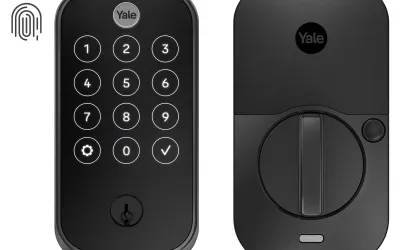
The smart lock market has exploded in recent years, but most products still force you to choose an ecosystem — buy the Apple version, or the Google version, or the Alexa version. Yale's Assure Lock 2 Touch with Matter support changes that equation. For $279.99, you get a fingerprint-reading smart lock that works natively with Apple Home, Google Home, Amazon Alexa, and SmartThings through the Matter standard. No proprietary hubs, no ecosystem lock-in.
After installing the Assure Lock 2 Touch on my front door and using it as my daily driver for several weeks, I'm impressed by how well it executes on its promise. The fingerprint reader is fast and reliable, Matter integration works across platforms, and the lock itself feels substantial and well-built. But at $280 (plus $40 for the Matter module if yours didn't include it), it faces stiff competition from Schlage's offerings — especially on the security certification front.
Design & Build
Yale has delivered one of the best-looking smart locks on the market. The Assure Lock 2 Touch features a slim, modern profile that doesn't scream "smart lock" from the curb. Available in Black Suede, Satin Nickel, and Oil Rubbed Bronze finishes, it blends seamlessly with most door hardware. The exterior escutcheon is clean and minimal, with the fingerprint sensor positioned naturally where your thumb rests when gripping the handle.
The backlit touchscreen keypad is invisible when not in use — it only illuminates when you touch the surface, which looks sleek and prevents the "I have a smart lock" advertisement that some competitors broadcast. Numbers are large and easy to read at night.
Build quality is excellent. The lock body is solid metal with a reassuring weight to it. The interior mechanism is clean and well-organized, with the battery compartment (4 AA batteries) easily accessible. Yale includes a 9V battery terminal on the exterior for emergency power if the batteries die — you hold a 9V battery to the contacts and the lock powers up enough to unlock. It's a thoughtful touch that prevents lockouts.
The physical key backup is included and fits into a discreet keyhole below the touchscreen. I'd recommend keeping a key in a lockbox or with a trusted neighbor as a failsafe, though I've never needed it in my testing.
Features
The feature set is well-rounded for a modern smart lock. The fingerprint reader stores up to 25 fingerprints — plenty for a family plus a few trusted visitors. Registration is quick: each finger requires about 10-12 touch samples during enrollment, and the sensor learns your print patterns over time, improving recognition with regular use.
- Matter over Thread — the Yale Access Module (WiFi or Thread) enables Matter support. Thread is preferred for lower latency and better battery life. Once connected, the lock appears natively in Apple Home, Google Home, Samsung SmartThings, and Amazon Alexa without any bridges or hubs.
- DoorSense — a magnetic sensor on the door frame detects whether the door is closed or ajar, enabling true auto-lock functionality. The lock won't engage the deadbolt if the door is open, preventing accidental lockouts.
- Tamper alarm — the lock sounds an alarm if it detects forced entry attempts. It's loud enough to be a deterrent, though it's not going to replace a dedicated security system.
- Access codes — supports multiple PIN codes with scheduling, so you can give a dog walker a code that only works on weekday afternoons, for example.
One important caveat: the Matter/Thread module is sold separately for $39.99 if your lock didn't come bundled with it. Some retail configurations include it, others don't — check carefully before purchasing. Without it, you're limited to Yale's own app and Bluetooth range.
Performance
The fingerprint reader is the star of the show, and it delivers. Unlocking time from touch to deadbolt retraction is consistently under one second — often closer to half a second. In my testing across different conditions (dry hands, slightly damp hands, cold weather), the sensor recognized registered prints reliably about 95% of the time on first try. The occasional miss requires just a second touch.
The motorized deadbolt is quiet by smart lock standards — a low mechanical hum rather than the grinding noise some competitors produce. It's not silent, but it won't wake anyone up if you're coming home late. Lock and unlock operations complete in about 1.5 seconds.
Matter connectivity has been stable in my testing. Commands from Apple Home, Google Home, and Alexa all work reliably with response times of 1-3 seconds depending on the platform. Thread connectivity provides faster local response than WiFi, and the lock maintains its connection to the Thread mesh without the dropout issues I've experienced with some WiFi-only smart locks.
Battery life is projected at approximately one year with the Thread module, which aligns with my usage pattern so far (about 8-10 daily lock/unlock cycles). Yale uses four standard AA batteries, which is a nice departure from proprietary battery packs — when they die, any gas station can get you back in business.
One area where Yale falls behind Schlage: the Assure Lock 2 carries an ANSI/BHMA Grade 2 (residential) security rating, while the Schlage Encode Plus boasts Grade 1 (commercial). For most homeowners, Grade 2 is perfectly adequate, but security-conscious buyers should note the difference.
Ease of Use
Installation is manageable for anyone comfortable with basic door hardware. Yale's instructions are clear with detailed illustrations, and the process took me about 25 minutes. The lock fits standard door preps, though you may need to adjust the backset — Yale includes both 2-3/8" and 2-3/4" backset options. No drilling required if your door has an existing deadbolt prep.
The Yale Access app walks you through setup, fingerprint enrollment, and Matter pairing step by step. Fingerprint registration is satisfying — you touch the sensor repeatedly from different angles, and a progress circle fills up as the lock builds a complete image of your fingerprint. The process takes about 30 seconds per finger.
Matter pairing was smooth with Apple Home (scan the Matter QR code, done) and slightly more involved with Google Home (required a firmware update first). Once paired, the lock behaves like any native device in your platform of choice — no separate app required for daily use.
DoorSense calibration is automatic once the magnetic sensor is mounted. Auto-lock can be configured to engage after a customizable delay (30 seconds to 10 minutes), and I'd recommend a longer delay — the default 30 seconds can be aggressive if you're carrying groceries in multiple trips. One-touch locking from the interior keypad is convenient for quick lock-ups when leaving.
Value
At $279.99 (or $319.98 with the Matter module purchased separately), the Yale Assure Lock 2 Touch sits at the premium end of the smart lock market. The Schlage Encode Plus ($299.99) is its most direct competitor, offering HomeKey support and Grade 1 security but lacking a fingerprint reader. The August Wi-Fi Smart Lock ($229.99) is more affordable but requires your existing deadbolt and doesn't include a keypad or fingerprint sensor.
The Matter support is the Assure Lock 2's strongest value proposition. By working natively across all major platforms, you're future-proofing your purchase against ecosystem changes. If you switch from Apple to Google or vice versa, the lock comes with you. That's a meaningful advantage over platform-specific locks that become less useful if you change your smart home ecosystem.
The fingerprint reader also adds tangible daily value. No fumbling for your phone, no remembering codes — just touch and enter. After a few weeks, it becomes so natural that using a traditional key feels primitive. The convenience factor is real and worth paying for.
For most homeowners, the Yale Assure Lock 2 Touch with Matter represents the best overall combination of convenience, compatibility, and security available today. The Grade 2 security rating is the main caveat — if maximum physical security is your priority, the Schlage Encode Plus is worth the trade-off of losing the fingerprint reader.
Pros
- Fingerprint reader unlocks in under one second with ~95% first-touch accuracy
- Matter over Thread works natively with Apple Home, Google Home, Alexa, and SmartThings
- Sleek, modern design with invisible backlit keypad that doesn't scream "smart lock"
- DoorSense prevents auto-lock from engaging when the door is ajar
- Standard AA batteries last approximately one year and are easily replaceable
Cons
- ANSI/BHMA Grade 2 residential security rating versus Schlage's Grade 1 commercial rating
- Matter/Thread module costs an extra $39.99 if not bundled with your lock
- Default 30-second auto-lock is aggressive and should be extended during initial setup
Final Grade
The Yale Assure Lock 2 Touch with Matter is the smart lock I'd recommend to most people in 2024. The fingerprint reader is fast and reliable, Matter support means true cross-platform compatibility without hubs or bridges, and the lock itself is well-designed and solidly built. Daily use is seamless — touch the sensor, hear the click, walk in. It's the kind of smart home product that makes you wonder why you didn't switch sooner.
The caveats are worth noting: Grade 2 security versus Schlage's Grade 1, the potentially separate Matter module purchase, and a $280+ total investment. But for the combination of biometric convenience, universal smart home compatibility, and clean industrial design, the Yale Assure Lock 2 Touch is the smart lock to beat right now.