Amazon's Echo Studio has always occupied a unique space in the smart speaker market — it is the only Alexa speaker that seriously attempts to compete with dedicated hi-fi equipment rather than just serving as a voice assistant that happens to play music. The second generation, released with updated spatial audio processing and improved room adaptation, doubles down on that ambition. With five dedicated speakers, Dolby Atmos support, and Amazon's latest Alexa+ AI integration, it promises an audiophile-adjacent experience wrapped in a smart home hub.
We spent four weeks with the Echo Studio (2nd Gen) in a living room environment, testing it with lossless music from Amazon Music Unlimited, Dolby Atmos tracks, stereo-paired configurations, and as a daily Alexa assistant. We also evaluated its smart home hub capabilities, including the built-in Zigbee, Matter, and Thread radios. The question is not whether it sounds good — it does — but whether it sounds good enough to justify its price against dedicated competitors like the Sonos Era 100 and Era 300.
Design & Build
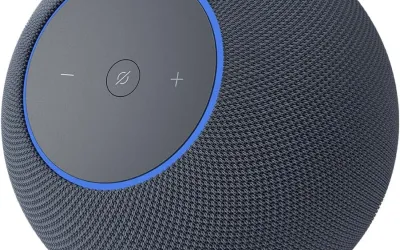
The Echo Studio (2nd Gen) is not a speaker you buy for its looks. It is a large cylinder — 8.1 inches tall and 6.9 inches in diameter — finished in charcoal fabric with a flat top panel that houses the physical volume and microphone mute buttons. The light ring at the base glows in the familiar Alexa blue when listening and provides visual feedback for volume changes and notifications. It is functional and inoffensive, but it lacks the sculptural elegance of a Sonos Era 300 or the minimalist charm of an Apple HomePod.
Build quality is solid without being remarkable. The fabric mesh is tightly woven and has resisted dust accumulation well during our testing period. The base has a rubberized ring that prevents the speaker from vibrating across surfaces even at high volumes — a practical touch that matters more than it sounds, since this speaker produces serious bass output. The power cable is proprietary and permanently attached to the included power adapter, which is slightly annoying if you need a longer run.
The top panel buttons are tactile and responsive, with raised dots on the volume buttons for easy identification by touch. Amazon added a dedicated button for Alexa+ interactions on the 2nd Gen, which provides quick access to the enhanced AI assistant without a voice command. The four-microphone array is embedded around the top edge and picks up voice commands reliably from across a large room, even while music is playing at moderate volumes.
For a speaker that prioritizes audio performance, the size is justified — you need physical volume for the driver array inside. But if your living space demands a discrete speaker, the Echo Studio will always be a visible presence. It comes in charcoal and glacier white color options, and the white version blends slightly better into bright interiors.
Features
Beyond audio, the Echo Studio (2nd Gen) functions as a full-featured Alexa smart speaker and smart home hub. The built-in Zigbee radio connects directly to Zigbee devices like Philips Hue bulbs, Aqara sensors, and IKEA Tradfri products without requiring their dedicated bridges. Matter and Thread support extend compatibility to the latest generation of smart home devices, and the Echo Studio acts as a Thread border router, strengthening the mesh network for any Thread devices in your home.
Alexa+ integration is the major software addition for the 2nd Gen model. The enhanced AI assistant provides more conversational interactions, better context retention across follow-up questions, and improved smart home routine suggestions based on your usage patterns. In practice, Alexa+ feels like a meaningful upgrade for complex queries and multi-step commands, though basic "turn off the lights" and "set a timer" commands work identically to the standard Alexa experience.
Music streaming support is broad but uneven. Amazon Music Unlimited delivers the best experience, including lossless HD audio and Dolby Atmos spatial tracks. Spotify Connect works well for standard streaming, and Apple Music is available via AirPlay-like functionality, but neither supports lossless or Atmos playback through the Echo Studio. This is a significant limitation if you are not an Amazon Music subscriber, because the spatial audio capability — arguably the speaker's headline feature — is effectively locked to one service. Audible, Pandora, iHeartRadio, TuneIn, and Deezer are also supported.
Stereo pairing with a second Echo Studio creates an impressively wide soundstage. The paired configuration assigns left and right channels properly and uses the upward-firing tweeters for Atmos height information. For music listening and movie audio (when paired with a Fire TV), stereo Echo Studios deliver a convincing home theater experience without a soundbar. Multi-room audio across Echo devices works seamlessly, though audio synchronization can occasionally drift by a fraction of a second between rooms.
Performance
Audio performance is where the Echo Studio (2nd Gen) makes its case, and it makes a strong one. The five-speaker configuration includes three 2-inch midrange drivers aimed at different angles, a 1-inch tweeter directed upward for height channels, and a 5.25-inch downward-firing woofer. This arrangement creates a sound field that extends well beyond the physical footprint of the speaker, and when Dolby Atmos content is playing, the spatial effect is genuinely impressive for a single enclosure.
Bass response is the first thing you notice. The 5.25-inch woofer delivers deep, controlled low end that fills a medium-sized room without strain. Kick drums have genuine punch, bass guitar lines are articulate rather than boomy, and electronic music sub-bass is felt as much as heard. At maximum volume, there is minimal distortion — the speaker maintains composure in a way that lesser smart speakers simply cannot. We measured comfortable listening levels at about 40% volume in a 250-square-foot room, which gives you a sense of the headroom available.
The midrange is clear and well-defined, handling vocals with warmth and detail. Acoustic guitar and piano have natural resonance, and spoken-word content like podcasts and audiobooks is rendered with excellent clarity. The tweeter handles high frequencies without harshness, though it does not have the sparkle and air that dedicated hi-fi tweeters provide. Cymbals and hi-hats are present and accurate but lack the shimmering decay you would hear on a proper bookshelf speaker.
Room adaptation is a genuine differentiator. The speaker plays test tones and uses its microphones to analyze the room acoustics, then adjusts its equalization profile accordingly. In our testing, the calibrated sound was noticeably better than the out-of-box default — tighter bass in a room with hard floors, and boosted highs in a carpeted space with heavy curtains. The calibration process takes about a minute and can be re-run whenever you move the speaker. Dolby Atmos tracks on Amazon Music Unlimited are the showcase — spatial audio adds height and width to the soundstage that makes music feel three-dimensional. However, the effect varies significantly by track, and poorly mixed Atmos content can sound worse than a good stereo master.
Ease of Use
Initial setup is handled entirely through the Alexa app and takes about five minutes. You plug in the speaker, open the app, and it is detected automatically. Wi-Fi configuration, room assignment, and Amazon account linking are guided with clear prompts. Room adaptation calibration runs automatically after setup and adds another minute. The entire process is among the simplest in the smart speaker category — significantly easier than configuring a Sonos system for the first time.
Daily interaction is mostly seamless. Voice commands for music playback, smart home control, timers, weather, and news work as expected from any Alexa device. The microphone array picks up commands reliably even during music playback, though you may need to raise your voice slightly at higher volumes. The physical mute button provides a hardware guarantee that the microphones are off, which is a privacy consideration that some users value.
The Alexa app is functional but cluttered. Finding specific settings for the Echo Studio — like adjusting the equalizer, re-running room calibration, or managing stereo pairs — requires navigating through several menu layers. Amazon has improved the app significantly over the years, but it still feels like it is trying to do too many things in one interface. Equalizer adjustments (bass, midrange, treble sliders) are available both in the app and via voice commands, which is convenient for quick tuning.
Firmware updates are applied automatically and occasionally introduce new features or audio improvements. We received one update during our testing period that reportedly improved Atmos processing, though the difference was subtle. The speaker reliably reconnects to Wi-Fi after power outages and maintains its settings and routines without intervention. One minor annoyance: the speaker occasionally plays a brief chime when it reconnects after a network interruption, which can be startling at night.
Value
At $199.99, the Echo Studio (2nd Gen) sits in an interesting price bracket. It is significantly cheaper than the Sonos Era 300 ($449) and Apple HomePod 2nd Gen ($299), both of which offer spatial audio capabilities. It is more expensive than the Sonos Era 100 ($249), which delivers excellent stereo sound but lacks Atmos support and does not function as a smart home hub.
The value proposition depends heavily on your existing ecosystem. If you are an Amazon Music Unlimited subscriber ($10.99/month or included with Prime at a reduced rate), the Echo Studio delivers Dolby Atmos spatial audio and lossless playback that would cost significantly more from any competitor. The built-in Zigbee/Matter/Thread hub adds genuine utility that replaces standalone devices costing $30-50 each. And if you are already using Alexa for smart home control, the Echo Studio slots in as a natural upgrade from a standard Echo.
The calculus shifts if you are a Spotify or Apple Music subscriber. Without Atmos support from those services, you are buying a very good stereo smart speaker for $200 — still competitive, but no longer the clear standout. The Sonos Era 100 at $249 offers better stereo imaging, wider streaming service support at full quality, and a more refined physical design. The Era 300 at $449 supports Atmos from multiple streaming services, which makes its higher price easier to justify for multi-platform households.
For pure audio-per-dollar within the Amazon ecosystem, the Echo Studio (2nd Gen) is hard to beat. A stereo pair at $400 total produces a sound experience that rivals speaker setups costing twice as much, with the added bonus of a built-in smart home hub and voice assistant. It is not an audiophile reference system, but it is the closest thing to one that also answers your questions and turns off your lights.
Pros
- Spatial audio with Dolby Atmos creates a genuinely immersive listening experience
- Five-speaker array delivers powerful bass and clear mids without distortion at high volumes
- Room adaptation calibrates audio automatically — noticeable improvement in treated vs untreated rooms
- Built-in Zigbee, Matter, and Thread hub eliminates the need for separate smart home bridges
- Stereo pairing produces a wide, convincing soundstage for the price
Cons
- Dolby Atmos content requires Amazon Music Unlimited — not available on Spotify or Apple Music via this speaker
- Design is bulky and utilitarian compared to the more refined Sonos aesthetic
- Room adaptation calibration can take several attempts to produce optimal results
Final Grade
The Amazon Echo Studio (2nd Gen) is the best-sounding Alexa speaker by a wide margin, and it holds its own against dedicated speakers that cost significantly more. The five-speaker array produces full, detailed audio across genres, and Dolby Atmos spatial audio adds a dimension of immersion that no other smart speaker in this price range can match. The built-in smart home hub with Zigbee, Matter, and Thread support makes it a practical centerpiece for any smart home setup.
The main caveat is ecosystem lock-in. If you want the full Dolby Atmos experience, you need Amazon Music Unlimited. Spotify and Apple Music work fine for standard stereo playback, but you are leaving the headline feature on the table. The design is also polarizing — it is a large, dark cylinder that prioritizes function over form. If sound quality and Alexa integration are your top priorities and you are willing to subscribe to Amazon Music, the Echo Studio (2nd Gen) delivers remarkable value. If platform flexibility matters more, the Sonos Era 300 remains the more versatile choice despite its higher price.