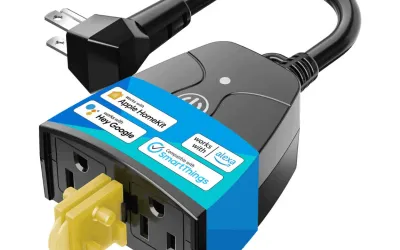
Every year around late November, the same question comes up: what's the easiest way to automate holiday lights? I've tried timer plugs, manual switches, and even a Z-Wave relay wired into a junction box. But for sheer simplicity, a WiFi smart outdoor plug is hard to beat. The Meross Smart Outdoor Plug has handled my holiday lights and year-round patio string lights for about five months now, and it's done the job reliably without any drama.
It's not a glamorous product. It's a weatherproof box with two outlets and a WiFi radio. But for the straightforward task of scheduling outdoor lights to turn on at sunset and off at a reasonable hour, it delivers exactly what you'd expect at a fair price -- especially if you're in the Apple ecosystem and want native HomeKit support without jumping through hoops.
Design & Build
The Meross outdoor plug is a rectangular black box measuring roughly 7.5 x 3 x 2 inches, with two three-prong outlets on the front and a short power cord (about 1 foot) with a grounded plug on the back. The outlets have individual spring-loaded weatherproof covers that snap shut when not in use, protecting the receptacles from rain and debris. When a plug is inserted, the cover flaps around the cord reasonably well, though a thick outdoor extension cord can prevent full closure -- something to keep in mind for long-term outdoor exposure.
The IP44 weather resistance rating means it's protected against splashing water from any direction, but it's not submersion-proof and shouldn't sit in standing water. I mounted mine on an exterior wall under a shallow eave, and it's handled rain, fog, and temperatures down to the low 30s without issue. If your outdoor outlet is fully exposed to direct rain, you might want to add a simple cover box, but for most covered or partially sheltered installations, the IP44 rating is sufficient.
Build quality is decent for the price bracket. The housing feels solid rather than flimsy, the outlet covers snap with authority, and the power cord uses a thick, weather-resistant jacket. The device is somewhat bulky compared to an indoor smart plug -- it doesn't exactly disappear behind your outdoor outlet cover plate. But for something that sits outside and needs to withstand the elements, I'd rather have a robust housing than a svelte one. There are no physical buttons on the unit itself, which is a design choice I'll address in the ease of use section. Two small LED indicators on the front show the power status of each outlet.
Features
The headline feature is two independently controllable outlets, each capable of handling up to 15 amps (combined). This means you can put your patio string lights on one outlet and your holiday decorations on another, with completely separate schedules and controls. I use outlet one for year-round patio lights (on at sunset, off at 11 PM) and outlet two for seasonal decorations (on at sunset, off at 10 PM during holiday season, off entirely during other months). The independent scheduling alone makes this more useful than single-outlet alternatives.
Platform support is where Meross distinguishes itself from many competitors. The plug works with Apple HomeKit, Amazon Alexa, Google Home, and Samsung SmartThings -- all natively, without requiring cloud workarounds or third-party bridges. The HomeKit support is particularly notable because many outdoor smart plugs skip Apple's ecosystem entirely. HomeKit integration means the plug can participate in HomeKit scenes and automations, respond to Siri commands, and -- importantly -- operate via local control when your internet connection drops, since HomeKit processes automations on your Apple TV or HomePod hub locally.
The Meross app adds energy monitoring for each outlet, showing real-time wattage and historical consumption data. It's not the most detailed energy tracking I've seen, but it's useful for verifying that your outdoor lights are actually drawing the expected power and for spotting issues like a strand of lights that's partially failed and drawing more current than usual. The app also supports countdown timers, though I find scheduling more practical for outdoor lighting.
What's missing: there's no physical on/off button or switch on the device. All control is through the app, voice commands, or scheduled automations. This means if your WiFi goes down and you haven't set up HomeKit local automations, you can't manually toggle the outlets. It's a minor annoyance during initial setup when you might want to test the outlets before configuring the app, and it could be genuinely frustrating during a network outage if you want your outdoor lights on for a party.
Performance
Reliability has been the Meross plug's strongest attribute. Over five months of continuous outdoor deployment, I haven't experienced a single missed schedule or unresponsive command. Lights turn on at sunset and off at their scheduled time every single night. Voice commands through Siri and Alexa execute within about one second, which is fast enough that it feels responsive. The Meross app controls are similarly quick -- tap the toggle, and the relay clicks within a second.
WiFi connectivity has held steady, though my situation is favorable: the outdoor outlet is roughly 25 feet from my mesh router's nearest access point, through one exterior wall. The plug connects on 2.4GHz only (no 5GHz support), which actually works in its favor for range and wall penetration. I've checked the connection status periodically in my router's admin panel, and the signal strength hovers around -55 dBm -- solid. If your outdoor outlet is farther from your router or separated by multiple walls, your experience could differ significantly. I'd recommend checking your WiFi signal strength at the outlet location before purchasing any WiFi-based outdoor device.
Weather resilience has been tested by several rainstorms, including one pretty aggressive winter storm with sustained wind-driven rain. The plug continued operating without interruption, and I didn't notice any moisture intrusion when I inspected it afterward. Temperatures in my area range from the low 30s to the high 80s, and the plug has been fine across that range. I can't speak to extreme cold (sub-zero) or extreme heat (100+), but for moderate climates, the IP44 rating holds up.
One behavior worth noting: after a power outage, the outlets return to their last known state. If they were on before the power went out, they come back on when power returns. This is actually the behavior I want for outdoor lights -- if power flickers during the evening, the lights come right back on without intervention. Some users might prefer the opposite default, but there's no setting to change this behavior in the Meross app.
Ease of Use
Setup through the Meross app is straightforward and took me about eight minutes. Download the app, create a Meross account (email and password, no phone number required), tap the plus icon to add a device, scan the QR code on the plug, and follow the WiFi pairing prompts. The plug creates a temporary WiFi hotspot during setup, your phone connects to it, you provide your home WiFi credentials, and the plug joins your network. Standard IoT onboarding, nothing unusual or problematic.
HomeKit pairing can happen simultaneously during Meross app setup or separately afterward. The plug has a HomeKit setup code printed on a sticker (save this -- you'll need it if you ever re-pair). Scanning the code in the Apple Home app worked on my first attempt, and both outlets appeared as separate accessories in HomeKit within about 30 seconds. From there, I assigned them to rooms, named them ("Patio Lights" and "Holiday Lights"), and created sunset/time-based automations in the Home app. The whole HomeKit configuration took another five minutes.
Creating schedules is intuitive in both the Meross app and in HomeKit. In the Meross app, you tap a schedule icon, pick days of the week, set on and off times, and choose which outlet to control. In HomeKit, you can use more sophisticated triggers like sunset/sunrise (which adjust automatically as days lengthen and shorten -- much better than hardcoding a time). I recommend using HomeKit automations rather than Meross app schedules if you have a HomeKit hub, since HomeKit automations execute locally even without internet.
The lack of a physical button is the one ease-of-use annoyance. During initial installation, when I was mounting the plug and wanted to verify the outlets were working before configuring the app, I had to go inside, open the app, and toggle each outlet. A simple manual override button on the housing would have been a welcome addition. Similarly, if a guest wants to turn on the patio lights and doesn't have the Meross app or access to your HomeKit setup, they're out of luck without asking you to do it from your phone.
Value
At $25-30 for a dual-outlet outdoor smart plug with HomeKit support and energy monitoring, the Meross offers strong value for its category. The closest comparable product is the Meross Smart Plug Mini for indoor use, which is cheaper but obviously not weather-rated. For outdoor-specific alternatives, the ConnectSense Smart Outlet 2 offers HomeKit support at roughly double the price. The Kasa outdoor plug is similarly priced but lacks HomeKit. If HomeKit compatibility matters to you -- and for Apple households, it should -- the Meross is one of the most affordable options available.
There are no subscription fees or premium tiers to worry about. All features, including energy monitoring, scheduling, and multi-platform voice control, work out of the box and remain free. This is how smart home devices should work, and Meross deserves credit for not following the subscription trend that's infected much of the industry.
For seasonal use cases like holiday lights, the value proposition is simple: buy it once, plug in your lights each year, and the schedules handle everything automatically. The time saved compared to manually turning lights on and off daily, multiplied across a multi-week holiday season, adds up surprisingly fast. For year-round patio lighting, the value compounds further -- automated sunset/off scheduling means your outdoor lights just work, every night, without you thinking about it.
For more permanent outdoor automation needs -- landscape lighting, pool pumps, or anything requiring higher amperage or more robust weather protection -- you might want to consider hardwired smart switches or relays instead. The Meross plug is excellent for its intended use case of plug-in outdoor loads, but it's not a substitute for proper hardwired outdoor automation. For holiday lights and patio decorations, though, it hits the sweet spot of price, features, and reliability.
Pros
- Two independently controlled outlets
- HomeKit, Alexa, Google support
- IP44 weatherproof rating
- Energy monitoring included
- Reasonable price
- Scheduling works reliably
Cons
- No physical control switch
- WiFi range limitations
- Not waterproof (IP44 only)
- Meross app is mediocre
- Somewhat bulky design
Final Grade
The Meross Smart Outdoor Plug is the kind of product that does its job so reliably that you forget it exists -- which is exactly what you want from an outdoor smart plug. Over five months of continuous use, it has turned my patio lights on at sunset and off at 11 PM every single night without a single failure. The dual independently-controlled outlets, native HomeKit support, and $25-30 price point make it one of the best values in the outdoor smart plug category. It's not exciting, it won't revolutionize your smart home, and nobody will be impressed when you show it to them. But it works, it's affordable, and it does exactly what it promises. For scheduling holiday lights, patio decorations, or any plug-in outdoor load, this is an easy recommendation -- just verify your WiFi signal reaches your outdoor outlet before purchasing.