Thread Network Explained: The Future of Smart Home Connectivity
The Problem Thread Actually Solves
Let me tell you about the moment I understood why Thread matters. I had a Zigbee door sensor on my back door. It worked fine for about eight months. Then one day, the sensor went offline. I rebooted the hub. Nothing. I removed the sensor, re-paired it, and it came back -- for about three days. Then it went offline again. After troubleshooting for a week, I realized the Zigbee mesh in that corner of the house was just too thin. The signal had to hop through a single smart plug to reach the hub, and when that plug got unplugged for vacuuming, the sensor lost its route and sometimes couldn't recover.
I replaced it with a Thread-based Eve Door & Window sensor. That was fourteen months ago. It has not gone offline once. Not once. The Thread mesh in my house has about eight routing devices, and if any one of them goes down, the network just... figures it out. No rebooting, no re-pairing, no troubleshooting. It just works.
That's Thread. And while I could bombard you with technical specs about IEEE 802.15.4 radio and 6LoWPAN networking stacks, the practical story is much simpler: it's the wireless protocol that finally makes smart home devices as reliable as dumb ones.
Thread Explained Like You're Talking to a Friend
Think of the wireless protocols in your home like different road systems. WiFi is a highway -- it's fast, it can carry a lot of data, and it goes straight from each device to your router. Great for cameras and streaming devices that need bandwidth. But highways get congested, and every new WiFi device you add is another car competing for the same lanes. Most routers start struggling around 30-40 connected devices, and if you've got smart plugs, bulbs, sensors, cameras, speakers, your laptop, your phone, the kids' tablets, and a smart TV in every room... you're getting close.
Bluetooth is like walking across the street. Short distance, low effort, but you can only go so far. That's why Bluetooth smart devices need you to be in the same room to control them (unless you set up a hub for remote access).
Zigbee and Z-Wave are like side roads -- mesh networks where devices relay messages to each other. They work well, but they need a dedicated hub that acts as a translator between their language and your home network's language. They've been the backbone of serious smart home setups for years, and they're still solid. But they have quirks: re-pairing issues, proprietary hubs, and the occasional mysterious device that just falls off the network for no apparent reason.
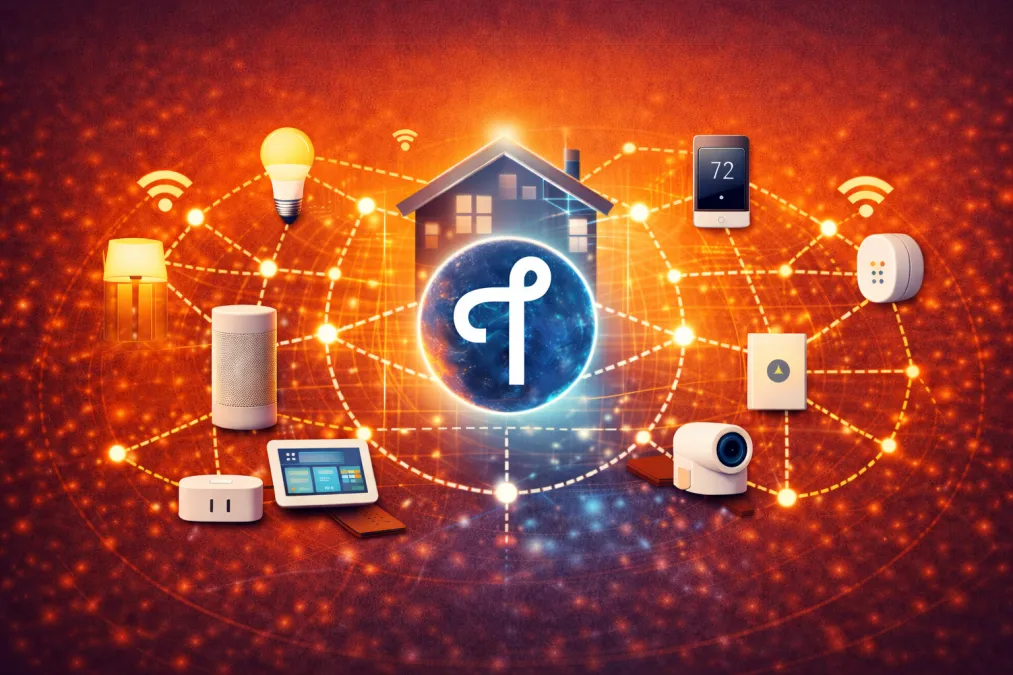
Thread is like a modern city grid. It's a mesh network (like Zigbee), so devices relay messages for each other. But it speaks native IP -- the same language your home network uses -- so there's no translation layer needed. Each Thread device has a real network address. It's low-power (like Zigbee), so battery devices last for years. And it's self-healing in a way that actually works in practice, not just on paper.
What Makes Thread Different In Practice
You Probably Already Have the Infrastructure
Here's what surprised me when I started paying attention to Thread: I already had three Thread border routers in my house without realizing it. A border router is the device that connects the Thread mesh to your regular home network. It turns out my HomePod Mini, my Apple TV 4K, and my Echo (4th gen) are all Thread border routers. They were quietly building a Thread network in the background without me doing anything.
If you have any of these devices, you already have a Thread border router:
- Apple HomePod Mini or HomePod (2nd gen)
- Apple TV 4K (2021 or later)
- Google Nest Hub (2nd gen) or Nest Hub Max
- Amazon Echo (4th gen) or newer
- Nanoleaf light panels (Elements or Shapes)
- Eero 6 or Pro 6 routers and newer
No separate hub purchase. No new hardware. It's just... there.
Battery Life That's Actually Impressive
WiFi sensors eat batteries. I had a WiFi-based temperature sensor that needed new batteries every six weeks. Six weeks. The sensor was constantly maintaining a WiFi connection, which is power-hungry even when idle. I replaced it with a Thread sensor, and after a year, the battery indicator still shows around 70%. Thread devices spend most of their time in a deep sleep state, waking only to transmit data or relay messages when needed. For sensors, door contacts, and other devices you want to install and forget, this is transformative.
It Doesn't Clog Your WiFi
This one is underappreciated. Every WiFi smart device is competing for airtime on your router. Thread operates on its own radio frequency (the same 802.15.4 band that Zigbee uses). Your Thread sensors, switches, and locks are chatting away on their own network without adding a single byte of traffic to your WiFi. When you've got 20, 30, 50+ smart devices in your house, this matters.
The Mesh Gets Better as You Add Devices
This is my favorite thing about Thread. Every powered Thread device (plugs, switches, always-on sensors) automatically becomes a router in the mesh. So that smart light switch in your hallway isn't just a switch -- it's also extending the Thread network for the battery-powered sensor in the next room. The more powered Thread devices you add, the more robust and reliable the entire network becomes. With WiFi, every new device makes the network slightly worse. With Thread, every new device makes it slightly better.
Thread and Matter: The Two Halves
You'll see Thread and Matter mentioned together constantly, and it's worth understanding the distinction because they solve different problems.
Thread is the road. It handles how data moves between devices -- the networking layer. It's the physical connection, the radio signals, the mesh routing.
Matter is the language. It defines what devices say to each other -- the application layer. It's the standardized commands, the setup process, the cross-platform compatibility.
Matter can actually run over WiFi too, and some Matter devices do. But Thread is the preferred transport for anything battery-powered or anything that doesn't need the bandwidth of WiFi. Most new Matter devices hitting the market today -- sensors, switches, locks, outlets -- are Thread devices. Cameras and displays, which need to stream video, still use WiFi. That division makes sense: use the high-bandwidth highway for the things that need it, and the efficient mesh for everything else.
Real-World Thread Devices Worth Buying
The Thread device ecosystem has grown substantially in the past year. Here's what I've personally tested and recommend:
- Sensors: The Eve Door & Window sensor is rock-solid. Eve Motion is great for automations. Aqara has been expanding their Thread lineup aggressively with affordable options.
- Switches and outlets: The Eve Light Switch and Eve Energy outlet are excellent, and every one doubles as a Thread router.
- Locks: The Yale Assure Lock 2 with a Thread module is my pick. Great battery life and incredibly responsive compared to the WiFi version.
- Lights: Nanoleaf Essentials bulbs and light strips are Thread-native and act as routers when powered on.
The Transition Doesn't Have to Be Sudden
You don't need to rip out your existing Zigbee or Z-Wave setup. Thread devices coexist happily with whatever you already have. If you're using Home Assistant, you can run Thread, Zigbee, Z-Wave, and WiFi devices all from the same dashboard. The practical approach is simple: when a device dies or when you buy something new, make it Thread. Over time, your mesh grows stronger and your setup gets more reliable.
I started with a single Eve door sensor. A year later, about half my devices are Thread, and the difference in day-to-day reliability compared to my older Zigbee devices is noticeable. Not dramatic -- Zigbee is still fine -- but the Thread devices are just a little faster to respond, a little more consistent, and a lot less likely to randomly drop off the network at 2 AM.
What Thread Can't Do (Yet)
Thread isn't the right protocol for everything. It's low-bandwidth by design, which means cameras, video doorbells, and smart displays will stay on WiFi. That's by design, not a flaw. You wouldn't stream 4K video over a protocol optimized for transmitting "door opened" messages. The smart home of the near future runs on both: Thread for the dozens of small devices that need to be reliable and power-efficient, WiFi for the handful that need to move a lot of data.
Explore Thread-compatible devices in our product guides to start building a more reliable smart home mesh.